Bai Yannan, Lian Yuan'e, Wu Jiayi, Chen Shi, Lai Jianlin, Zheng Yu, Tian Yifeng, Yan Maolin, Wang Yaodong
Hepatobiliary Surgery Department, Shengli Clinical Medical College of Fujian Medical University, Fujian Provincial Hospital, Fuzhou, 350001, China.
Pathology Department, Fujian Medical University Union Hospital, Fuzhou, 350001, People's Republic of China.
Cancer Manag Res. 2021 Mar 2;13:2131-2142. doi: 10.2147/CMAR.S289826. eCollection 2021.
Postoperative prognosis prediction models for patients with stage Ⅰ and Ⅱ hepatocellular carcinoma (HCC) according to the 8th edition of the Tumor-Node-Metastasis staging system after surgery are rare. This study aimed to build a prognostic score to predict survival outcomes and stratify these patients into different prognostic strata.
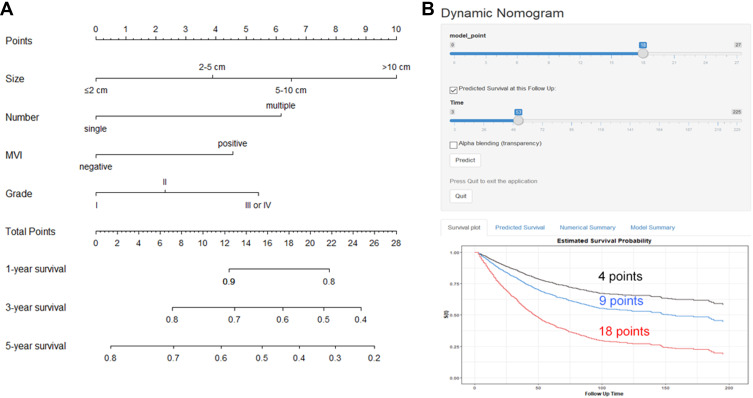
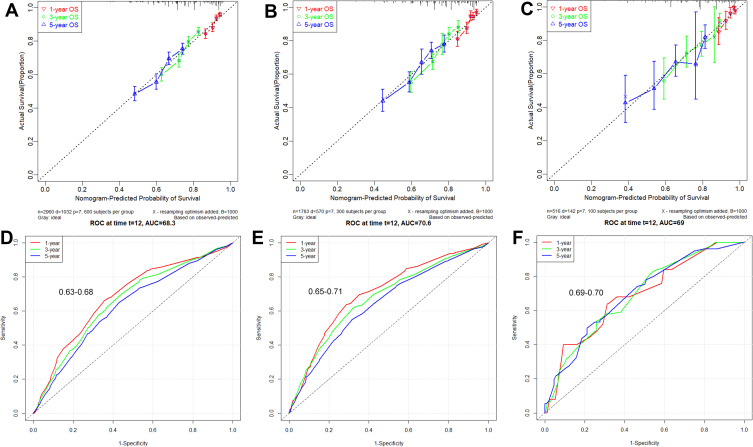
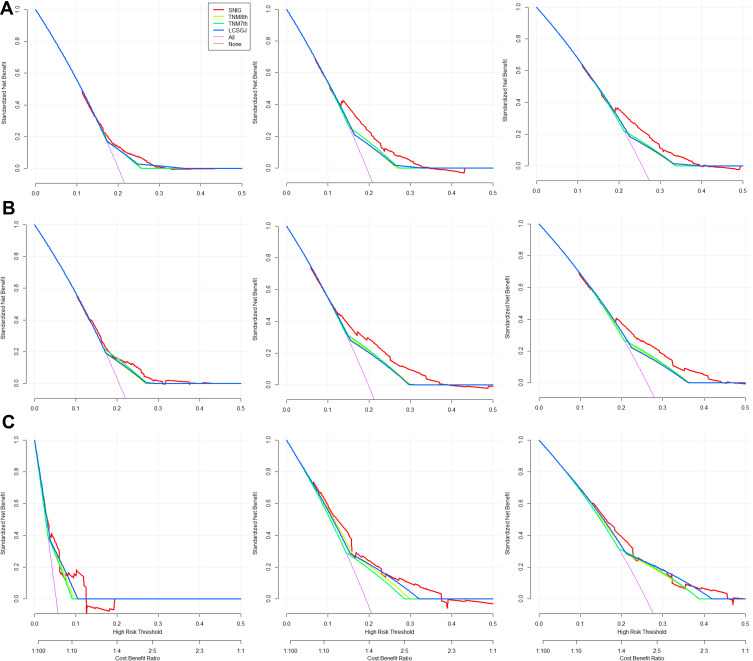
We developed a web-based nomogram that incorporated four selected risk factors based on the multivariate Cox regression, using a training set (n=3567) from the Surveillance, Epidemiology, and End Results (SEER) database. It was validated with an independent internal set from the SEER database (n=1783) and an external validation set of 516 Chinese patients. The predictive performance and discrimination ability of our model were further evaluated and compared with those of the conventional HCC staging systems.
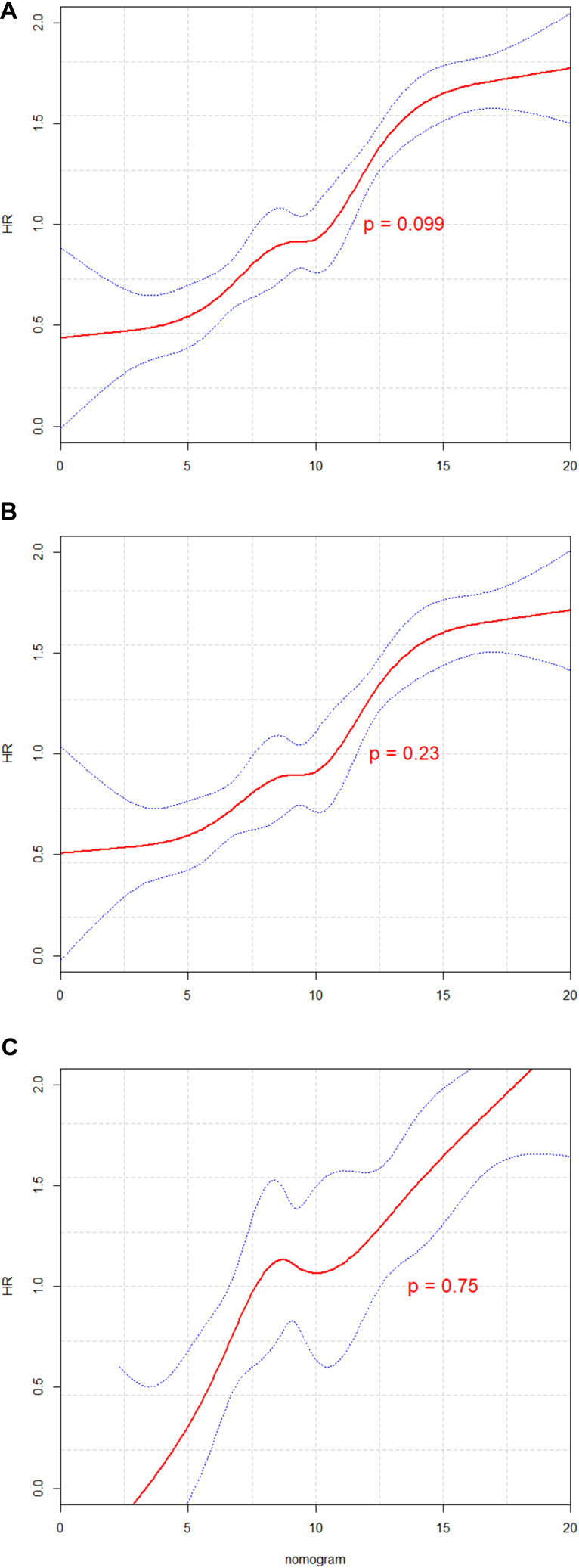
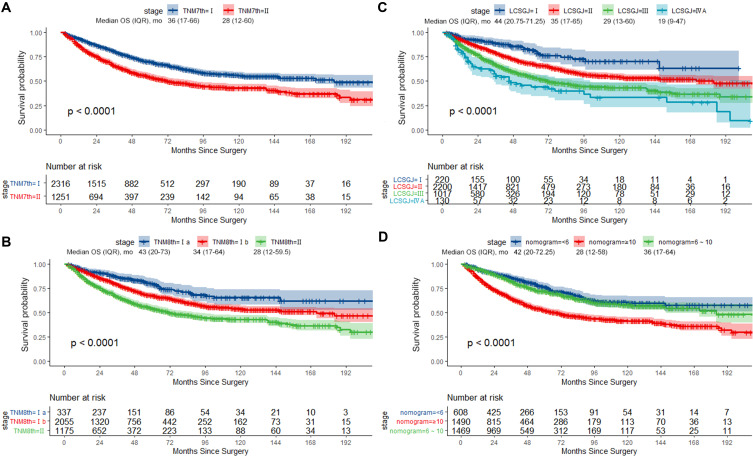
Our nomogram consistently outperformed the conventional staging systems in the training, internal validation set, and external validation set. We quantified the nomogram model into a numerical SNIG (an abbreviation of the incorporated variables - size, number, MVI, and grade) score by summing the points assigned to each incorporated variable, leading to the optimal cut-off values of 6 and 10, which could stratify patients into 3 categories (SNIG score <6, 6-10, ≥10). This yielded significantly different median overall survivals (interquartile ranges) of 42.0 (20.0-72.0) and 37.0 (17.0-67.0); 28.0 (12.0-60.0) and 42.0 (21.75-82.0); 40.0 (18.0-70.0) and 29.0 (11.5-61.0) months for the 3 categories in the entire SEER and external validation sets, respectively.
We developed a web-based SNIG model to graphically and numerically predict the overall survival of stage Ⅰ and Ⅱ HCC. This scoring system may shed light on risk stratification for these patients in clinical practice and clinical trials.
根据肿瘤-淋巴结-转移分期系统第8版,术后Ⅰ期和Ⅱ期肝细胞癌(HCC)患者的术后预后预测模型较少。本研究旨在构建一个预后评分系统,以预测生存结局,并将这些患者分为不同的预后分层。
我们基于监测、流行病学和最终结果(SEER)数据库的训练集(n = 3567),利用多变量Cox回归纳入四个选定的风险因素,开发了一个基于网络的列线图。使用来自SEER数据库的独立内部数据集(n = 1783)和516例中国患者的外部验证集对其进行验证。进一步评估了我们模型的预测性能和鉴别能力,并与传统的HCC分期系统进行比较。
在训练集、内部验证集和外部验证集中,我们的列线图始终优于传统分期系统。我们通过将分配给每个纳入变量的分数相加,将列线图模型量化为一个数值SNIG(纳入变量——大小、数量、微血管侵犯和分级的缩写)评分,得出最佳临界值为6和10,这可以将患者分为3类(SNIG评分<6、6 - 10、≥10)。在整个SEER和外部验证集中,这3类患者的中位总生存期(四分位间距)分别为42.0(20.0 - 72.0)和37.0(17.0 - 67.0)个月;28.0(12.0 - 60.0)和42.0(21.75 - 82.0)个月;40.0(18.0 - 70.0)和29.0(11.5 - 61.0)个月。
我们开发了一个基于网络的SNIG模型,以图形和数值方式预测Ⅰ期和Ⅱ期HCC的总生存期。该评分系统可能为临床实践和临床试验中这些患者的风险分层提供参考。