Goel Rishi R, Apostolidis Sokratis A, Painter Mark M, Mathew Divij, Pattekar Ajinkya, Kuthuru Oliva, Gouma Sigrid, Kuri-Cervantes Leticia, Meng Wenzhao, Adamski Sharon, Baxter Amy E, Giles Josephine R, Weirick Madison E, McAllister Christopher M, Hicks Amanda, Korte Scott, Dougherty Jeanette, Long Sherea, D'Andrea Kurt, Hamilton Jacob T, Prak Eline T Luning, Betts Michael R, Bates Paul, Hensley Scott E, Greenplate Allison R, Wherry E John
Institute for Immunology, University of Pennsylvania Perelman School of Medicine, Philadelphia, PA, USA.
Immune Health™, University of Pennsylvania Perelman School of Medicine, Philadelphia, PA, USA.
medRxiv. 2021 Mar 6:2021.03.03.21252872. doi: 10.1101/2021.03.03.21252872.
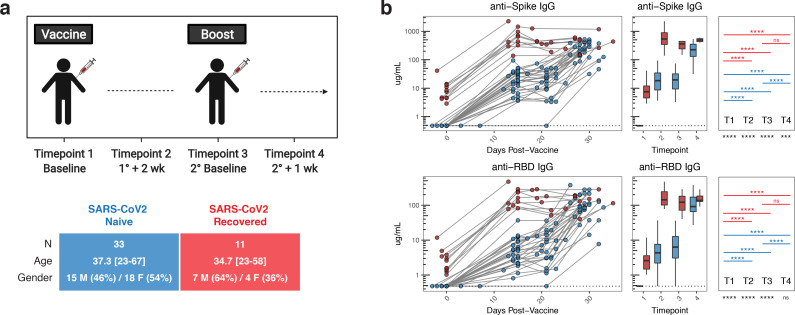
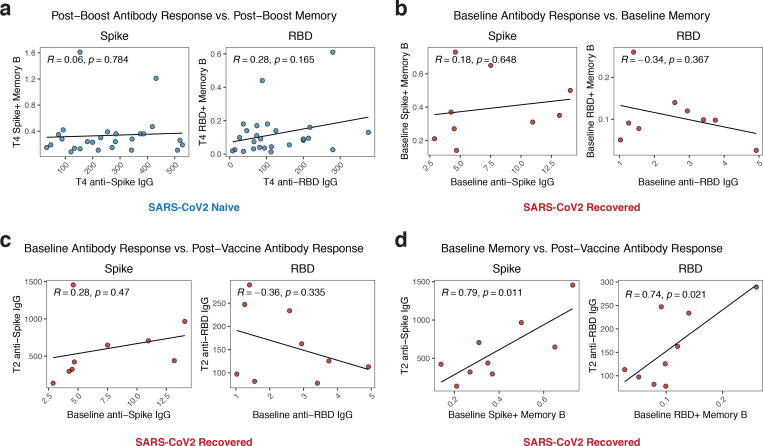
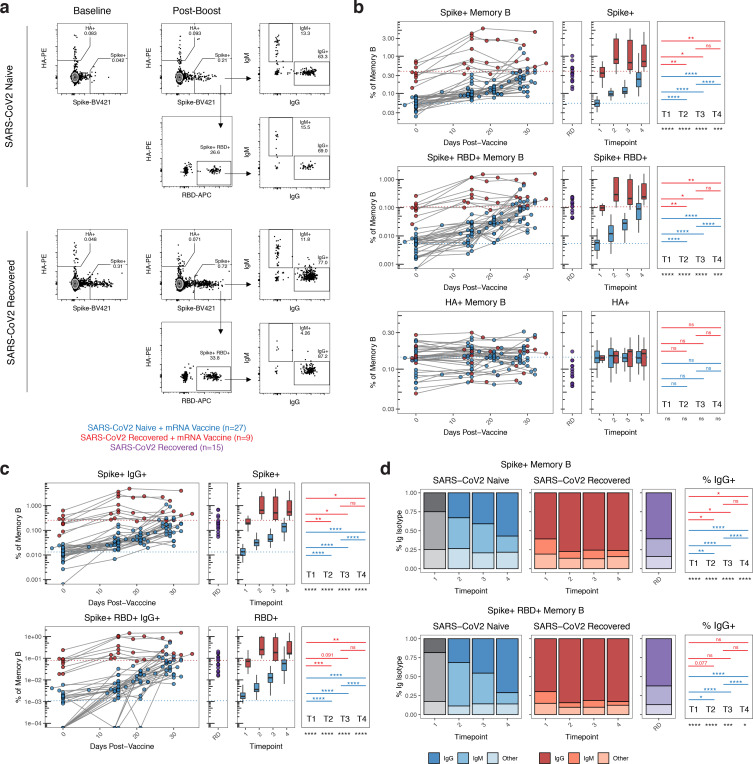
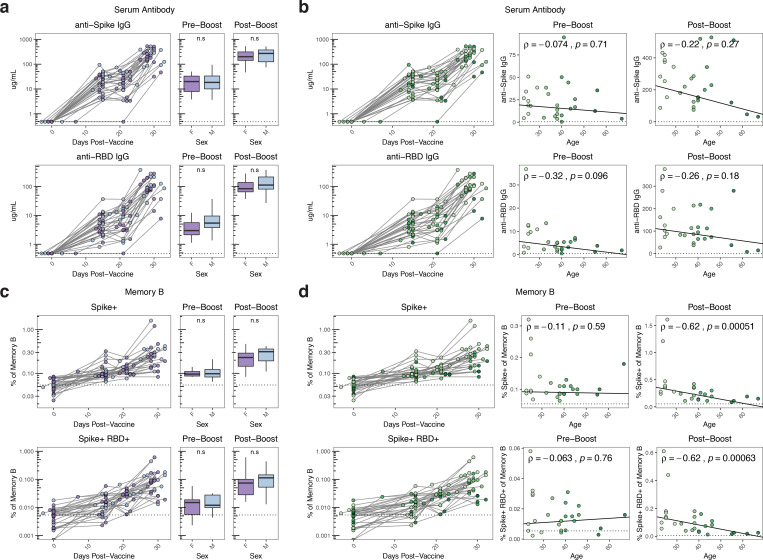
Novel mRNA vaccines for SARS-CoV2 have been authorized for emergency use and are currently being administered to millions of individuals worldwide. Despite their efficacy in clinical trials, there is limited data on vaccine-induced immune responses in individuals with a prior SARS-CoV2 infection compared to SARS-CoV2 naïve subjects. Moreover, how mRNA vaccines impact the development of antibodies as well as memory B cells in COVID-19 experienced versus COVID-19 naïve subjects remains poorly understood. In this study, we evaluated antibody responses and antigen-specific memory B cell responses over time in 33 SARS-CoV2 naïve and 11 SARS-CoV2 recovered subjects. mRNA vaccination induced significant antibody and memory B cell responses against full-length SARS-CoV2 spike protein and the spike receptor binding domain (RBD). SARS-CoV2 naïve individuals benefitted from both doses of mRNA vaccine with additional increases in antibodies and memory B cells following booster immunization. In contrast, SARS-CoV2 recovered individuals had a significant immune response after the first dose with no increase in circulating antibodies or antigen-specific memory B cells after the second dose. Moreover, the magnitude of the memory B cell response induced by vaccination was lower in older individuals, revealing an age-dependence to mRNA vaccine-induced B cell memory. Side effects also tended to associate with post-boost antibody levels, but not with post-boost memory B cells, suggesting that side effect severity may be a surrogate of short-term antibody responses. The frequency of pre-vaccine antigen-specific memory B cells in SARS-CoV2 recovered individuals strongly correlated with post-vaccine antibody levels, supporting a key role for memory B cells in humoral recall responses to SARS-CoV2. This observation may have relevance for future booster vaccines and for responses to viral variants that partially escape pre-existing antibodies and require new humoral responses to be generated from memory B cells. Finally, post-boost antibody levels were not correlated with post-boost memory responses in SARS-CoV2 naïve individuals, indicating that short-term antibody levels and memory B cells are complementary immunological endpoints that should be examined in tandem when evaluating vaccine response. Together, our data provide evidence of both serological response and immunological memory following mRNA vaccination that is distinct based on prior SARS-CoV2 exposure. These findings may inform vaccine distribution in a resource-limited setting.
新型SARS-CoV-2 mRNA疫苗已获紧急使用授权,目前正在全球数百万人中接种。尽管它们在临床试验中显示出疗效,但与未感染过SARS-CoV-2的受试者相比,关于既往感染过SARS-CoV-2的个体中疫苗诱导的免疫反应的数据有限。此外,mRNA疫苗如何影响有过COVID-19感染经历的受试者与未感染过COVID-19的受试者体内抗体以及记忆B细胞的发育,目前仍知之甚少。在本研究中,我们评估了33名未感染过SARS-CoV-2的受试者和11名感染过SARS-CoV-2后康复的受试者随时间变化的抗体反应和抗原特异性记忆B细胞反应。mRNA疫苗接种诱导了针对全长SARS-CoV-2刺突蛋白和刺突受体结合域(RBD)的显著抗体和记忆B细胞反应。未感染过SARS-CoV-2的个体从两剂mRNA疫苗中获益,加强免疫后抗体和记忆B细胞进一步增加。相比之下,感染过SARS-CoV-2后康复的个体在第一剂疫苗接种后有显著的免疫反应,但第二剂疫苗接种后循环抗体或抗原特异性记忆B细胞没有增加。此外,接种疫苗诱导的记忆B细胞反应强度在老年人中较低,这表明mRNA疫苗诱导的B细胞记忆存在年龄依赖性。副作用也往往与加强免疫后的抗体水平相关,但与加强免疫后的记忆B细胞无关,这表明副作用的严重程度可能是短期抗体反应的一个替代指标。感染过SARS-CoV-2后康复的个体中疫苗接种前抗原特异性记忆B细胞的频率与疫苗接种后的抗体水平密切相关,这支持了记忆B细胞在针对SARS-CoV-2的体液回忆反应中的关键作用。这一观察结果可能与未来的加强疫苗以及对部分逃避现有抗体并需要从记忆B细胞产生新的体液反应的病毒变体的反应有关。最后,在未感染过SARS-CoV-2的个体中,加强免疫后的抗体水平与加强免疫后的记忆反应不相关,这表明短期抗体水平和记忆B细胞是互补的免疫终点,在评估疫苗反应时应同时进行检测。总之,我们的数据提供了mRNA疫苗接种后血清学反应和免疫记忆的证据,且根据既往SARS-CoV-2暴露情况而有所不同。这些发现可能为资源有限环境下的疫苗分配提供参考。