Médecins Sans Frontières, Mumbai, India.
Tata Institute of Social Sciences, Mumbai, India.
PLoS One. 2021 Mar 10;16(3):e0248408. doi: 10.1371/journal.pone.0248408. eCollection 2021.
Childhood multidrug-resistant TB (MDR-TB) still affects around 25000 children every year across the globe. Though the treatment success rates for drug-resistant TB (DR-TB) in children are better than adults, children and adolescents face unique hurdles during DR-TB (MDR-TB, Pre-XDR TB and XDR-TB) treatment. This study aimed to understand the patients, guardians and healthcare providers' perspectives about DR-TB treatment journey of patients and caregivers.
This is a qualitative study involving in depth-interviews of purposively selected adolescents (n = 6), patients guardians (for children and adolescents, n = 5) and health care providers (n = 8) of Médecins Sans Frontières (MSF) clinic, Mumbai, India. In-depth face to face interviews were conducted in English or Hindi language using interview guides during September-November 2019. The interviews were audio-recorded after consent. Thematic network analysis was used to summarize textual data. ATLAS.ti (version 7) was used for analysis.
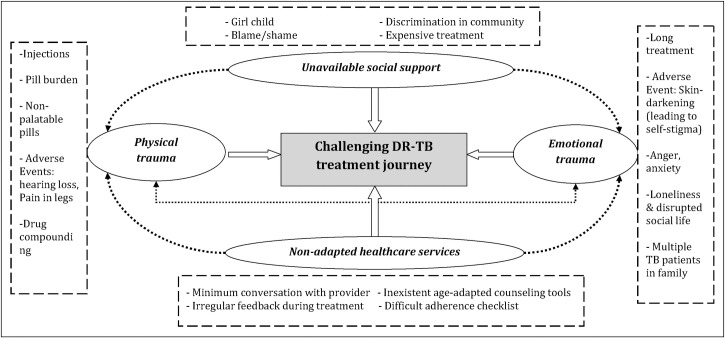
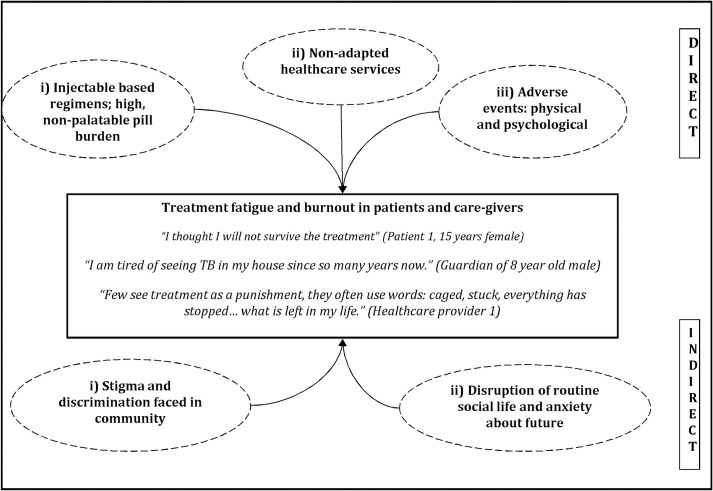
The age of adolescent patients ranged from 15-19 years and four were female. Five guardians (of three child and two adolescent patients) and eight healthcare providers (including clinicians- 2, DOT providers-2, counselors-2 and programme managers-2) were interviewed. The overarching theme of the analysis was: Challenging DR-TB treatment journey which consisted of four sub-themes: 1) physical-trauma, 2) emotional-trauma, 3) unavailable social-support and 4) non-adapted healthcare services. Difficulties in compounding of drugs were noted for children while adolescents shared experiences around disruption in social life due to disease and treatment. Most of the patients and caregivers experienced treatment fatigue and burnout during the DR-TB treatment. Participants during interviews gave recommendations to improve care.
The TB programmes must consider the patient and family as one unit when designing the package of care for paediatric DR-TB. Child and adolescent friendly services (paediatric-formulations, age-specific counselling tools and regular interaction with patients and caregivers) will help minimizing burnout in patients and caregivers.
全球每年仍有大约 25000 名儿童患有儿童耐多药结核病(MDR-TB)。虽然儿童耐药结核病(DR-TB)的治疗成功率优于成人,但儿童和青少年在 DR-TB(MDR-TB、预耐多药结核病和广泛耐药结核病)治疗期间面临着独特的障碍。本研究旨在了解患者、监护人以及医疗保健提供者对患者和照护者 DR-TB 治疗过程的看法。
这是一项定性研究,涉及在印度孟买无国界医生组织(MSF)诊所中,对 6 名青少年(n=6)、5 名儿童和青少年的监护人(n=5)以及 8 名医疗保健提供者(n=8)进行深入访谈。2019 年 9 月至 11 月,使用访谈指南以英语或印地语进行深入的面对面访谈。征得同意后,对访谈进行录音。采用主题网络分析对文本数据进行总结。使用 ATLAS.ti(版本 7)进行分析。
青少年患者的年龄在 15 至 19 岁之间,其中 4 名为女性。5 名监护人(3 名儿童和 2 名青少年患者的监护人)和 8 名医疗保健提供者(包括临床医生 2 名、DOT 提供者 2 名、咨询师 2 名和项目管理人员 2 名)接受了访谈。分析的主旨是:DR-TB 治疗之旅充满挑战,由四个子主题组成:1)身体创伤,2)情感创伤,3)缺乏社会支持,4)医疗服务不适应。在为儿童混合药物时存在困难,而青少年则分享了由于疾病和治疗而导致社交生活中断的经历。大多数患者和照护者在 DR-TB 治疗过程中经历了治疗疲劳和倦怠。访谈参与者提出了改善护理的建议。
在设计儿科 DR-TB 护理套餐时,结核病规划必须将患者和家庭视为一个整体。儿童友好服务(儿科配方、针对特定年龄的咨询工具以及与患者和照护者的定期互动)将有助于减少患者和照护者的倦怠感。