• 文献检索
  • 文档翻译
  • 深度研究
  • 学术资讯
  • Suppr Zotero 插件Zotero 插件
  • 邀请有礼
  • 套餐&价格
  • 历史记录
应用&插件
Suppr Zotero 插件Zotero 插件浏览器插件Mac 客户端Windows 客户端微信小程序
定价
高级版会员购买积分包购买API积分包
服务
文献检索文档翻译深度研究API 文档MCP 服务
关于我们
关于 Suppr公司介绍联系我们用户协议隐私条款
关注我们

Suppr 超能文献

核心技术专利:CN118964589B侵权必究
粤ICP备2023148730 号-1Suppr @ 2026

文献检索

告别复杂PubMed语法,用中文像聊天一样搜索,搜遍4000万医学文献。AI智能推荐,让科研检索更轻松。

立即免费搜索

文件翻译

保留排版,准确专业,支持PDF/Word/PPT等文件格式,支持 12+语言互译。

免费翻译文档

深度研究

AI帮你快速写综述,25分钟生成高质量综述,智能提取关键信息,辅助科研写作。

立即免费体验

为什么人们反对戴口罩?对 COVID-19 大流行期间美国推特的综合分析。

Why do people oppose mask wearing? A comprehensive analysis of U.S. tweets during the COVID-19 pandemic.

机构信息

Department of Informatics, Donald Bren School of Information and Computer Science, University of California, Irvine, Irvine, California, USA.

Department of Computer Science and Engineering, Hong Kong University of Science and Technology, Hong Kong SAR, China.

出版信息

J Am Med Inform Assoc. 2021 Jul 14;28(7):1564-1573. doi: 10.1093/jamia/ocab047.

DOI:10.1093/jamia/ocab047
PMID:33690794
原文链接:https://pmc.ncbi.nlm.nih.gov/articles/PMC7989302/
Abstract

OBJECTIVE

Facial masks are an essential personal protective measure to fight the COVID-19 (coronavirus disease) pandemic. However, the mask adoption rate in the United States is still less than optimal. This study aims to understand the beliefs held by individuals who oppose the use of facial masks, and the evidence that they use to support these beliefs, to inform the development of targeted public health communication strategies.

MATERIALS AND METHODS

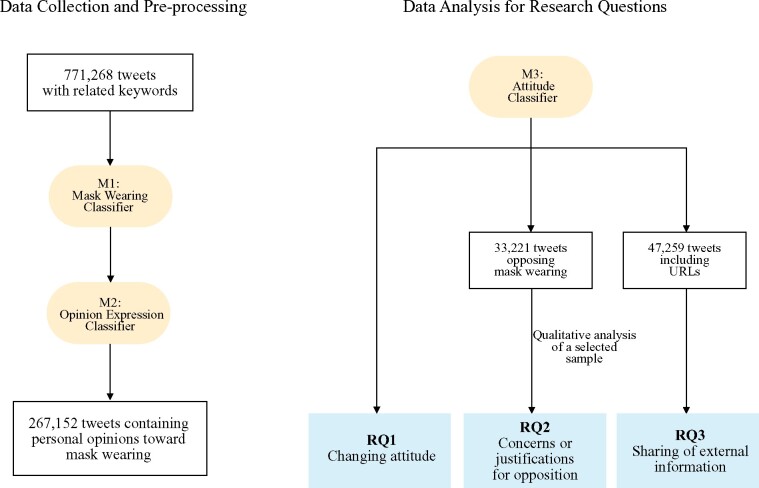
We analyzed a total of 771 268 U.S.-based tweets between January to October 2020. We developed machine learning classifiers to identify and categorize relevant tweets, followed by a qualitative content analysis of a subset of the tweets to understand the rationale of those opposed mask wearing.

RESULTS

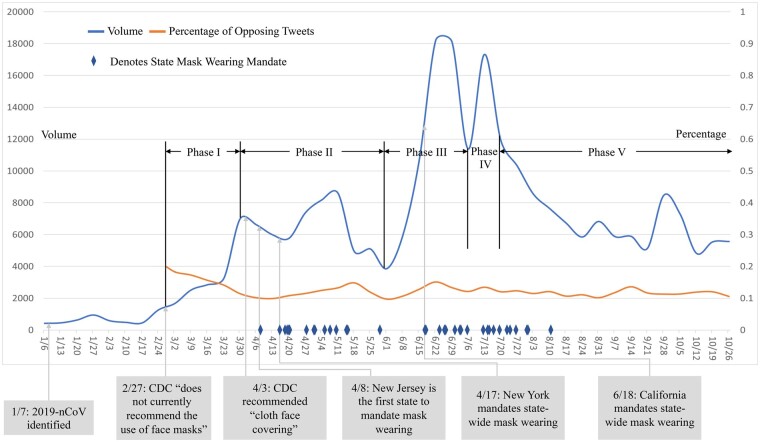
We identified 267 152 tweets that contained personal opinions about wearing facial masks to prevent the spread of COVID-19. While the majority of the tweets supported mask wearing, the proportion of anti-mask tweets stayed constant at about a 10% level throughout the study period. Common reasons for opposition included physical discomfort and negative effects, lack of effectiveness, and being unnecessary or inappropriate for certain people or under certain circumstances. The opposing tweets were significantly less likely to cite external sources of information such as public health agencies' websites to support the arguments.

CONCLUSIONS

Combining machine learning and qualitative content analysis is an effective strategy for identifying public attitudes toward mask wearing and the reasons for opposition. The results may inform better communication strategies to improve the public perception of wearing masks and, in particular, to specifically address common anti-mask beliefs.

摘要

目的

口罩是抗击 COVID-19(冠状病毒病)大流行的重要个人防护措施。然而,美国的口罩佩戴率仍然不尽如人意。本研究旨在了解反对佩戴口罩的个人所持有的信念,以及他们用来支持这些信念的证据,以为制定有针对性的公共卫生传播策略提供信息。

材料与方法

我们分析了 2020 年 1 月至 10 月期间美国的共计 771,268 条推文。我们开发了机器学习分类器来识别和分类相关推文,然后对其中一部分推文进行定性内容分析,以了解反对戴口罩者的基本原理。

结果

我们确定了 267,152 条推文,其中包含了关于戴口罩预防 COVID-19 传播的个人意见。虽然大多数推文支持戴口罩,但在整个研究期间,反口罩推文的比例一直保持在 10%左右。反对的常见原因包括身体不适和负面影响、缺乏有效性,以及在某些情况下对某些人或在某些情况下不必要或不合适。反对的推文明显不太可能引用公共卫生机构网站等外部信息来源来支持这些论点。

结论

结合使用机器学习和定性内容分析是识别公众对戴口罩态度和反对原因的有效策略。研究结果可能为改善公众对戴口罩的看法提供信息,特别是针对常见的反口罩信念提供信息。
https://cdn.ncbi.nlm.nih.gov/pmc/blobs/2b5e/8279800/67bcd1307b23/ocab047f2.jpg
https://cdn.ncbi.nlm.nih.gov/pmc/blobs/2b5e/8279800/8a2f8ac5629d/ocab047f1.jpg
https://cdn.ncbi.nlm.nih.gov/pmc/blobs/2b5e/8279800/67bcd1307b23/ocab047f2.jpg
https://cdn.ncbi.nlm.nih.gov/pmc/blobs/2b5e/8279800/8a2f8ac5629d/ocab047f1.jpg
https://cdn.ncbi.nlm.nih.gov/pmc/blobs/2b5e/8279800/67bcd1307b23/ocab047f2.jpg

相似文献

1
Why do people oppose mask wearing? A comprehensive analysis of U.S. tweets during the COVID-19 pandemic.为什么人们反对戴口罩?对 COVID-19 大流行期间美国推特的综合分析。
J Am Med Inform Assoc. 2021 Jul 14;28(7):1564-1573. doi: 10.1093/jamia/ocab047.
2
Public Discourse Against Masks in the COVID-19 Era: Infodemiology Study of Twitter Data.新冠疫情时代反对戴口罩的公共话语:推特数据的信息流行病学研究。
JMIR Public Health Surveill. 2021 Apr 5;7(4):e26780. doi: 10.2196/26780.
3
The social amplification and attenuation of COVID-19 risk perception shaping mask wearing behavior: A longitudinal twitter analysis.社交媒体对 COVID-19 风险感知的放大和衰减对戴口罩行为的影响:一项纵向推特分析。
PLoS One. 2021 Sep 23;16(9):e0257428. doi: 10.1371/journal.pone.0257428. eCollection 2021.
4
Face Masks During the COVID-19 Pandemic: A Simple Protection Tool With Many Meanings.口罩在 COVID-19 大流行期间:一个具有多重意义的简单防护工具。
Front Public Health. 2021 Jan 13;8:606635. doi: 10.3389/fpubh.2020.606635. eCollection 2020.
5
Appropriate attitude promotes mask wearing in spite of a significant experience of varying discomfort.适当的态度促进了口罩的佩戴,尽管佩戴者会经历不同程度的不适。
Infect Dis Health. 2021 May;26(2):145-151. doi: 10.1016/j.idh.2021.01.002. Epub 2021 Feb 18.
6
Negative attitudes about facemasks during the COVID-19 pandemic: The dual importance of perceived ineffectiveness and psychological reactance.新冠疫情期间对口罩的负面态度:感知无效性和心理抗拒的双重重要性。
PLoS One. 2021 Feb 17;16(2):e0246317. doi: 10.1371/journal.pone.0246317. eCollection 2021.
7
Evolving Face Mask Guidance During a Pandemic and Potential Harm to Public Perception: Infodemiology Study of Sentiment and Emotion on Twitter.大流行期间不断变化的口罩指南和对公众认知的潜在危害:Twitter 上情感的信息流行病学研究。
J Med Internet Res. 2023 Feb 27;25:e40706. doi: 10.2196/40706.
8
Content and User Engagement of Health-Related Behavior Tweets Posted by Mass Media Outlets From Spain and the United States Early in the COVID-19 Pandemic: Observational Infodemiology Study.新冠疫情早期西班牙和美国大众媒体发布的与健康行为相关推文的内容和用户参与度:观察性信息流行病学研究。
JMIR Infodemiology. 2023 Aug 22;3:e43685. doi: 10.2196/43685.
9
Using Tweets to Understand How COVID-19-Related Health Beliefs Are Affected in the Age of Social Media: Twitter Data Analysis Study.利用推文了解社交媒体时代 COVID-19 相关健康信念如何受到影响:推特数据分析研究。
J Med Internet Res. 2021 Feb 22;23(2):e26302. doi: 10.2196/26302.
10
Public Opinions toward COVID-19 Vaccine Mandates: A Machine Learning-based Analysis of U.S. Tweets.公众对 COVID-19 疫苗强制接种令的看法:基于机器学习的美国推特分析。
AMIA Annu Symp Proc. 2023 Apr 29;2022:502-511. eCollection 2022.

引用本文的文献

1
Impact of a New SARS-CoV-2 Variant on the Population: A Mathematical Modeling Approach.一种新型严重急性呼吸综合征冠状病毒2变体对人群的影响:一种数学建模方法。
Math Comput Appl. 2021 Jun;26(2). doi: 10.3390/mca26020025. Epub 2021 Mar 27.
2
Using Large Language Models for sentiment analysis of health-related social media data: empirical evaluation and practical tips.使用大语言模型对健康相关社交媒体数据进行情感分析:实证评估与实用技巧
AMIA Annu Symp Proc. 2025 May 22;2024:503-512. eCollection 2024.
3
Social media crisis communication and public engagement during COVID-19 analyzing public health and news media organizations' tweeting strategies.

本文引用的文献

1
Unmasking the conversation on masks: Natural language processing for topical sentiment analysis of COVID-19 Twitter discourse.揭开口罩话题的面纱:针对 COVID-19 推特话语的主题情感分析的自然语言处理。
AMIA Jt Summits Transl Sci Proc. 2021 May 17;2021:555-564. eCollection 2021.
2
Developing a standardized protocol for computational sentiment analysis research using health-related social media data.开发使用与健康相关的社交媒体数据进行计算情感分析研究的标准化协议。
J Am Med Inform Assoc. 2021 Jun 12;28(6):1125-1134. doi: 10.1093/jamia/ocaa298.
3
Effectiveness of Adding a Mask Recommendation to Other Public Health Measures to Prevent SARS-CoV-2 Infection in Danish Mask Wearers : A Randomized Controlled Trial.
新冠疫情期间的社交媒体危机沟通与公众参与:分析公共卫生和新闻媒体组织的推文策略
Sci Rep. 2025 May 24;15(1):18082. doi: 10.1038/s41598-025-90759-w.
4
Application of an Innovative Methodology to Build Infrastructure for Digital Transformation of Health Systems: Developmental Program Evaluation.一种用于构建卫生系统数字转型基础设施的创新方法的应用:发展项目评估
JMIR Form Res. 2025 Apr 17;9:e53339. doi: 10.2196/53339.
5
Wearing face masks when no longer mandatory: An exploratory study about attitudinal and psychological health factors in a large Italian sample.口罩不再强制佩戴时:对意大利一个大型样本中态度和心理健康因素的探索性研究。
PLoS One. 2025 Mar 4;20(3):e0314607. doi: 10.1371/journal.pone.0314607. eCollection 2025.
6
Ideological Consistency and News Sharing as Predictors of Masking Among College Students.思想一致性和新闻分享作为大学生口罩佩戴行为的预测因素
Int J Environ Res Public Health. 2024 Dec 11;21(12):1652. doi: 10.3390/ijerph21121652.
7
Using the diffusion of innovations theory to understand factors associated with COVID-19 vaccination among tobacco users.运用创新扩散理论来理解与烟草使用者中新冠病毒疫苗接种相关的因素。
PLoS One. 2024 Dec 12;19(12):e0309780. doi: 10.1371/journal.pone.0309780. eCollection 2024.
8
Risk messaging style and its effect on public preparedness for earthquakes: longitudinal intervention-based study.风险信息传达方式及其对公众地震防范准备的影响:基于纵向干预的研究。
J Public Health Policy. 2025 Mar;46(1):87-109. doi: 10.1057/s41271-024-00534-w. Epub 2024 Dec 2.
9
Disclosure Patterns of Opioid Use Disorders in Perinatal Care During the Opioid Epidemic on X From 2019 to 2021: Thematic Analysis.2019年至2021年阿片类药物流行期间围产期护理中阿片类药物使用障碍的披露模式:主题分析
JMIR Pediatr Parent. 2024 Oct 7;7:e52735. doi: 10.2196/52735.
10
Examination of factors that impact mask or respirator purchase and usage during the COVID-19 pandemic.考察在 COVID-19 大流行期间影响口罩或呼吸器购买和使用的因素。
PLoS One. 2024 Sep 25;19(9):e0308841. doi: 10.1371/journal.pone.0308841. eCollection 2024.
在丹麦口罩佩戴者中,将口罩推荐与其他公共卫生措施结合使用以预防 SARS-CoV-2 感染的效果:一项随机对照试验。
Ann Intern Med. 2021 Mar;174(3):335-343. doi: 10.7326/M20-6817. Epub 2020 Nov 18.
4
The False positive problem of automatic bot detection in social science research.自动化 Bot 检测在社会科学研究中的假阳性问题。
PLoS One. 2020 Oct 22;15(10):e0241045. doi: 10.1371/journal.pone.0241045. eCollection 2020.
5
To mask or not to mask: Modeling the potential for face mask use by the general public to curtail the COVID-19 pandemic.戴口罩还是不戴口罩:模拟公众使用口罩遏制新冠疫情的可能性。
Infect Dis Model. 2020 Apr 21;5:293-308. doi: 10.1016/j.idm.2020.04.001. eCollection 2020.
6
Rationale for universal face masks in public against COVID-19.公众佩戴通用口罩预防新冠病毒病的基本原理。
Respirology. 2020 Jul;25(7):678-679. doi: 10.1111/resp.13834. Epub 2020 Apr 30.
7
Universal Masking in Hospitals in the Covid-19 Era.新冠疫情时代医院中的普遍口罩佩戴措施
N Engl J Med. 2020 May 21;382(21):e63. doi: 10.1056/NEJMp2006372. Epub 2020 Apr 1.
8
How Do General-Purpose Sentiment Analyzers Perform when Applied to Health-Related Online Social Media Data?当应用于与健康相关的在线社交媒体数据时,通用情感分析器的表现如何?
Stud Health Technol Inform. 2019 Aug 21;264:1208-1212. doi: 10.3233/SHTI190418.
9
Understanding the Patterns of Health Information Dissemination on Social Media during the Zika Outbreak.了解寨卡疫情期间社交媒体上健康信息的传播模式。
AMIA Annu Symp Proc. 2018 Apr 16;2017:820-829. eCollection 2017.
10
Leveraging machine learning-based approaches to assess human papillomavirus vaccination sentiment trends with Twitter data.利用基于机器学习的方法,利用 Twitter 数据评估人乳头瘤病毒疫苗接种情绪趋势。
BMC Med Inform Decis Mak. 2017 Jul 5;17(Suppl 2):69. doi: 10.1186/s12911-017-0469-6.