Department of Medicine, Unit of Andrology and Reproductive Medicine, University Hospital Padua, Via N. Giustiniani 2, 35128, Padua, Italy.
Department of Surgery Oncology and Gastroenterology, University of Padua, Padua, Italy.
Mol Med. 2021 Mar 10;27(1):26. doi: 10.1186/s10020-021-00287-2.
Breast cancer is the most common neoplasia among women in developed countries. The risk factors of breast cancer can be distinguished in modifiable and unmodifiable factors and, among the latter, genetic factors play a key role. Copy number variations (CNVs) are genetic variants that are classified as rare when present in less than 1% of the healthy population. Since rare CNVs are often cause of diseases, over the last years, their contribution in carcinogenesis has become a relevant matter of study. E2F1 is a transcriptional factor that plays an important role in regulating cell cycle and apoptosis. Its double and conflicting role is the reason why it acts both as oncogene and as tumour suppressor, depending on cell context. Since anomalies in expression or in number of copies of E2F1 have been related to several cancers, we aimed to study number of germline copies of E2F1 in women with breast cancer in order to better elucidate their contribution as predisposing factor to this tumour.
We performed, hence, a retrospective study on 222 Italian women with breast cancer recruited from October 2002 to December 2007. TaqMan CNV assay and Real-Time PCR were carried out to analyse, respectively, E2F1 CNV and E2F1 expression in the subjects of the study. Chi square test or Fisher's exact test and Student's t-test were used to calculate the frequency of CNVs and differences in continuous variables between groups, respectively.
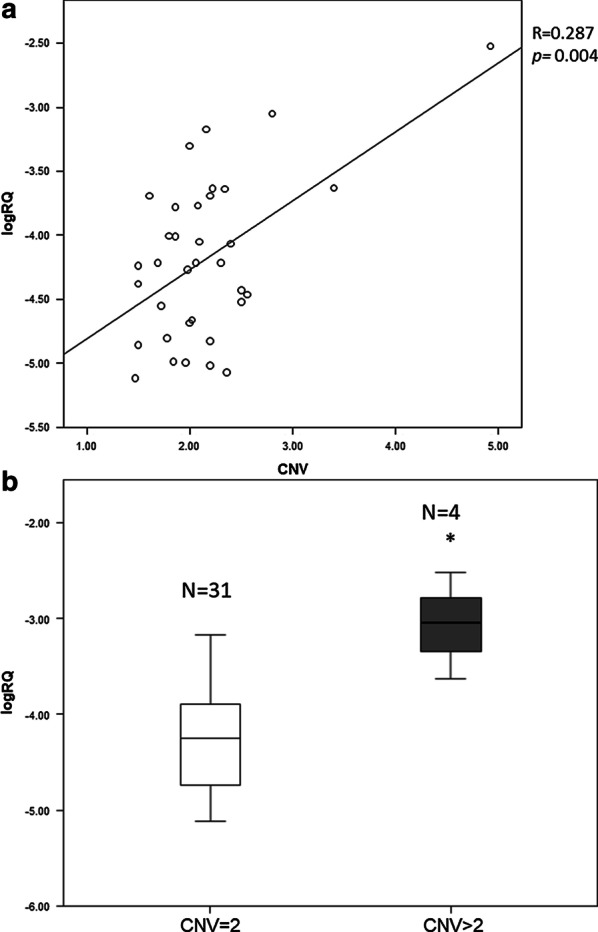
Intriguingly, we found that 10/222 (4.5%) women with breast cancer had more copies than controls (0/200, 0%), furthermore, the number of copies positively correlated with E2F1 gene expression in breast cancer tissue, suggesting that the constitutive gain of the gene could translate into an increased risk of genomic instability. Additionally, we found that altered E2F1 copies were present prevalently in the patients with contralateral breast cancer (20%) and all of them had a positive family history, both typically associated with hereditary cancer.
Our findings suggest that copy number variations of E2F1 might be a susceptibility factor for breast cancer, however, further studies on large cohorts are to be performed in order to better delineate the phenotype linked to the gain of E2F1 copies.
乳腺癌是发达国家女性中最常见的肿瘤。乳腺癌的危险因素可分为可改变和不可改变的因素,后者中遗传因素起着关键作用。拷贝数变异(CNVs)是一种遗传变异,当它们在健康人群中出现的频率低于 1%时被归类为罕见。由于罕见的 CNVs 通常是疾病的原因,近年来,它们在致癌作用中的贡献已成为一个相关的研究课题。E2F1 是一种转录因子,在调节细胞周期和细胞凋亡中发挥重要作用。它的双重和矛盾作用是其既是癌基因又是肿瘤抑制基因的原因,这取决于细胞的上下文。由于 E2F1 的表达或拷贝数异常与多种癌症有关,我们旨在研究乳腺癌患者中 E2F1 的种系拷贝数,以更好地阐明其作为该肿瘤易患因素的作用。
因此,我们对 2002 年 10 月至 2007 年 12 月期间招募的 222 名意大利乳腺癌女性患者进行了回顾性研究。TaqMan CNV 检测和实时 PCR 分别用于分析研究对象的 E2F1 CNV 和 E2F1 表达。卡方检验或 Fisher 确切检验和学生 t 检验分别用于计算 CNV 的频率和组间连续变量的差异。
有趣的是,我们发现 222 名乳腺癌女性中有 10 名(4.5%)的 E2F1 拷贝数高于对照组(200 名中的 0 名,0%),此外,E2F1 基因在乳腺癌组织中的表达与 E2F1 基因的拷贝数呈正相关,这表明基因的组成性获得可能会转化为基因组不稳定性的风险增加。此外,我们发现改变的 E2F1 拷贝数主要存在于对侧乳腺癌患者(20%)中,且所有患者均有阳性家族史,这两者通常与遗传性癌症相关。
我们的研究结果表明,E2F1 的拷贝数变异可能是乳腺癌的易感因素,但需要进一步对大型队列进行研究,以更好地描绘与 E2F1 拷贝数增加相关的表型。