The Provincial Clinical Medical College, Fujian Medical University, 134 Dong Street, Fujian, 350004, Fuzhou, China.
Department of Anesthesiology, Fujian Provincial Hospital, Fuzhou, Fujian, China.
BMC Anesthesiol. 2021 Mar 10;21(1):75. doi: 10.1186/s12871-021-01296-8.
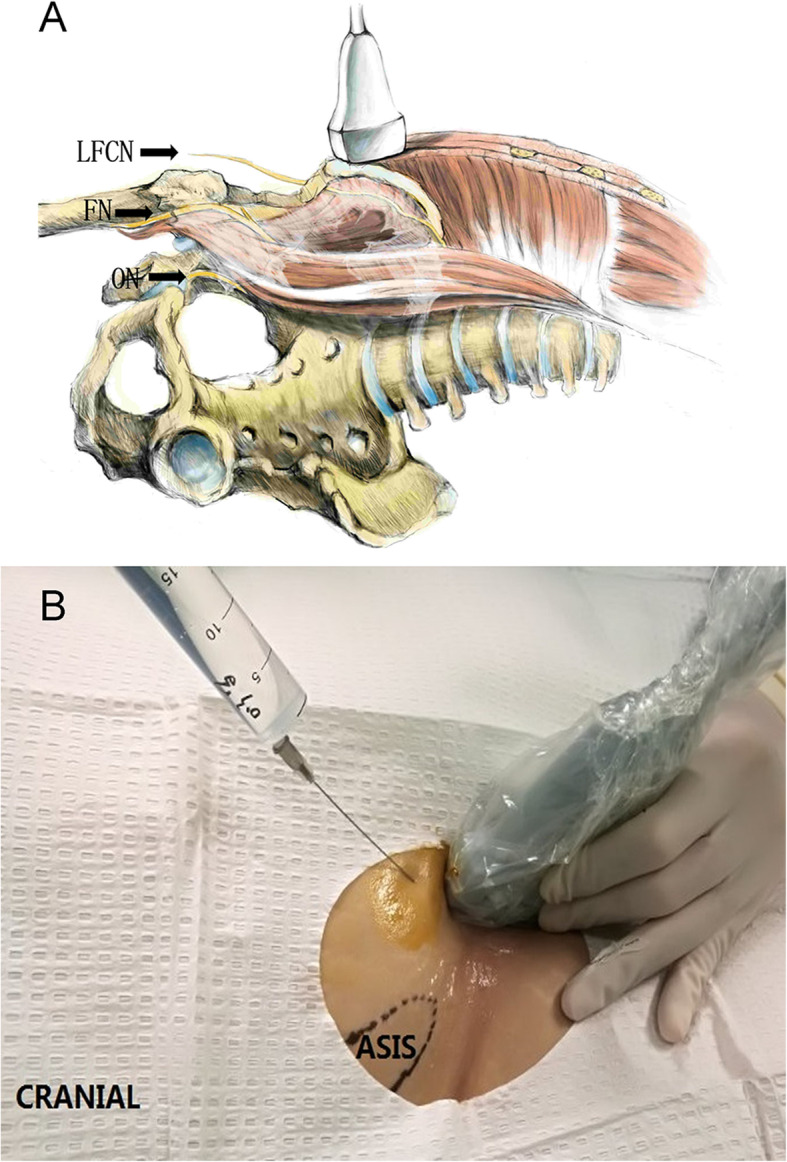
Fascia iliaca compartment block (FICB) is an anterior approach to the lumbar plexus block and provides the effective adjunctive analgesia for total hip arthroplasty (THA).
As a case series study, 28 patients (≥ 65 years old) with THA were received a modified in-plane ultrasound-guided supra-inguinal (S-FICB) as an analgesic adjunct to evaluate the analgesic effectiveness and the local anesthetic diffusion with magnetic resonance imaging (MRI). A combination of propofol and sufentanil was administered to conduct target-controlled infusion.
The pain scores were 1 (0-4), 2 (1-5), 3 (1-6) and 3 (1-6) at 4, 8, 12, and 24 h. The cumulative opioids were 8 (8-12), 18 (16-32), 28 (24-54) and 66 (48-104) mg of i.v. morphine equivalents at 4, 8, 12, and 24 h. The patient-controlled analgesia (PCA) times were 0 (0-1), 1 (0-2), 2 (0-5) and 5 (3-8) at 4, 8, 12, and 24 h. In lateral, anterior and medial part of thigh, the sensory blockade in 28 patients was 23 (82 %), 21 (75 %) and 19 (68 %) at 5 min; 28 (100 %) at 10 and 20 min. Motor blockade of femoral nerve (FN) and obturator nerve (ON) was present in 13 (46 %) and 3 (11 %) patients at 5 min, 24 (86 %) and 9 (32 %) at 10 min, 26 (93 %) and 11 (39 %) at 20 min. Injectate permeated to the FN and extended superiorly over the surface of iliac muscle (IM) and pectineus muscle (PM) in all patients.
The modified S-FICB has provided an effective postoperative analgesic adjunct after THA with the satisfactory blockade of femoral (FN), obturator (ON) and sciatic (SN) nerves, especially for ON, when compared with the existing techniques.
股外侧肌间隙阻滞(FICB)是一种腰椎丛阻滞的前入路方法,可为全髋关节置换术(THA)提供有效的辅助镇痛。
作为一项病例系列研究,对 28 例(≥65 岁)接受 THA 的患者进行改良平面内超声引导的超髂(S-FICB)阻滞,作为辅助镇痛,以评估镇痛效果和磁共振成像(MRI)下局部麻醉剂的扩散情况。采用异丙酚和舒芬太尼联合靶控输注。
术后 4、8、12 和 24 小时的疼痛评分为 1(0-4)、2(1-5)、3(1-6)和 3(1-6)。静脉注射吗啡等效物的累积阿片类药物用量分别为 8(8-12)、18(16-32)、28(24-54)和 66(48-104)mg。术后 4、8、12 和 24 小时的患者自控镇痛(PCA)时间分别为 0(0-1)、1(0-2)、2(0-5)和 5(3-8)。在大腿的外侧、前侧和内侧,28 例患者在 5 分钟时的感觉阻滞率为 23(82%)、21(75%)和 19(68%);10 分钟和 20 分钟时为 28(100%)。5 分钟时,13 例(46%)和 3 例(11%)患者的股神经(FN)和闭孔神经(ON)出现运动阻滞,10 分钟时,24 例(86%)和 9 例(32%)出现运动阻滞,20 分钟时,26 例(93%)和 11 例(39%)出现运动阻滞。所有患者的注射剂均渗透到 FN,并向上扩展到髂肌(IM)和耻骨肌(PM)的表面。
与现有技术相比,改良的 S-FICB 可为 THA 提供有效的术后辅助镇痛,可有效阻滞股神经(FN)、闭孔神经(ON)和坐骨神经(SN),尤其是 ON。