Department of Orthodontics, School of Stomatology, Capital Medical University, No. 4, Tian Tan Xi Li, Beijing, 100050, China.
BMC Oral Health. 2021 Mar 10;21(1):109. doi: 10.1186/s12903-021-01474-7.
Pathologic tooth migration (PTM) is a common complication of mild to severe periodontitis and proper orthodontic treatment is helpful to alleviate periodontal diseases. The goal of this study is to explore an optimal orthodontic displacement of clear aligner using a three-dimensional (3D) finite element model (FEM).
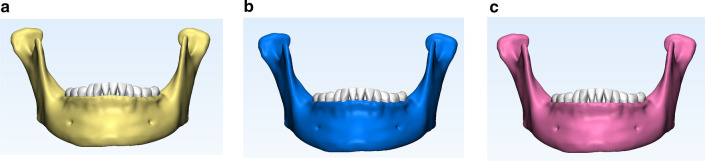
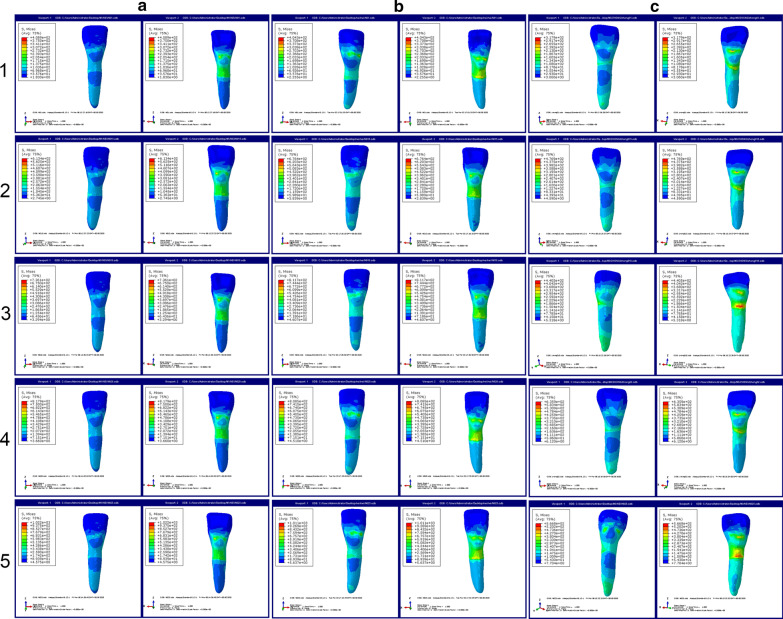
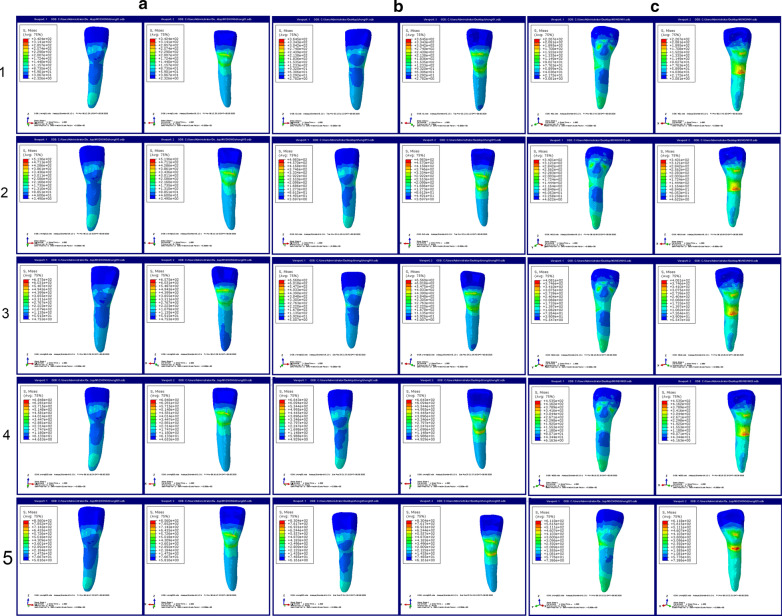
The cone beam computed tomography (CBCT) data of a patient received invisible orthodontics without diabetes and other systemic diseases were collected. Based on the new classification scheme for periodontal diseases in 2017 (stage I: mild periodontitis, [M1]; stage II: moderate periodontitis, [M2]; stage III: severe periodontitis, [M3]), 3D-FEMs of mandible were established using MIMICS 10.0 and ABAQUS 6.5 softwares. The 3D stress distribution diagrams and stress value of the teeth (left lower incisor, left lower central incisor, right lower lateral incisor, and right lower central incisor) under three different periodontal conditions (M1, M2, and M3) with axial inclination 90° and 100° were obtained by ABAQUS 6.5.
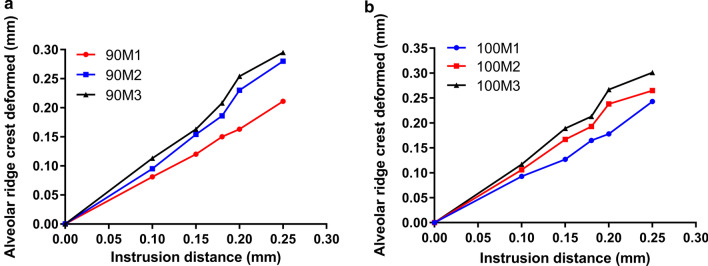
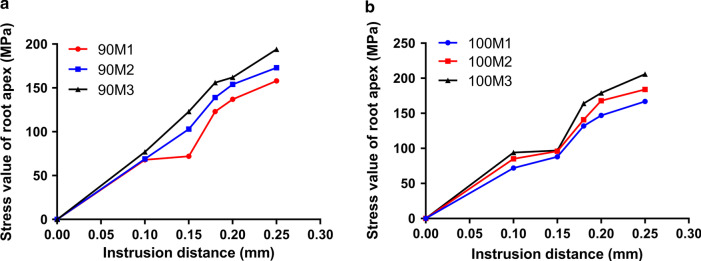
The stress of anterior teeth was concentrated in the teeth neck, and became greater when the periodontal condition was worse. The stress value of anterior teeth and the strain at the top of the alveolar crest are greater as the displacement increasing. The stress value of anterior teeth and the strain at the top of the alveolar crest in axial inclination 100° are relatively great compared to those of axial inclination 90°. For patients with excessively inclined anterior teeth (such as 100°), the optimal orthodontic displacement is 0.18 mm. In order to ensure that alveolar ridge crest is not deformed, the displacement is less than 0.18 mm (strain for 0.165 mm), 0.15 mm (strain for 0.167 mm) and 0.10 mm (strain for 0.117 mm) respectively when alveolar bone is normal, resorption 1/3 or 1/3-1/2.
The optimal orthodontic displacement for patients (M1, M2, and M3) with excessively inclined anterior teeth (axial inclination 100°) is 0.18 mm. To avoid the strain at the top of the alveolar crest, the optimal displacements for M1, M2 and M3 periodontal disease patients are less than 0.18 mm, 0.15 mm and 0.10 mm, respectively.
病理性牙齿迁移(PTM)是轻度至重度牙周炎的常见并发症,适当的正畸治疗有助于缓解牙周病。本研究的目的是利用三维(3D)有限元模型(FEM)探索透明矫正器的最佳正畸位移。
收集了一位接受隐形正畸治疗且无糖尿病等全身疾病的患者的锥形束 CT(CBCT)数据。基于 2017 年牙周病新分类方案(I 期:轻度牙周炎[M1];II 期:中度牙周炎[M2];III 期:重度牙周炎[M3]),使用 MIMICS 10.0 和 ABAQUS 6.5 软件建立下颌 3D-FEM。通过 ABAQUS 6.5 获得三种不同牙周状况(M1、M2 和 M3)下牙齿(左下切牙、左下中切牙、右下侧切牙和右下中切牙)在轴向倾斜 90°和 100°时的 3D 应力分布图和牙齿的应力值。
前牙的应力集中在牙齿颈部,牙周状况越差,应力越大。随着位移的增加,前牙的应力值和牙槽嵴顶的应变越大。轴向倾斜 100°时前牙的应力值和牙槽嵴顶的应变大于轴向倾斜 90°时的应变。对于前牙过度倾斜的患者(如 100°),最佳正畸位移为 0.18mm。为了确保牙槽嵴顶不变形,当牙槽骨正常时,位移小于 0.18mm(应变 0.165mm)、0.15mm(应变 0.167mm)和 0.10mm(应变 0.117mm);当牙槽骨吸收 1/3 或 1/3-1/2 时,位移分别为 0.10mm 和 0.18mm。
对于前牙过度倾斜(轴向倾斜 100°)的患者(M1、M2 和 M3),最佳正畸位移为 0.18mm。为避免牙槽嵴顶的应变,M1、M2 和 M3 牙周病患者的最佳位移分别小于 0.18mm、0.15mm 和 0.10mm。