School of Public Health, University of Sydney, Sydney, Australia.
The Australian Prevention Partnership Centre, Sax Institute, Sydney, Australia.
Health Res Policy Syst. 2021 Mar 10;19(1):33. doi: 10.1186/s12961-021-00687-0.
Understanding why research is conducted may help address the under-utilisation of research. This study examined the reasons for childhood obesity prevention knowledge production in New South Wales (NSW), Australia, and the factors influencing research choices from the perspective of the researchers and health policy agencies contributing to the research.
A literature search of SCOPUS and ISI Web of Knowledge (affiliation and key word searches) was conducted to compile a database of NSW childhood obesity research outputs, published between 2000 and 2015 (n = 543). Descriptive statistics were used to quantify outputs by research type, differentiating measurement, descriptive, and intervention research, systematic reviews and other publications. Interviews were conducted with a sample of researchers drawn from the database (n = 13) and decision makers from health policy agencies who funded and contributed to childhood obesity research in NSW (n = 15). Researcher interviews examined views about societal impacts, why and under what circumstances the research was conducted. Decision-maker interviews examined policy agency research investment and how research was used in decision making. Content analysis and a thematic approach was used to analyse the interview transcripts.
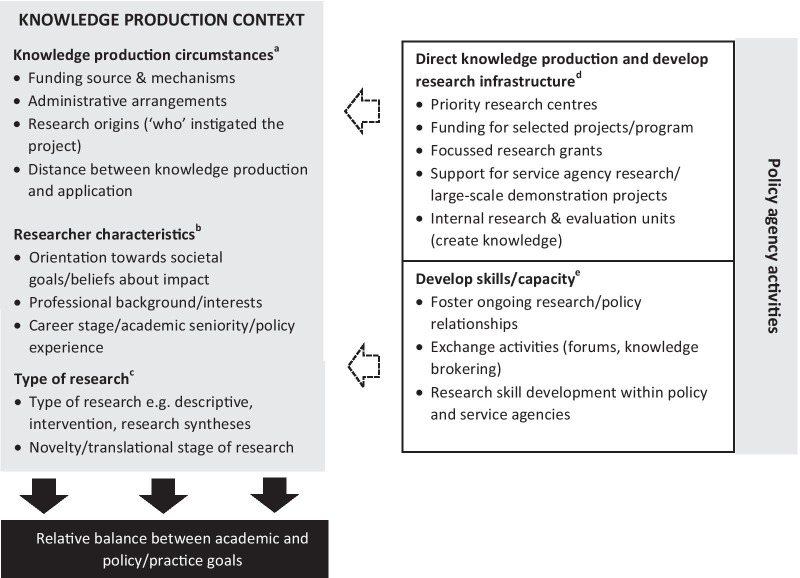
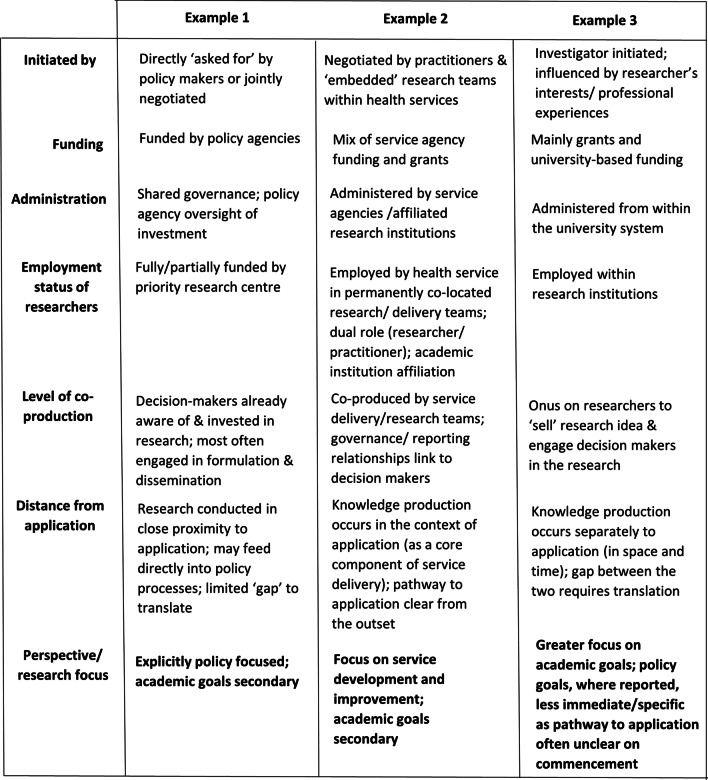
The research in this case was conducted for mix of reasons including those traditionally associated with academic inquiry, as well as intentions to influence policy and practice. Differences in funding mechanisms, administrative and employment arrangements, and 'who' initiated the research, created differing incentives and perspectives for knowledge production. Factors associated with the characteristics and experience of the individuals involved also influenced goals, as did the type of research conducted. Policy agencies played a role in directing research to address policy needs.
The findings of this study confirm that researchers are strongly influenced by their working environment. Funding schemes and other incentives to support policy relevant knowledge production are important. Contextual factors such as policy priorities, policy-driven research funding and the embedded nature or strong connections between some researchers and the policy agencies involved, are likely to have influenced the extent to which policy goals were reported in this study.
了解研究的目的有助于解决研究利用不足的问题。本研究从研究人员和为研究做出贡献的卫生政策机构的角度,考察了澳大利亚新南威尔士州(NSW)开展儿童肥胖预防知识生产的原因,以及影响研究选择的因素。
通过 SCOPUS 和 ISI Web of Knowledge(隶属关系和关键词搜索)进行文献检索,编制了 NSW 儿童肥胖研究成果数据库,研究成果发表于 2000 年至 2015 年期间(n=543)。使用描述性统计方法,根据研究类型对产出进行量化,区分测量、描述和干预研究、系统评价和其他出版物。从数据库中抽取研究人员样本(n=13)和为 NSW 儿童肥胖研究提供资金和做出贡献的卫生政策机构决策者(n=15)进行访谈。研究人员访谈调查了他们对社会影响的看法,以及他们为什么以及在什么情况下进行研究。决策者访谈调查了政策机构的研究投资以及研究如何用于决策。采用内容分析和主题方法对访谈记录进行分析。
本案例中的研究是出于多种原因进行的,包括与学术探究传统相关的原因,以及影响政策和实践的意图。不同的资助机制、行政和就业安排,以及“谁”发起了研究,为知识生产创造了不同的激励和观点。与参与人员的特点和经验相关的因素也影响了目标,研究类型也是如此。政策机构在指导研究以满足政策需求方面发挥了作用。
本研究的结果证实,研究人员受到其工作环境的强烈影响。资助计划和其他支持政策相关知识生产的激励措施非常重要。背景因素,如政策优先事项、政策驱动的研究资金以及一些研究人员与参与的政策机构之间的固有联系或紧密联系,可能会影响本研究中报告的政策目标的程度。