Shilpakar Aryatara, Ansari Mehraj, Rai Kul Raj, Rai Ganesh, Rai Shiba Kumar
Shi-Gan International College of Science and Technology (SICOST), Tribhuvan University, Kathmandu, Nepal.
Institute of Microbiology, University of Chinese Academy of Sciences, Beijing, China.
Trop Med Health. 2021 Mar 11;49(1):23. doi: 10.1186/s41182-021-00313-3.
The existence of multidrug-resistant organisms, including extended-spectrum beta-lactamases (ESBLs), is on rise across the globe and is becoming a severe problem. Knowledge of the prevalence and antibiogram profile of such isolates is essential to develop an appropriate treatment methodology. This study aimed to study the prevalence of Gram-negative isolates exhibiting ESBL at a tertiary care hospital and study their antibiogram profile.
A cross-sectional study was conducted at Shahid Gangalal National Heart Centre, Kathmandu, Nepal, from June 2018 to November 2018. A total of 770 clinical samples were collected and identified using the conventional biochemical tests following the Clinical and Laboratory Standard Institute (CLSI) guidelines. Antimicrobial susceptibility testing (AST) was performed using the standardized Kirby-Bauer disk diffusion method. The screening test for ESBL producers was performed as recommended by the CLSI and the confirmatory test was performed phenotypically using the E-test.
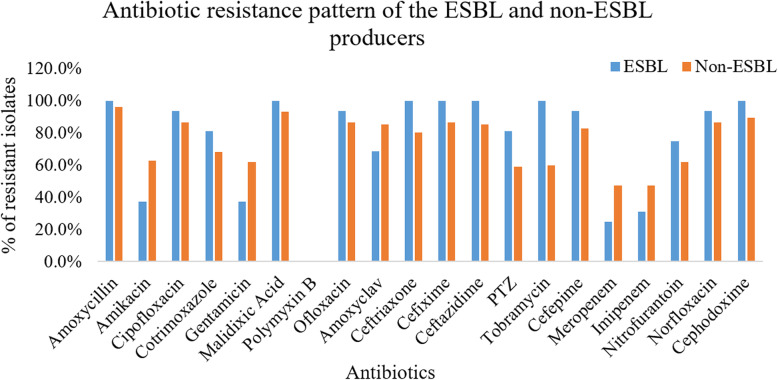
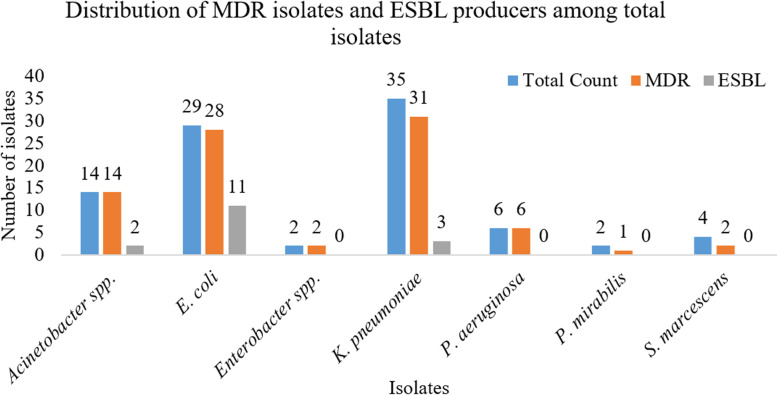
Out of the 92 isolates, 84 (91.3%) were multidrug-resistant, and 47 (51.1%) were found to be potential ESBL producers. Of these, 16 isolates were confirmed ESBL producers by the E-test. Escherichia coli and Klebsiella pneumoniae were the predominant isolates and were also the major ESBL producers. Besides polymyxin B (100% sensitive), meropenem and imipenem showed high efficacy against the ESBL producers.
Multidrug resistance was very high; however, ESBL production was low. Polymyxin B and carbapenems are the choice of drugs against ESBL producers but should be used only as the last line drugs.
包括超广谱β-内酰胺酶(ESBLs)在内的多重耐药菌在全球范围内不断增加,正成为一个严重问题。了解此类分离株的流行情况和抗菌谱对于制定合适的治疗方法至关重要。本研究旨在研究一家三级护理医院中表现出ESBL的革兰氏阴性分离株的流行情况,并研究它们的抗菌谱。
2018年6月至2018年11月在尼泊尔加德满都的沙希德·甘加拉尔国家心脏中心进行了一项横断面研究。按照临床和实验室标准协会(CLSI)指南,共收集了770份临床样本,并使用传统生化试验进行鉴定。采用标准化的 Kirby-Bauer 纸片扩散法进行药敏试验(AST)。按照CLSI的建议进行ESBL产生菌的筛选试验,并使用E-test进行表型确证试验。
在92株分离株中,84株(91.3%)为多重耐药,47株(51.1%)被发现可能是ESBL产生菌。其中,16株通过E-test确认为ESBL产生菌。大肠埃希菌和肺炎克雷伯菌是主要的分离株,也是主要的ESBL产生菌。除多粘菌素B(100%敏感)外,美罗培南和亚胺培南对ESBL产生菌显示出高效。
多重耐药性非常高;然而,ESBL的产生率较低。多粘菌素B和碳青霉烯类是针对ESBL产生菌的药物选择,但应仅作为最后一线药物使用。