Department of Pharmacy, The Affiliated Brain Hospital of Guangzhou Medical University (Guangzhou Huiai Hospital), Guangzhou, 510370, China.
Guangdong Engineering Technology Research Center for Translational Medicine of Mental Disorders, Guangzhou, 510370, China.
Sci Rep. 2021 Mar 10;11(1):5568. doi: 10.1038/s41598-021-85157-x.
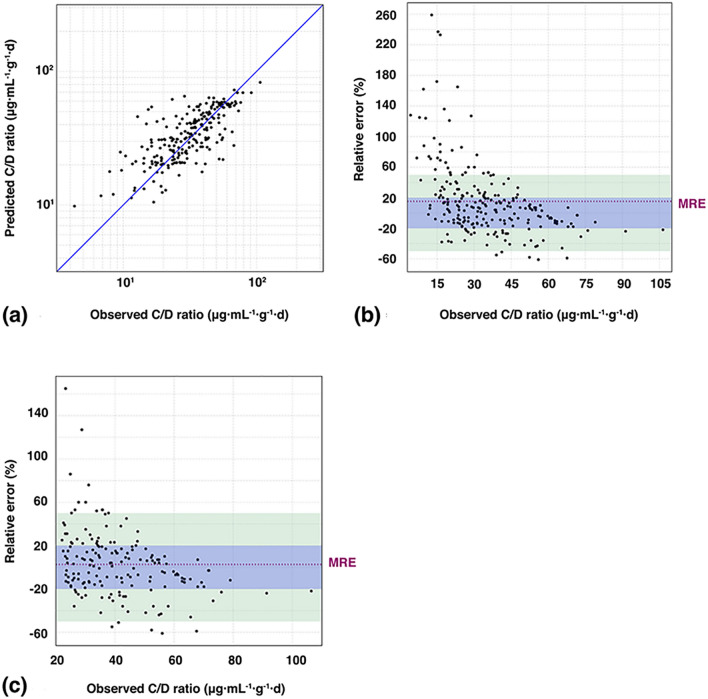
The pharmacokinetic variability of lamotrigine (LTG) plays a significant role in its dosing requirements. Our goal here was to use noninvasive clinical parameters to predict the dose-adjusted concentrations (C/D ratio) of LTG based on machine learning (ML) algorithms. A total of 1141 therapeutic drug-monitoring measurements were used, 80% of which were randomly selected as the "derivation cohort" to develop the prediction algorithm, and the remaining 20% constituted the "validation cohort" to test the finally selected model. Fifteen ML models were optimized and evaluated by tenfold cross-validation on the "derivation cohort," and were filtered by the mean absolute error (MAE). On the whole, the nonlinear models outperformed the linear models. The extra-trees' regression algorithm delivered good performance, and was chosen to establish the predictive model. The important features were then analyzed and parameters of the model adjusted to develop the best prediction model, which accurately described the C/D ratio of LTG, especially in the intermediate-to-high range (≥ 22.1 μg mL g day), as illustrated by a minimal bias (mean relative error (%) = + 3%), good precision (MAE = 8.7 μg mL g day), and a high percentage of predictions within ± 20% of the empirical values (60.47%). This is the first study, to the best of our knowledge, to use ML algorithms to predict the C/D ratio of LTG. The results here can help clinicians adjust doses of LTG administered to patients to minimize adverse reactions.
拉莫三嗪(LTG)的药代动力学变异性在其剂量需求中起着重要作用。我们的目标是使用非侵入性临床参数,基于机器学习(ML)算法预测 LTG 的剂量调整浓度(C/D 比值)。共使用了 1141 次治疗药物监测测量值,其中 80%随机选择作为“推导队列”来开发预测算法,其余 20%构成“验证队列”来测试最终选择的模型。在“推导队列”上,通过 10 倍交叉验证优化和评估了 15 个 ML 模型,并通过平均绝对误差(MAE)进行过滤。总的来说,非线性模型优于线性模型。随机森林回归算法表现良好,被选择来建立预测模型。然后分析重要特征并调整模型参数以开发最佳预测模型,该模型准确描述了 LTG 的 C/D 比值,尤其是在中至高范围(≥22.1μg mL g day),表现出最小的偏差(平均相对误差(%)=+3%)、良好的精度(MAE=8.7μg mL g day)和高比例的预测值在经验值的±20%范围内(60.47%)。据我们所知,这是首次使用 ML 算法预测 LTG 的 C/D 比值。结果有助于临床医生调整患者的 LTG 剂量,以最大程度地减少不良反应。