Department of Mechanical and Aerospace Engineering, University of California, 5200 Engineering Hall, Irvine, CA, 92617-2700, USA.
, 4200 Engineering Gateway, Irvine, USA.
Sci Rep. 2021 Mar 10;11(1):5622. doi: 10.1038/s41598-021-85150-4.
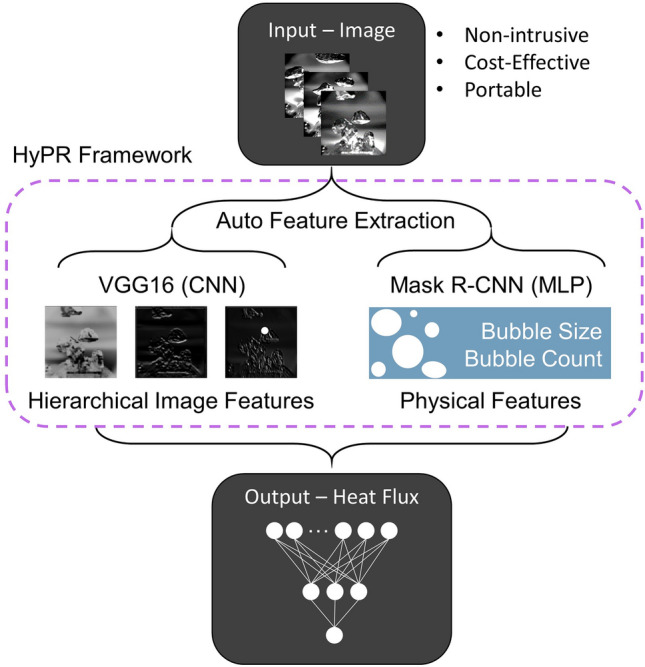
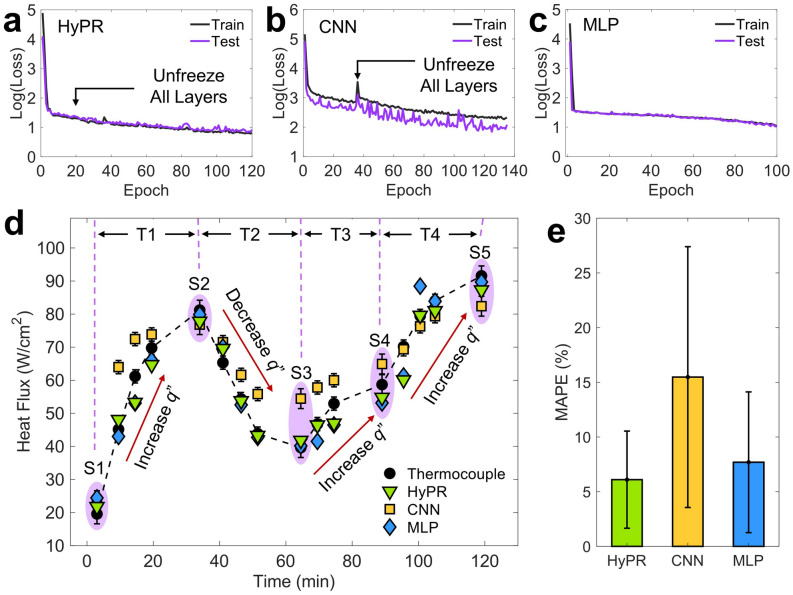
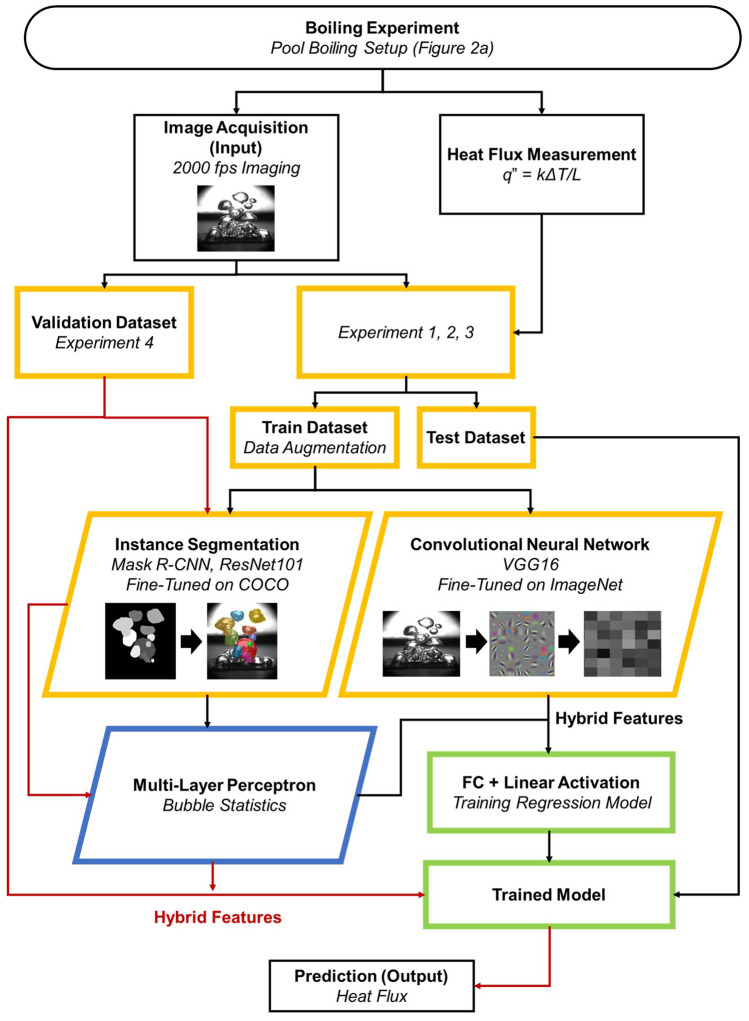
Boiling is arguably Nature's most effective thermal management mechanism that cools submersed matter through bubble-induced advective transport. Central to the boiling process is the development of bubbles. Connecting boiling physics with bubble dynamics is an important, yet daunting challenge because of the intrinsically complex and high dimensional of bubble dynamics. Here, we introduce a data-driven learning framework that correlates high-quality imaging on dynamic bubbles with associated boiling curves. The framework leverages cutting-edge deep learning models including convolutional neural networks and object detection algorithms to automatically extract both hierarchical and physics-based features. By training on these features, our model learns physical boiling laws that statistically describe the manner in which bubbles nucleate, coalesce, and depart under boiling conditions, enabling in situ boiling curve prediction with a mean error of 6%. Our framework offers an automated, learning-based, alternative to conventional boiling heat transfer metrology.
煮沸可以说是自然界最有效的热管理机制,通过气泡诱导的对流输运来冷却浸没物质。沸腾过程的核心是气泡的发展。将沸腾物理学与气泡动力学联系起来是一项重要而艰巨的挑战,因为气泡动力学本质上是复杂和高维的。在这里,我们引入了一个数据驱动的学习框架,该框架将对动态气泡的高质量成像与相关的沸腾曲线相关联。该框架利用了包括卷积神经网络和目标检测算法在内的前沿深度学习模型,自动提取分层和基于物理的特征。通过对这些特征进行训练,我们的模型学习了物理沸腾定律,这些定律统计描述了气泡在沸腾条件下成核、聚结和脱离的方式,从而能够以平均误差为 6%的精度进行原位沸腾曲线预测。我们的框架提供了一种自动化、基于学习的替代传统沸腾传热计量学的方法。