Farkas Carlos, Quiroz Aracelly, Alvarez Claudia, Hermosilla Viviana, Aylwin Carlos F, Lomniczi Alejandro, Castro Ariel F, Hepp Matias I, Pincheira Roxana
Laboratorio de Transducción de Señales y Cáncer, Departamento de Bioquímica y Biología Molecular, Facultad de Ciencias Biológicas, Universidad de Concepción, Concepción, Chile.
Division of Neuroscience, Oregon National Primate Research Center, Oregon Health and Science University, Portland, OR, United States.
Front Genet. 2021 Feb 22;12:613808. doi: 10.3389/fgene.2021.613808. eCollection 2021.
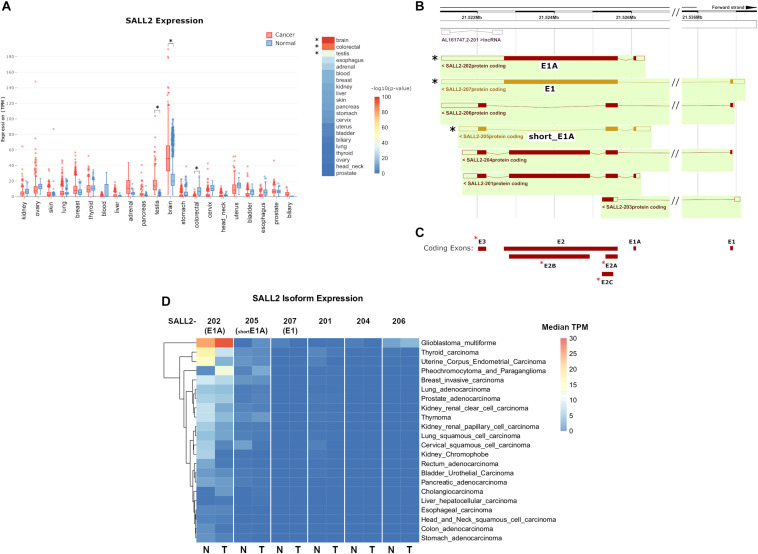
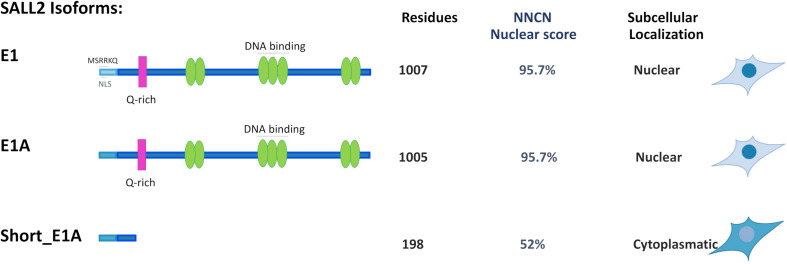
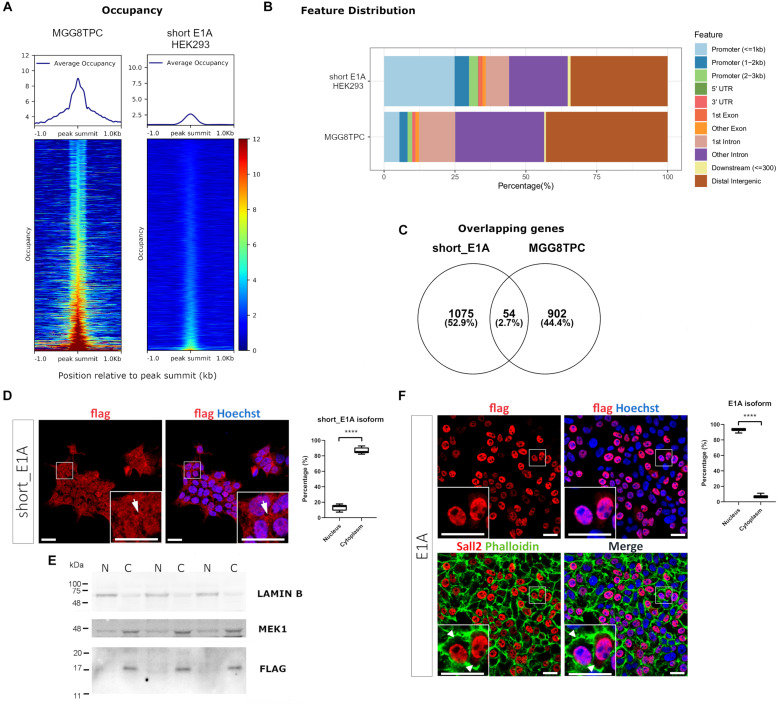
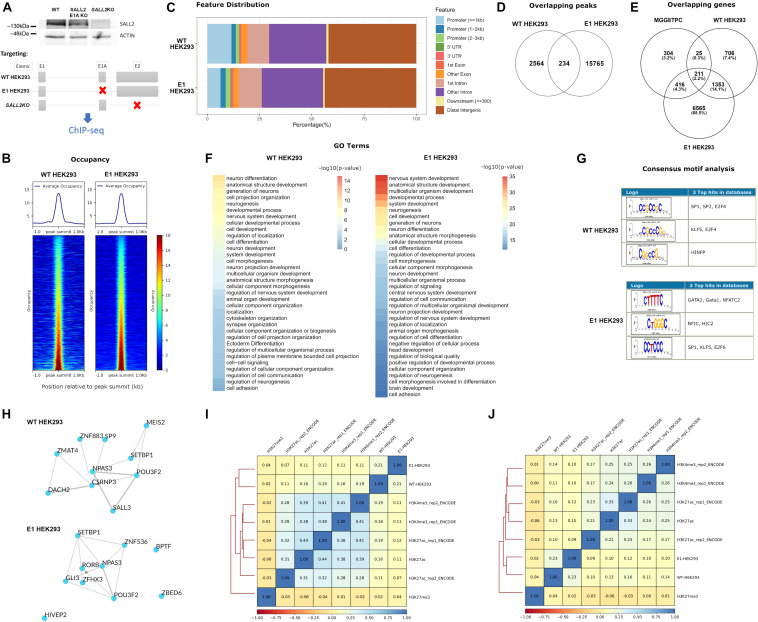
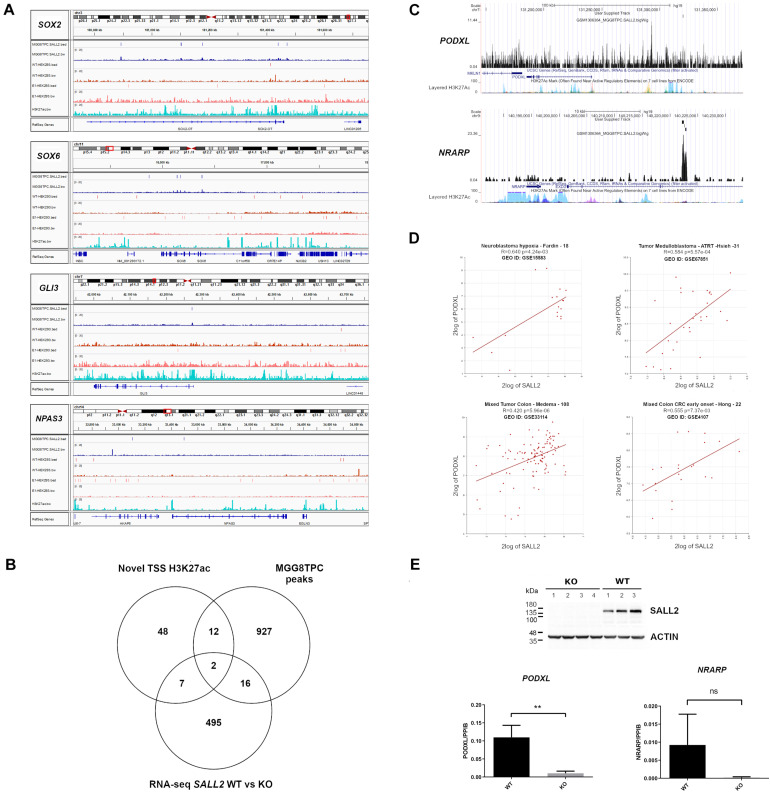
The SALL2 transcription factor, an evolutionarily conserved gene through vertebrates, is involved in normal development and neuronal differentiation. In disease, SALL2 is associated with eye, kidney, and brain disorders, but mainly is related to cancer. Some studies support a tumor suppressor role and others an oncogenic role for SALL2, which seems to depend on the cancer type. An additional consideration is tissue-dependent expression of different SALL2 isoforms. Human and mouse gene loci contain two promoters, each controlling the expression of a different protein isoform (E1 and E1A). Also, several improvements on the human genome assembly and gene annotation through next-generation sequencing technologies reveal correction and annotation of additional isoforms, obscuring dissection of SALL2 isoform-specific transcriptional targets and functions. We here integrated current data of normal/tumor gene expression databases along with ChIP-seq binding profiles to analyze SALL2 isoforms expression distribution and infer isoform-specific SALL2 targets. We found that the canonical SALL2 E1 isoform is one of the lowest expressed, while the E1A isoform is highly predominant across cell types. To dissect SALL2 isoform-specific targets, we analyzed publicly available ChIP-seq data from Glioblastoma tumor-propagating cells and in-house ChIP-seq datasets performed in SALL2 wild-type and E1A isoform knockout HEK293 cells. Another available ChIP-seq data in HEK293 cells (ENCODE Consortium Phase III) overexpressing a non-canonical SALL2 isoform (short_E1A) was also analyzed. Regardless of cell type, our analysis indicates that the SALL2 long E1 and E1A isoforms, but not short_E1A, are mostly contributing to transcriptional control, and reveals a highly conserved network of brain-specific transcription factors (i.e., SALL3, POU3F2, and NPAS3). Our data integration identified a conserved molecular network in which SALL2 regulates genes associated with neural function, cell differentiation, development, and cell adhesion between others. Also, we identified as a gene that is likely regulated by SALL2 across tissues. Our study encourages the validation of publicly available ChIP-seq datasets to assess a specific gene/isoform's transcriptional targets. The knowledge of SALL2 isoforms expression and function in different tissue contexts is relevant to understanding its role in disease.
SALL2转录因子是一种在脊椎动物中进化保守的基因,参与正常发育和神经元分化。在疾病方面,SALL2与眼睛、肾脏和脑部疾病有关,但主要与癌症相关。一些研究支持SALL2具有肿瘤抑制作用,而另一些研究则支持其致癌作用,这似乎取决于癌症类型。另一个需要考虑的因素是不同SALL2异构体的组织依赖性表达。人类和小鼠基因位点包含两个启动子,每个启动子控制一种不同蛋白质异构体(E1和E1A)的表达。此外,通过下一代测序技术对人类基因组组装和基因注释的一些改进揭示了其他异构体的校正和注释,这使得剖析SALL2异构体特异性转录靶点和功能变得模糊不清。我们在此整合了正常/肿瘤基因表达数据库的当前数据以及ChIP-seq结合图谱,以分析SALL2异构体的表达分布并推断异构体特异性的SALL2靶点。我们发现,典型的SALL2 E1异构体是表达量最低的异构体之一,而E1A异构体在各种细胞类型中高度占主导地位。为了剖析SALL2异构体特异性靶点,我们分析了来自胶质母细胞瘤肿瘤增殖细胞的公开可用ChIP-seq数据以及在SALL2野生型和E1A异构体敲除的HEK293细胞中进行的内部ChIP-seq数据集。还分析了在过表达非典型SALL2异构体(short_E1A)的HEK293细胞(ENCODE联盟第三阶段)中的另一个可用ChIP-seq数据。无论细胞类型如何,我们的分析表明,SALL2的长E1和E1A异构体而非short_E1A主要参与转录调控,并揭示了一个高度保守的脑特异性转录因子网络(即SALL3、POU3F2和NPAS3)。我们的数据整合确定了一个保守的分子网络,其中SALL2调节与神经功能、细胞分化、发育以及细胞黏附等相关的基因。此外,我们确定了一个可能在各个组织中受SALL2调控的基因。我们的研究鼓励对公开可用的ChIP-seq数据集进行验证,以评估特定基因/异构体的转录靶点。了解SALL2异构体在不同组织背景下的表达和功能与理解其在疾病中的作用相关。