Lin Ting-Yu, Huang Yu-Chen, Kuo Chih-Hsi, Chung Fu-Tsai, Lin Yu-Ting, Wang Tsai-Yu, Lin Shu-Min, Lo Yu-Lun
Dept of Thoracic Medicine, Chang Gung Memorial Hospital, Chang Gung University, College of Medicine, Taipei, Taiwan.
Dept of Anesthesiology, Taipei-Veterans General Hospital, Taipei, Taiwan.
ERJ Open Res. 2020 Nov 10;6(4). doi: 10.1183/23120541.00064-2020. eCollection 2020 Oct.
Appropriate sedation is important to the success of endobronchial ultrasound-guided transbronchial needle aspiration (EBUS-TBNA). Dexmedetomidine is a sedative agent that operates the α2 adrenergic agonist, which provides sleep-like sedation with little respiratory suppression. This study compared the efficacy and safety of dexmedetomidine sedation with propofol in cases of EBUS-TBNA.
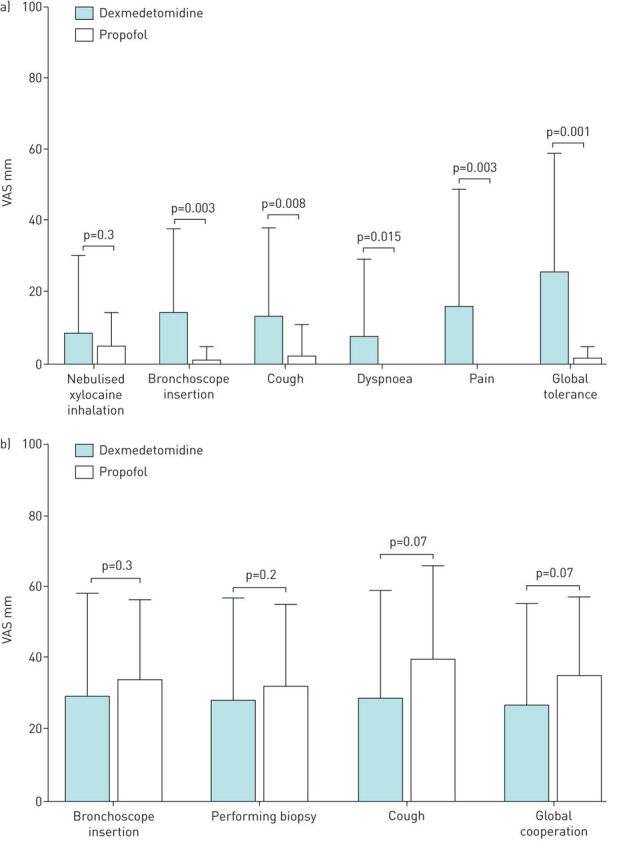
Patients requiring EBUS-TBNA were randomly assigned dexmedetomidine sedation (D, n=25) or propofol sedation (P, n=25). Vital signs, diagnostic yield and the bispectral index (BIS) were recorded throughout the bronchoscopic procedure and recovery period. The tolerance and cooperation of the patients were evaluated using questionnaires.
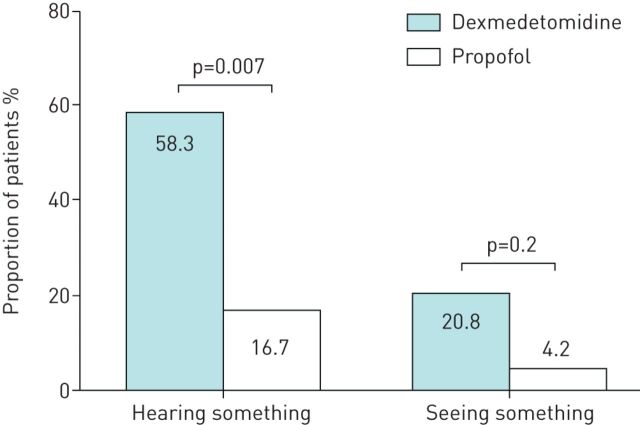
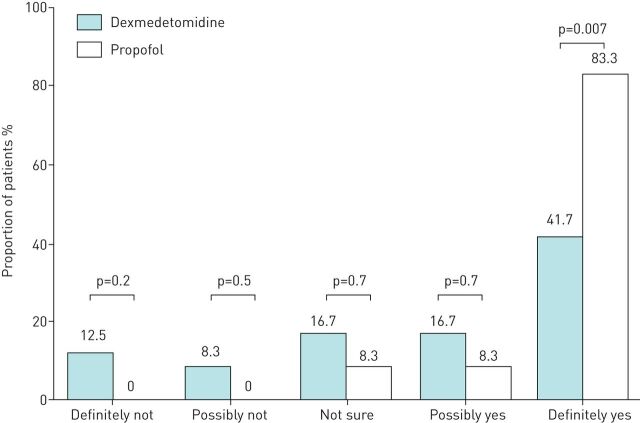
The lowest mean arterial blood pressure in group D (79.2±9.9 72.5±12.9 mmHg, p=0.049) exceeded that in group P, the lowest heart rate was lower (60.9±10.2 71.4±11.8 beats·min, p=0.006) and the mean BIS during sedation was significantly higher (84.1±8.3 73.6±5.7, p<0.001). Patients in group D were more likely to report perceiving procedure-related symptoms and express an unwillingness to undergo the bronchoscopy again, if indicated (41.1 83.3%, p=0.007). One subject in group D aborted EBUS-TBNA due to intolerance. Many of the variables in the two groups were similar, including the proportion of hypoxaemic events, recovery times, patient cooperation and diagnostic yield.
The effects of dexmedetomidine on haemodynamics were in line with its pharmacodynamic features. Patients who received dexmedetomidine were more likely than those who received propofol to perceive the procedures. Overall, dexmedetomidine did not prove inferior to propofol sedation in terms of patient cooperation or diagnostic yield.
合适的镇静对于支气管内超声引导下经支气管针吸活检术(EBUS-TBNA)的成功至关重要。右美托咪定是一种作用于α2肾上腺素能激动剂的镇静药物,能提供类似睡眠的镇静效果且呼吸抑制作用小。本研究比较了右美托咪定与丙泊酚在EBUS-TBNA病例中的镇静效果及安全性。
需要进行EBUS-TBNA的患者被随机分为右美托咪定镇静组(D组,n = 25)和丙泊酚镇静组(P组,n = 25)。在整个支气管镜检查过程及恢复期记录生命体征、诊断阳性率和脑电双频指数(BIS)。通过问卷调查评估患者的耐受性及配合度。
D组最低平均动脉血压(79.2±9.9 72.5±12.9 mmHg,p = 0.049)高于P组,最低心率更低(60.9±10.2 71.4±11.8 次/分钟,p = 0.006),镇静期间平均BIS显著更高(84.1±8.3 73.6±5.7,p < 0.001)。D组患者更有可能报告感觉到与操作相关的症状,并表示如果有必要不愿意再次接受支气管镜检查(41.1 83.3%,p = 0.007)。D组有1名受试者因不耐受而中止了EBUS-TBNA。两组的许多变量相似,包括低氧事件发生率、恢复时间、患者配合度及诊断阳性率。
右美托咪定对血流动力学的影响与其药效学特征相符。接受右美托咪定的患者比接受丙泊酚的患者更有可能感觉到操作过程。总体而言,在患者配合度或诊断阳性率方面,右美托咪定并不逊于丙泊酚镇静。