Horie Kazunori, Kuramitsu Shoichi, Matsuo Hitoshi, Shinozaki Tomohiro, Takashima Hiroaki, Shiono Yasutsugu, Terai Hidenobu, Kikuta Yuetsu, Ishihara Takayuki, Saigusa Tatsuya, Sakamoto Tomohiro, Asano Taku, Tsujita Kenichi, Masamura Katsuhiko, Doijiri Tatsuki, Ogita Manabu, Kurita Tairo, Matsuo Akiko, Sonoda Shinjo, Yokoi Hiroyoshi, Tanaka Nobuhiro
Department of Cardiovascular Medicine, Sendai Kousei Hospital Sendai Japan.
Department of Cardiology, Kokura Memorial Hospital Kitakyushu Japan.
Circ Rep. 2020 Nov 18;2(12):744-752. doi: 10.1253/circrep.CR-20-0110.
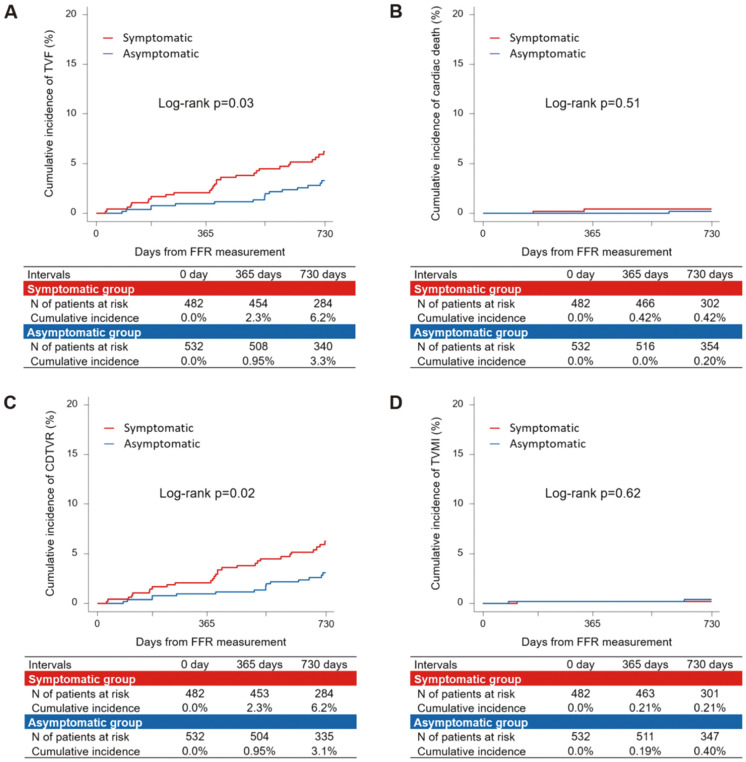
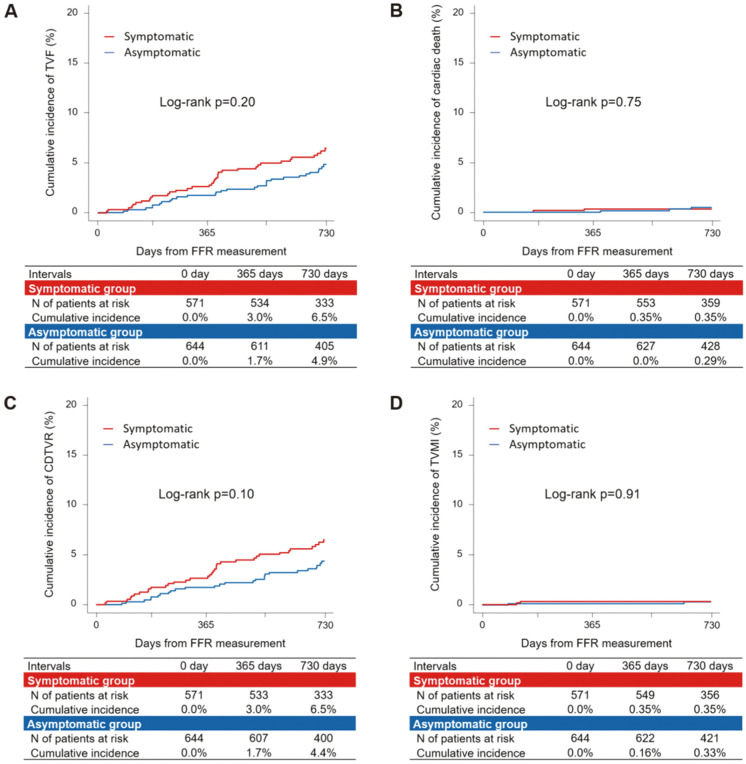
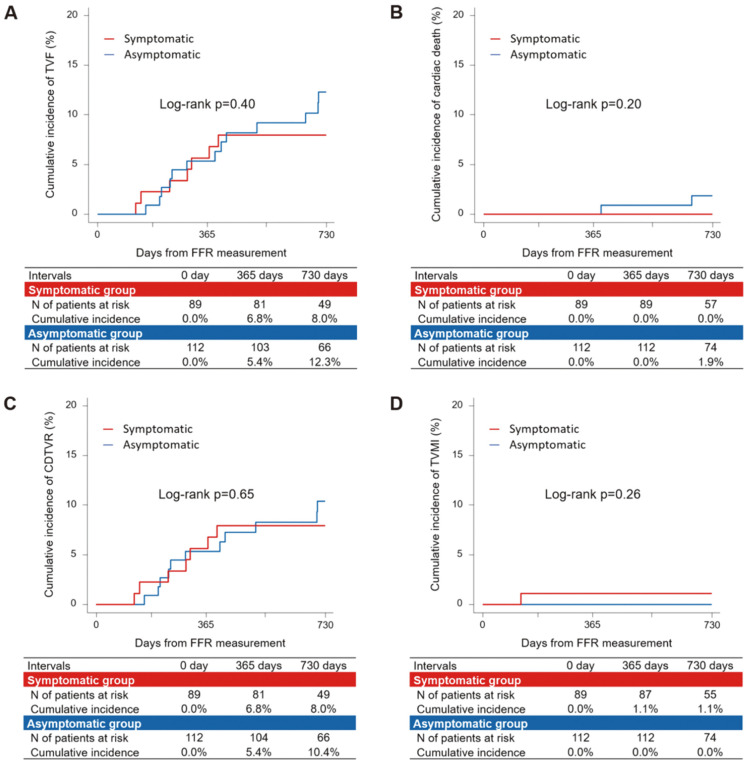
The effect of symptoms on clinical outcomes after deferral of revascularization based on fractional flow reserve (FFR) remains poorly understood. From the J-CONFIRM (Long-Term Outcomes of Japanese Patients With Deferral of Coronary Intervention Based on Fractional Flow Reserve in Multicenter) Registry, this study evaluated 1,215 patients with stable coronary artery disease, including symptomatic and asymptomatic patients (n=571 and 644, respectively). The primary endpoint was the cumulative 2-year incidence of target vessel failure (TVF), including cardiac death, target vessel-related myocardial infarction (TVMI), and clinically driven target vessel revascularization (CDTVR). An inverse probability weighted analysis was performed to adjust for the differences in baseline clinical characteristics between the 2 groups. At 2 years, the TVF rate did not differ significantly between symptomatic and asymptomatic patients (6.5% vs. 4.9%, respectively; P=0.15) or between symptomatic and asymptomatic patients with lesions with an FFR ≤0.80 (8.0% vs. 12.3%, respectively; P=0.20). Conversely, symptomatic patients showed significantly higher rates of TVF (6.2% vs. 3.3%; P=0.01) and CDTVR (6.2% vs. 3.1%; P=0.009) than asymptomatic patients, regardless of negative FFR values (>0.80). Despite negative FFR values, symptomatic patients were at higher risk of TVF than asymptomatic patients, driven primarily by a higher rate of CDTVR. Conversely, those with a positive FFR were likely to develop TVF regardless of their symptoms.
基于血流储备分数(FFR)延迟血运重建后症状对临床结局的影响仍知之甚少。本研究从J-CONFIRM(基于多中心血流储备分数延迟冠状动脉介入治疗的日本患者的长期结局)注册研究中评估了1215例稳定型冠状动脉疾病患者,包括有症状和无症状患者(分别为n = 571例和644例)。主要终点是靶血管失败(TVF)的累积2年发生率,包括心源性死亡、靶血管相关心肌梗死(TVMI)和临床驱动的靶血管血运重建(CDTVR)。进行了逆概率加权分析以调整两组之间基线临床特征的差异。在2年时,有症状和无症状患者之间的TVF率无显著差异(分别为6.5%和4.9%;P = 0.15),FFR≤0.80的有症状和无症状病变患者之间也无显著差异(分别为8.0%和12.3%;P = 0.20)。相反,无论FFR值是否为阴性(>0.80),有症状患者的TVF率(6.2%对3.3%;P = 0.01)和CDTVR率(6.2%对3.1%;P = 0.009)均显著高于无症状患者。尽管FFR值为阴性,但有症状患者发生TVF的风险高于无症状患者,主要是由于CDTVR率较高。相反,FFR为阳性的患者无论有无症状都可能发生TVF。