Masonic Cancer Center, University of Minnesota, Minneapolis, MN 55455, USA.
Department of Medicinal Chemistry, University of Minnesota, Minneapolis, MN 55455, USA.
Carcinogenesis. 2021 May 28;42(5):694-704. doi: 10.1093/carcin/bgab020.
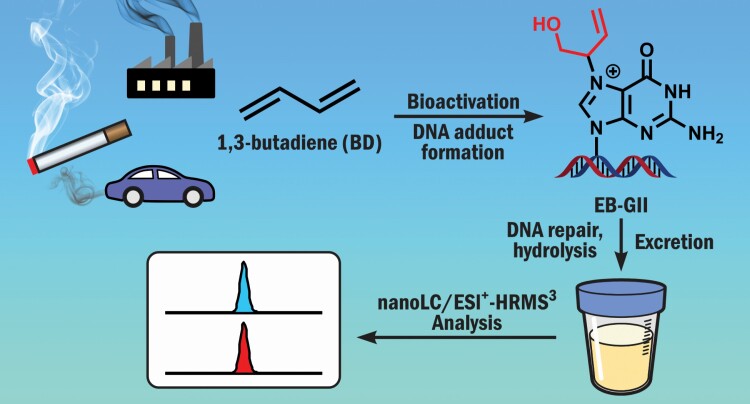
1,3-Butadiene (BD) is a known human carcinogen used in the synthetic polymer industry and also found in cigarette smoke, automobile exhaust and wood burning smoke. BD is metabolically activated by cytochrome P450 monooxygenases (CYP) 2E1 and 2A6 to 3,4-epoxy-1-butene (EB), which can be detoxified by GST-catalyzed glutathione conjugation or hydrolysis. We have previously observed ethnic differences in urinary levels of EB-mercapturic acids in white, Japanese American and Native Hawaiian smokers. In the present study, similar analyses were extended to urinary BD-DNA adducts. BD-induced N7-(1-hydroxy-3-buten-2-yl) guanine (EB-GII) adducts were quantified in urine samples obtained from smokers and non-smokers belonging to three racial/ethnic groups: white, Japanese American and Native Hawaiian. After adjusting for sex, age, nicotine equivalents, body mass index and batch, we found that Japanese American smokers excreted significantly higher amounts of urinary EB-GII than whites [1.45 (95% confidence interval: 1.12-1.87) versus 0.68 (95% confidence interval: 0.52-0.85) fmol/ml urine, P = 4 × 10⁻⁵]. Levels of urinary EB-GII in Native Hawaiian smokers were not different from those in whites [0.67 (95% confidence interval: 0.51-0.84) fmol/ml urine, P = 0.938]. There were no racial/ethnic differences in urinary EB-GII adduct levels in non-smokers. Racial/ethnic differences in urinary EB-GII adduct levels in smokers could not be explained by GSTT1 gene deletion or CYP2A6 enzymatic activity. Urinary EB-GII adduct levels in smokers were significantly associated with concentrations of BD metabolite dihyroxybutyl mercapturic acid. Overall, our results reveal that urinary EB-GII adducts in smokers differ across racial/ethnic groups. Future studies are required to understand genetic and epigenetic factors that may be responsible for these differences.
1,3-丁二烯(BD)是一种已知的人类致癌物质,用于合成聚合物工业,也存在于香烟烟雾、汽车尾气和燃烧木材的烟雾中。BD 通过细胞色素 P450 单加氧酶(CYP)2E1 和 2A6 代谢激活为 3,4-环氧-1-丁烯(EB),可以通过 GST 催化的谷胱甘肽结合或水解解毒。我们之前观察到白种人、日裔美国人和夏威夷原住民吸烟者尿液中 EB-巯基尿酸的代谢物水平存在种族差异。在本研究中,我们将类似的分析扩展到尿液 BD-DNA 加合物。在属于三个种族/民族群体的吸烟者和非吸烟者的尿液样本中定量了 BD 诱导的 N7-(1-羟基-3-丁烯-2-基)鸟嘌呤(EB-GII)加合物:白种人、日裔美国人和夏威夷原住民。在调整性别、年龄、尼古丁当量、体重指数和批次后,我们发现日裔美国吸烟者尿液中 EB-GII 的排泄量明显高于白种人[1.45(95%置信区间:1.12-1.87)比 0.68(95%置信区间:0.52-0.85)fmol/ml 尿液,P=4×10⁻⁵]。夏威夷原住民吸烟者尿液中 EB-GII 的水平与白种人无差异[0.67(95%置信区间:0.51-0.84)fmol/ml 尿液,P=0.938]。非吸烟者尿液中 EB-GII 加合物水平无种族/民族差异。吸烟者尿液中 EB-GII 加合物水平的种族/民族差异不能用 GSTT1 基因缺失或 CYP2A6 酶活性来解释。吸烟者尿液中 EB-GII 加合物水平与 BD 代谢物二羟丁基巯基尿酸的浓度显著相关。总的来说,我们的结果表明,吸烟者尿液中的 EB-GII 加合物在不同种族/民族群体之间存在差异。需要进一步的研究来了解可能导致这些差异的遗传和表观遗传因素。