Department of Ophthalmology, Semmelweis University, Budapest, Hungary.
2nd Department of Pathology, Semmelweis University, Budapest, Hungary.
Int Ophthalmol. 2021 May;41(5):1827-1834. doi: 10.1007/s10792-021-01743-y. Epub 2021 Mar 10.
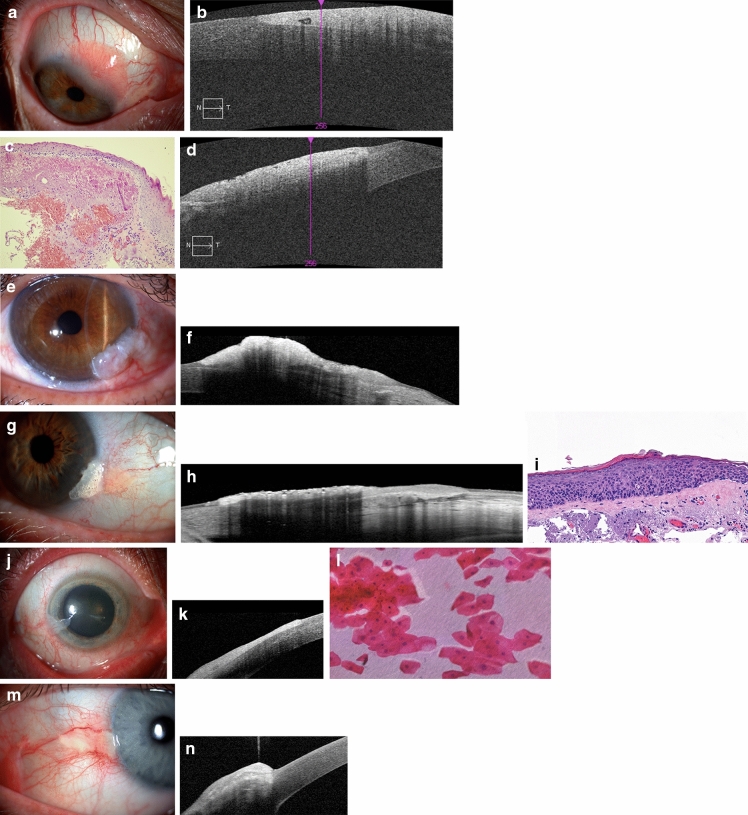
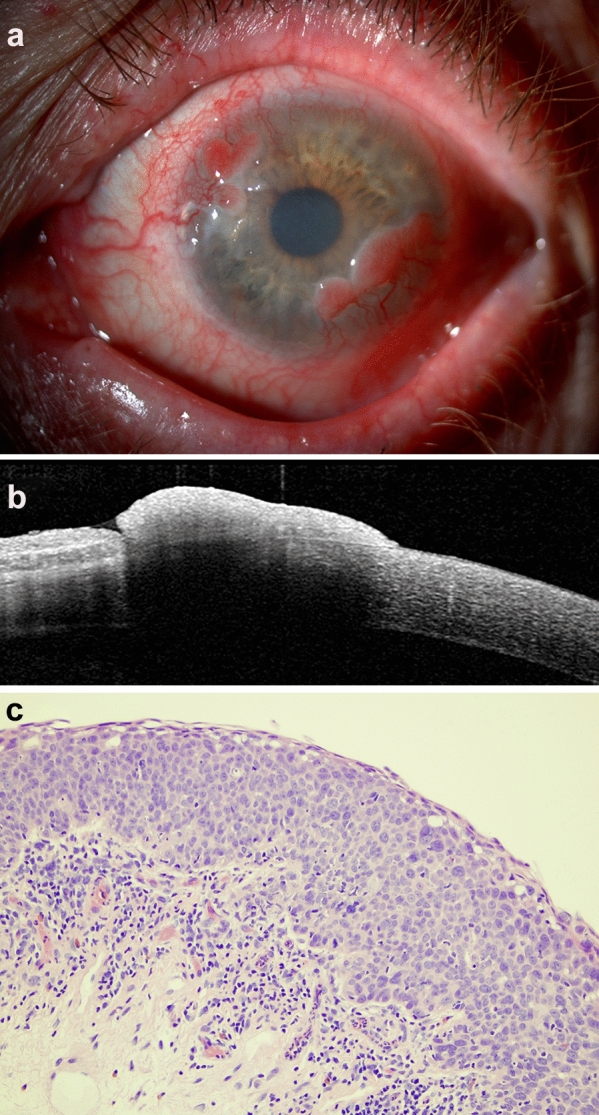
To observe and describe the anterior segment optical coherence tomography features of limbally localised non-malignant epithelial mass lesions METHODS: Thirteen patients (age: 66.9 ± 16.3 years) with conjunctival mass suggesting ocular surface squamous neoplasia with biomicroscopic examination were imaged using anterior segment ocular coherence tomography (anterior segment optical coherence tomography)/Cirrus HD-OCT, Model 4000, Carl Zeiss Meditec, Inc., Dublin, CA, and Spectralis HRA + OCT system, Heidelberg Engineering, Vista, CA/. Cases with ocular surface squamous neoplasia-like anterior segment optical coherence tomography (hyperreflective, thickened epithelium and an abrupt transition from normal to abnormal) were included in the study. Maximal thickness of the epithelium was measured. Histological diagnosis was gained from an excisional or incisional biopsy or impression cytology specimens.
In six patients (age: 68.5 ± 15.4 years) with ocular surface squamous neoplasia-like anterior segment optical coherence tomography features, the histological diagnosis was other than ocular surface squamous neoplasia (papilloma, parakeratosis and a keratotic plaque with mild dysplasia), and ocular surface squamous neoplasia in seven cases (age: 65.6 ± 18.0 years). The maximal epithelial thickness was between 250 and 859 µm in non-ocular surface squamous neoplasia cases and between 252 and 596 µm in ocular surface squamous neoplasia cases.
Non-malignant epithelial lesions can mimic ocular surface squamous neoplasia on anterior segment optical coherence tomography.
观察和描述局限性眼表上皮肿块病变的眼前节光学相干断层扫描特征。
对 13 名(年龄:66.9 ± 16.3 岁)因结膜肿块而怀疑为眼表鳞状上皮肿瘤的患者进行眼前节光学相干断层扫描(前节光学相干断层扫描)/Cirrus HD-OCT、Model 4000、Carl Zeiss Meditec,Inc.,Dublin,CA 和 Spectralis HRA + OCT 系统,Heidelberg Engineering,Vista,CA/成像。本研究纳入了具有眼表鳞状上皮肿瘤样眼前节光学相干断层扫描(高反射性、增厚的上皮和从正常到异常的突然转变)特征的病例。测量上皮的最大厚度。组织学诊断来自切除或切开活检或印模细胞学标本。
在 6 名(年龄:68.5 ± 15.4 岁)具有眼表鳞状上皮肿瘤样眼前节光学相干断层扫描特征的患者中,组织学诊断为非眼表鳞状上皮肿瘤(乳头状瘤、角化不全和角化斑块伴轻度发育不良),而在 7 名患者(年龄:65.6 ± 18.0 岁)中诊断为眼表鳞状上皮肿瘤。非眼表鳞状上皮肿瘤病例的上皮最大厚度在 250 至 859 µm 之间,眼表鳞状上皮肿瘤病例的上皮最大厚度在 252 至 596 µm 之间。
非恶性上皮病变在眼前节光学相干断层扫描上可模拟眼表鳞状上皮肿瘤。