Department of Internal Medicine, Faculty of Medicine, Centro Hospitalar Universitário São João, Porto, Portugal.
Department of Internal Medicine, Centro Hospitalar Tâmega e Sousa-Hospital Padre Américo, Penafiel, Portugal.
Clin Transl Gastroenterol. 2021 Mar 10;12(3):e00320. doi: 10.14309/ctg.0000000000000320.
Dipeptidyl peptidase-4 (DPP-4) is a membrane-bound glycoprotein that acts as a receptor but also exists in a soluble form. It has been recognized as a mediator of inflammation and considered a biomarker in inflammatory bowel disease (IBD).
We evaluated a prospectively recruited cohort, consisting of 101 patients with IBD, using validated clinical indexes; 22 patients with ulcerative colitis (UC) underwent endoscopic evaluation. Fecal DPP-4 (fDPP-4) levels were analyzed and correlated with clinical scores, Mayo endoscopic score (in UC patients), serum DPP-4, C-reactive protein, and fecal calprotectin. Immunohistochemical staining for DPP-4 in intestinal biopsies was also performed.
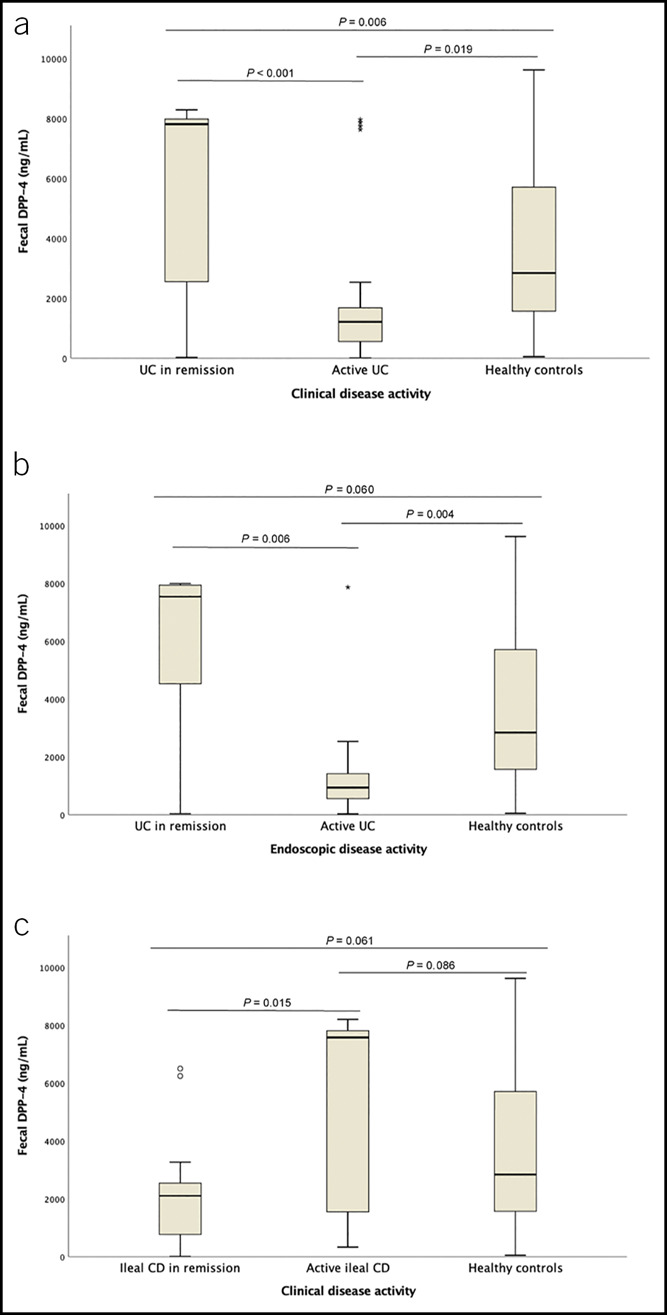
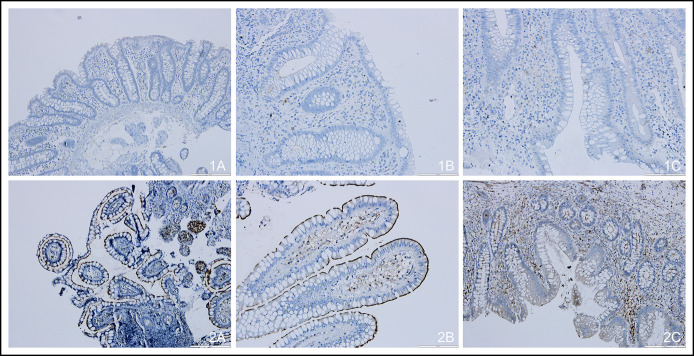
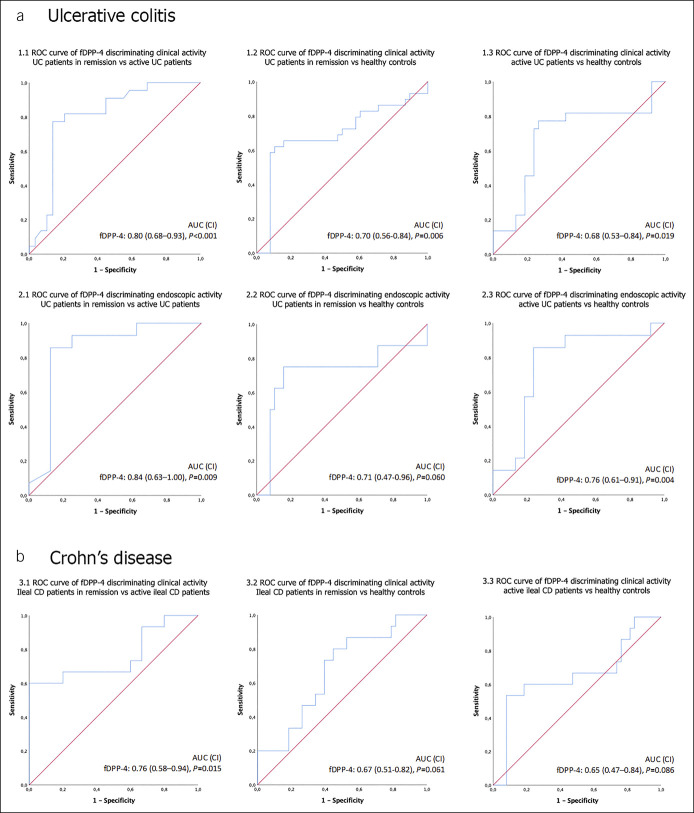
When compared with remitters, median fDPP-4 levels were higher in patients with ileal Crohn's disease (CD) (7,584 [1,464-7,816] vs 2,104 [630-2,676] ng/mL, P = 0.015) and lower in patients with UC exhibiting clinical activity (1,213 [559-1,682] vs 7,814 [2,555-7,985] ng/mL, P < 0.001). Patients with UC presenting endoscopic activity also had lower levels than remitters (939 [559-1,420] vs 7,544 [4,531-7,940] ng/mL, P = 0.006). Fecal DPP-4 discriminated clinical activity from remission with areas under the curve of 0.76 (95% confidence interval [CI] 0.58-0.94, P = 0.015) and 0.80 (95% CI 0.68-0.93, P < 0.001) in CD and UC, respectively; it allowed to differentiate endoscopic activity in patients with UC, with areas under the curve of 0.84 (95% CI 0.63-1.00, P = 0.009). Immunohistochemical analysis revealed higher DPP-4 apical expression in UC remitters, but no statistically significant differences were revealed between patients with ileal CD.
Our results suggest that fDPP-4 can be used as a biomarker of IBD activity, particularly in UC. The expression profiles in intestinal tissue might represent a functional compartmentalization of DPP-4 expression.
二肽基肽酶-4(DPP-4)是一种膜结合糖蛋白,既可以作为受体发挥作用,也可以以可溶性形式存在。它已被认为是炎症的介质,并被视为炎症性肠病(IBD)的生物标志物。
我们评估了一个前瞻性招募的队列,该队列由 101 名 IBD 患者组成,使用了经过验证的临床指标;22 名溃疡性结肠炎(UC)患者接受了内镜评估。分析粪便 DPP-4(fDPP-4)水平,并与临床评分、Mayo 内镜评分(UC 患者)、血清 DPP-4、C 反应蛋白和粪便钙卫蛋白进行相关分析。还对肠活检组织中的 DPP-4 进行了免疫组织化学染色。
与缓解者相比,回肠克罗恩病(CD)患者的中位 fDPP-4 水平更高(7,584 [1,464-7,816] 与 2,104 [630-2,676] ng/mL,P = 0.015),而 UC 患者的水平更低,表现出临床活动(1,213 [559-1,682] 与 7,814 [2,555-7,985] ng/mL,P < 0.001)。内镜活动的 UC 患者也低于缓解者(939 [559-1,420] 与 7,544 [4,531-7,940] ng/mL,P = 0.006)。粪便 DPP-4 在 CD 和 UC 中,曲线下面积分别为 0.76(95%置信区间[CI] 0.58-0.94,P = 0.015)和 0.80(95% CI 0.68-0.93,P < 0.001),可用于区分临床缓解与缓解者的活动;在 UC 患者中,可区分内镜活动,曲线下面积为 0.84(95% CI 0.63-1.00,P = 0.009)。免疫组织化学分析显示 UC 缓解者的 DPP-4 顶端表达更高,但回肠 CD 患者之间无统计学差异。
我们的结果表明,fDPP-4 可作为 IBD 活动的生物标志物,特别是在 UC 中。肠道组织中的表达谱可能代表 DPP-4 表达的功能分区。