Division of General Internal Medicine, Johns Hopkins School of Medicine.
Departments of Health Policy and Management.
Med Care. 2021 Apr 1;59(4):327-333. doi: 10.1097/MLR.0000000000001499.
Persons with serious mental illness (SMI) die 10-20 years earlier than the general population; cancer is the second leading cause of death. Differences in cancer screening between SMI and the general population are not well understood.
To describe receipt of cancer screening among individuals with versus without SMI and to explore clinicians' perceptions around cancer screening for people with SMI.
Mixed-methods study using 2010-2017 MarketScan commercial insurance administrative claims data and semi-structured clinician interviews. In the quantitative analyses, we used multivariate logistic regression analyses to calculate the likelihood of receiving cervical, breast, colorectal, or prostate cancer screening among people with versus without SMI, defined as schizophrenia or bipolar disorder. We conducted semi-structured interviews with 17 primary care physicians and 15 psychiatrists. Interview transcripts were coded using a hybrid deductive/inductive approach.
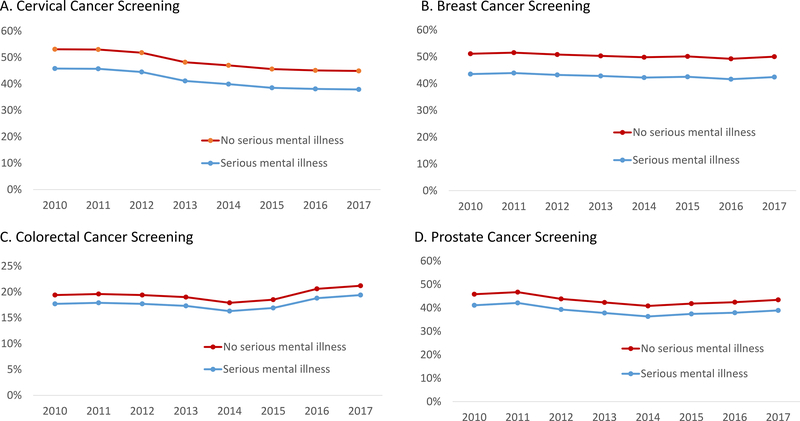
Relative to those without SMI, individuals with SMI were less likely to receive screening for cervical cancer [adjusted odds ratio (aOR): 0.80; 95% confidence interval (CI): 0.80-0.81], breast cancer (aOR: 0.79; 95% CI: 0.78-0.80), colorectal cancer (aOR: 0.90; 95% CI: 0.89-0.91), and prostate cancer (aOR: 0.85; 95% CI: 0.84-0.87). Clinicians identified 5 themes that may help explain the lower rates of cancer screening in persons with SMI: access to care, available support, prioritization of other issues, communication, and patient concerns.
People with SMI were less likely to receive 4 common types of cancer screening. Improving cancer screening rates in the SMI population will likely require a multidisciplinary approach to overcome barriers to screening.
严重精神疾病患者(SMI)比一般人群早死 10-20 年;癌症是第二大致死原因。SMI 人群与一般人群之间的癌症筛查差异尚不清楚。
描述 SMI 患者与非 SMI 患者接受癌症筛查的情况,并探讨临床医生对 SMI 患者癌症筛查的看法。
采用 2010-2017 年 MarketScan 商业保险行政索赔数据和半结构化临床医生访谈的混合方法研究。在定量分析中,我们使用多变量逻辑回归分析来计算 SMI 患者与非 SMI 患者接受宫颈癌、乳腺癌、结直肠癌或前列腺癌筛查的可能性,SMI 定义为精神分裂症或双相情感障碍。我们对 17 名初级保健医生和 15 名精神科医生进行了半结构化访谈。使用混合演绎/归纳方法对访谈记录进行编码。
与非 SMI 患者相比,SMI 患者接受宫颈癌(校正优势比[aOR]:0.80;95%置信区间[CI]:0.80-0.81)、乳腺癌(aOR:0.79;95% CI:0.78-0.80)、结直肠癌(aOR:0.90;95% CI:0.89-0.91)和前列腺癌(aOR:0.85;95% CI:0.84-0.87)筛查的可能性较小。临床医生确定了 5 个主题,这些主题可能有助于解释 SMI 患者癌症筛查率较低的原因:获得医疗服务、可获得的支持、其他问题的优先顺序、沟通和患者担忧。
SMI 患者接受 4 种常见类型癌症筛查的可能性较低。提高 SMI 人群的癌症筛查率可能需要采取多学科方法来克服筛查障碍。