Department of Medicine, University of Ottawa, Ottawa, ON K1H 8L6, Canada.
The Ottawa Hospital Research Institute, Ottawa, ON K1Y 4E9, Canada.
Curr Oncol. 2020 Dec 4;28(1):60-68. doi: 10.3390/curroncol28010008.
Non-small cell lung cancer (NSCLC) commonly presents at advanced stage. We previously reported systemic treatment uptake in stage IV NSCLC climbing from 55% (2009-2012) to 62% (2015-2017). Since then, first-line immunotherapy and 2nd/3rd generation tyrosine kinase inhibitors (TKIs) have emerged as standards of care. We explored whether treatment rates continued to rise and studied outcomes.
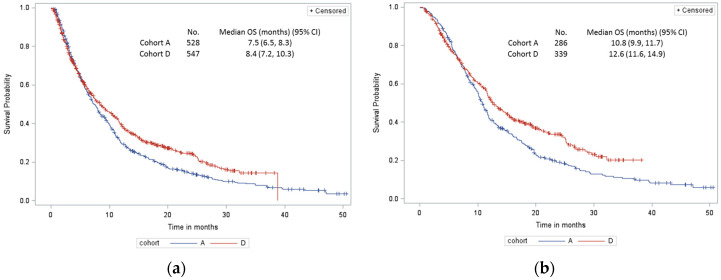
We reviewed all cases of de novo stage IIIB/IIIC/IV NSCLC seen in out-patient medical oncology consultation at our institution between 2009-2012 (cohort A), 2015-2017 (cohort B), and June-December 2018 (cohort C). We compared rates of systemic treatment, molecular testing, targeted therapy, and immune checkpoint inhibitor (ICI) use. We compared survival in the overall, treated/untreated, younger and elderly population in cohort A vs. cohort B + C (=cohort D).
Cohorts A, B, and C included 528, 463, and 93 patients, respectively. Overall, 66% received any systemic therapy in cohort C, compared to 62% in cohort B and 55% in cohort A. Across three time periods, first-line chemotherapy rates fell (93, 76, 46%) while rates of first-line targeted therapy (5, 16, 15%) and ICI (0, 2, 36%) rose. Among molecular subtypes, first-line targeted treatment in EGFR-positive patients (63, 94, 100%) and anaplastic lymphoma kinase (ALK)-positive patients (0, 91, 100%) rose. Survival improved in all subgroups in cohort D vs. cohort A, except for patients ≥ 70 years and the untreated population.
Systemic treatment rose across three time periods, reflecting the introduction of rapid diagnostic pathways, reflex molecular testing, ICI, and targeted therapies. Survival outcomes of advanced NSCLC patients have significantly improved.
非小细胞肺癌(NSCLC)通常在晚期出现。我们之前曾报道过,IV 期 NSCLC 的全身治疗使用率从 55%(2009-2012 年)上升至 62%(2015-2017 年)。此后,一线免疫疗法和 2/3 代酪氨酸激酶抑制剂(TKI)已成为标准治疗方法。我们探讨了治疗率是否继续上升,并研究了相关结果。
我们回顾了我院门诊肿瘤内科就诊的初诊 IIIB/IIIC/IV 期 NSCLC 患者,这些患者分别来自 2009-2012 年(队列 A)、2015-2017 年(队列 B)和 2018 年 6-12 月(队列 C)。我们比较了全身治疗、分子检测、靶向治疗和免疫检查点抑制剂(ICI)的使用情况。我们比较了队列 A 与队列 B+C(即队列 D)中治疗和未治疗、年龄较小和较大的患者的总生存期。
队列 A、B 和 C 分别包括 528、463 和 93 例患者。总的来说,队列 C 中有 66%的患者接受了任何全身治疗,而队列 B 和队列 A 中的这一比例分别为 62%和 55%。在三个时期内,一线化疗的比例下降(93%、76%、46%),而一线靶向治疗(5%、16%、15%)和 ICI(0%、2%、36%)的比例上升。在分子亚型中,EGFR 阳性患者(63%、94%、100%)和间变性淋巴瘤激酶(ALK)阳性患者(0%、91%、100%)的一线靶向治疗比例上升。除了≥70 岁的患者和未治疗的患者外,队列 D 中所有亚组的生存均优于队列 A。
在三个时期内,全身治疗率上升,这反映了快速诊断途径、反射性分子检测、ICI 和靶向治疗的引入。晚期 NSCLC 患者的生存结果有了显著改善。