University Cancer Center, University Hospital Frankfurt, Theodor-Stern-Kai 7, 60590, Frankfurt am Main, Germany.
Department of Medicine, Hematology/Oncology, Goethe University, Frankfurt am Main, Germany.
BMC Pulm Med. 2023 Jan 13;23(1):16. doi: 10.1186/s12890-022-02288-1.
Immune checkpoint inhibitors (ICIs) have improved outcomes for patients with advanced non-small cell lung cancer (NSCLC) versus chemotherapy in clinical trials. In Germany, ICIs have been used clinically since 2015 for patients with advanced/metastatic NSCLC without epidermal growth factor receptor (EGFR)/anaplastic lymphoma kinase (ALK) aberrations. As part of I-O Optimise, a multinational research program utilizing real-world data on thoracic malignancies, we describe real-world treatment patterns and survival following reimbursement of ICIs for advanced NSCLC in Germany.
This retrospective cohort study included patients with locally advanced/metastatic NSCLC without known EGFR/ALK aberrations who received a first line of therapy at Frankfurt University Hospital between January 2012 and December 2018, with follow-up to December 2019 or death, whichever occurred first. Using electronic medical records, treatment patterns and survival outcomes were described by histology (squamous cell [SQ]; non-squamous cell [NSQ]/other) and time period (pre- and post-ICI approval).
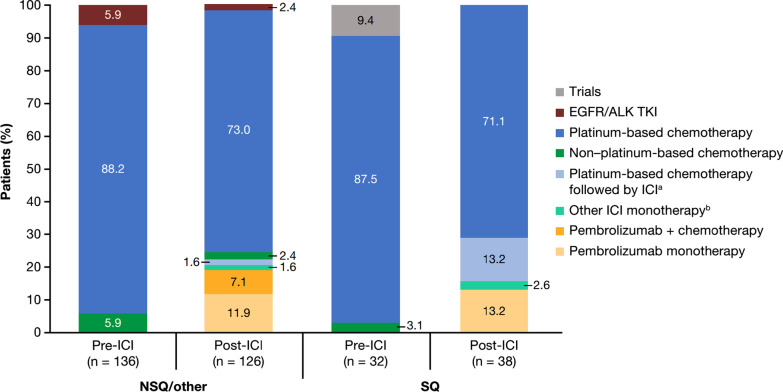
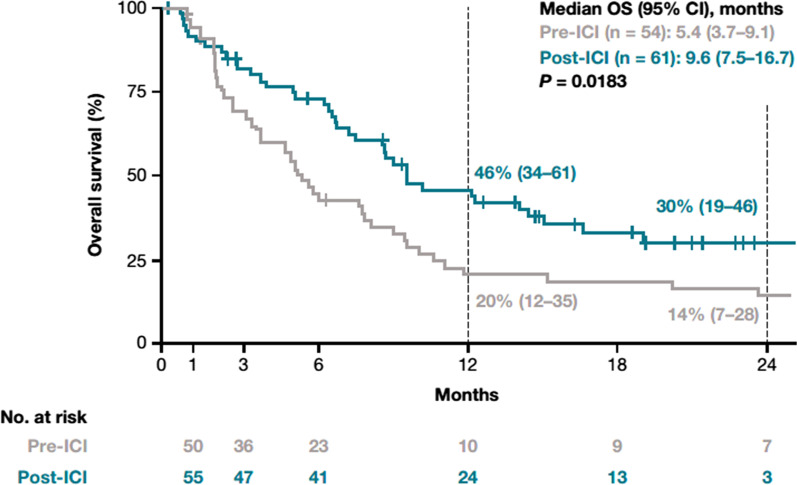
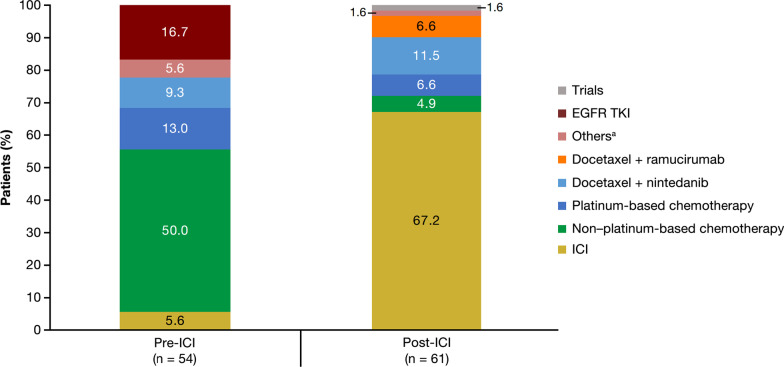
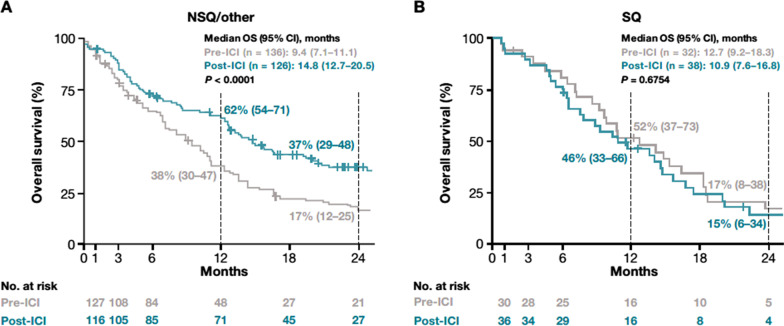
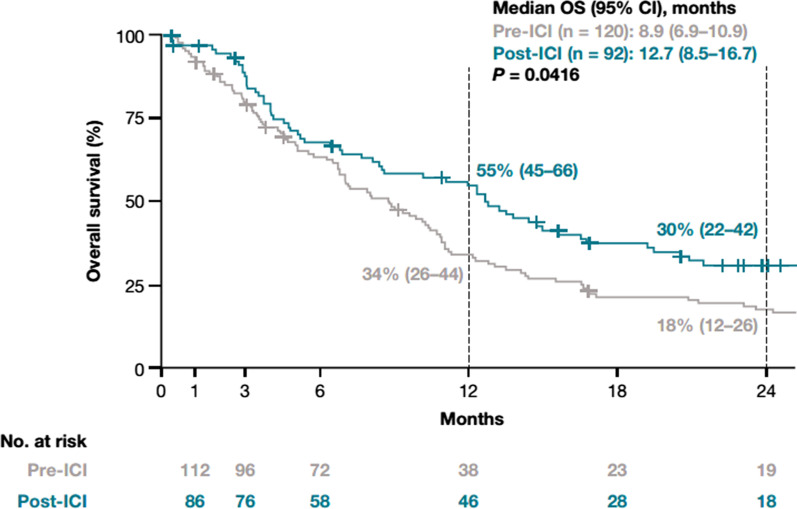
Among eligible patients who started first-line treatment, 136 (pre-ICI) and 126 (post-ICI) had NSQ/other histology, and 32 (pre-ICI) and 38 (post-ICI) had SQ histology. Use of an ICI in the NSQ/other cohort increased from 5.9% (all second- or third-line) in the pre-ICI period to 57.1% (22.2% in first-line, including 13.5% as monotherapy and 8.7% combined with chemotherapy) in the post-ICI period. This was paralleled by a significant (P < 0.0001) prolongation of median (95% CI) OS from 9.4 (7.1-11.1) to 14.8 (12.7-20.5) months between the pre-ICI and post-ICI periods. A similar increase in the uptake of ICI was observed for the SQ cohort (from 3.1% pre-ICI [fourth-line] to 52.6% post-ICI [28.9% as first-line, including 15.8% as monotherapy and 13.2% combined with chemotherapy]); however, analysis of survival outcomes was limited by small group sizes.
These real-world data complement clinical trial evidence on the effectiveness of ICIs in patients with advanced NSCLC and NSQ/other histology in Germany.
免疫检查点抑制剂(ICI)在临床试验中改善了晚期非小细胞肺癌(NSCLC)患者的预后,优于化疗。在德国,自 2015 年以来,对于没有表皮生长因子受体(EGFR)/间变性淋巴瘤激酶(ALK)异常的晚期/转移性 NSCLC 患者,ICI 已在临床上使用。作为利用胸部恶性肿瘤真实世界数据的多国研究计划 I-O Optimise 的一部分,我们描述了德国 ICI 用于晚期 NSCLC 后的真实世界治疗模式和生存情况。
本回顾性队列研究纳入了 2012 年 1 月至 2018 年 12 月期间在法兰克福大学医院接受一线治疗的局部晚期/转移性 NSCLC 且无已知 EGFR/ALK 异常的患者,随访至 2019 年 12 月或死亡,以先发生者为准。使用电子病历描述了治疗模式和生存结局,并按组织学(鳞状细胞[SQ];非鳞状细胞[NSQ]/其他)和时间段(ICI 批准前和批准后)进行了描述。
在开始一线治疗的合格患者中,136 例(ICI 前)和 126 例(ICI 后)为 NSQ/其他组织学,32 例(ICI 前)和 38 例(ICI 后)为 SQ 组织学。NSQ/其他队列中 ICI 的使用从 ICI 前的 5.9%(均为二线或三线)增加到 ICI 后的 57.1%(22.2%为一线,包括 13.5%为单药治疗和 8.7%为联合化疗)。这与 ICI 批准前和批准后期间中位(95%CI)OS 从 9.4(7.1-11.1)至 14.8(12.7-20.5)个月的显著延长(P<0.0001)相对应。SQ 队列中 ICI 使用率也出现了类似的增加(从 ICI 前的 3.1%[四线]增加到 ICI 后的 52.6%[28.9%为一线,包括 15.8%为单药治疗和 13.2%联合化疗]);然而,由于小组规模较小,对生存结果的分析受到限制。
这些真实世界数据补充了临床试验中 ICI 在德国晚期 NSCLC 和 NSQ/其他组织学患者中的有效性证据。