Unit of Geriatric Medicine, Department of Community Medicine and Rehabilitation, Umeå University, Umeå, Sweden.
Department of Public Health and Clinical Medicine, Section of Sustainable Health, Umeå University, Umeå, Sweden.
Eur J Epidemiol. 2021 Mar;36(3):287-298. doi: 10.1007/s10654-021-00732-w. Epub 2021 Mar 11.
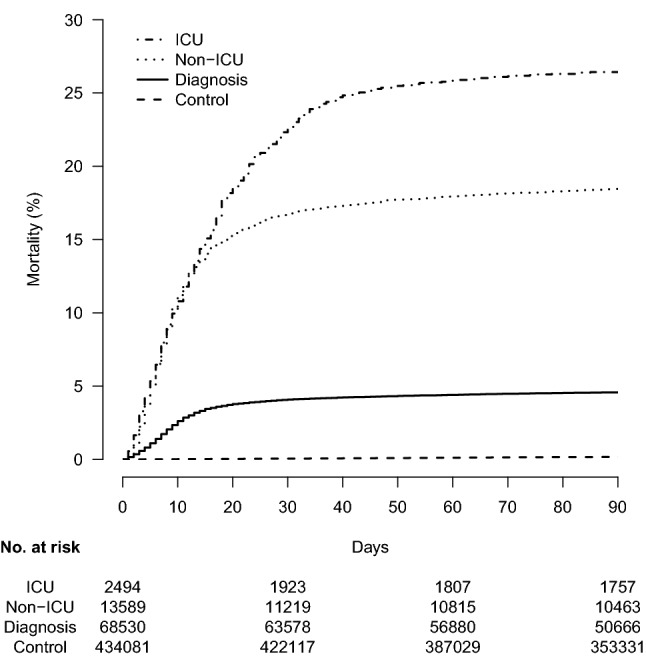
We conducted a nationwide, registry-based study to investigate the importance of 34 potential risk factors for coronavirus disease 2019 (COVID-19) diagnosis, hospitalization (with or without intensive care unit [ICU] admission), and subsequent all-cause mortality. The study population comprised all COVID-19 cases confirmed in Sweden by mid-September 2020 (68,575 non-hospitalized, 2494 ICU hospitalized, and 13,589 non-ICU hospitalized) and 434,081 randomly sampled general-population controls. Older age was the strongest risk factor for hospitalization, although the odds of ICU hospitalization decreased after 60-69 years and, after controlling for other risk factors, the odds of non-ICU hospitalization showed no trend after 40-49 years. Residence in a long-term care facility was associated with non-ICU hospitalization. Male sex and the presence of at least one investigated comorbidity or prescription medication were associated with both ICU and non-ICU hospitalization. Three comorbidities associated with both ICU and non-ICU hospitalization were asthma, hypertension, and Down syndrome. History of cancer was not associated with COVID-19 hospitalization, but cancer in the past year was associated with non-ICU hospitalization, after controlling for other risk factors. Cardiovascular disease was weakly associated with non-ICU hospitalization for COVID-19, but not with ICU hospitalization, after adjustment for other risk factors. Excess mortality was observed in both hospitalized and non-hospitalized COVID-19 cases. These results confirm that severe COVID-19 is related to age, sex, and comorbidity in general. The study provides new evidence that hypertension, asthma, Down syndrome, and residence in a long-term care facility are associated with severe COVID-19.
我们进行了一项全国性的基于登记的研究,旨在调查 34 个潜在的 COVID-19 危险因素对 COVID-19 诊断、住院(包括 ICU 住院和非 ICU 住院)和随后全因死亡率的重要性。研究人群包括 2020 年 9 月中旬在瑞典确诊的所有 COVID-19 病例(68575 例非住院、2494 例 ICU 住院和 13589 例非 ICU 住院)和 434081 名随机抽样的一般人群对照。年龄较大是住院的最强危险因素,但在 60-69 岁之后 ICU 住院的可能性降低,并且在控制其他危险因素后,40-49 岁之后非 ICU 住院的可能性没有趋势。居住在长期护理机构与非 ICU 住院有关。男性和至少一种调查的合并症或处方药物与 ICU 和非 ICU 住院都有关。与 ICU 和非 ICU 住院都有关的三种合并症是哮喘、高血压和唐氏综合征。癌症史与 COVID-19 住院无关,但在控制其他危险因素后,过去一年的癌症与非 ICU 住院有关。心血管疾病与 COVID-19 的非 ICU 住院相关,但与 ICU 住院无关,在调整其他危险因素后。住院和非住院 COVID-19 病例都观察到超额死亡率。这些结果证实,严重的 COVID-19 与年龄、性别和一般合并症有关。该研究提供了新的证据,表明高血压、哮喘、唐氏综合征和居住在长期护理机构与严重的 COVID-19 有关。