Xomalis Angelos, Zheng Xuezhi, Demetriadou Angela, Martínez Alejandro, Chikkaraddy Rohit, Baumberg Jeremy J
NanoPhotonics Centre, Cavendish Laboratory, Department of Physics, University of Cambridge, JJ Thompson Avenue, Cambridge CB3 0HE, United Kingdom.
Department of Electrical Engineering (ESAT-TELEMIC), KU Leuven, Kasteelpark Arenberg 10, BUS 2444, 3001 Leuven, Belgium.
Nano Lett. 2021 Mar 24;21(6):2512-2518. doi: 10.1021/acs.nanolett.0c04987. Epub 2021 Mar 11.
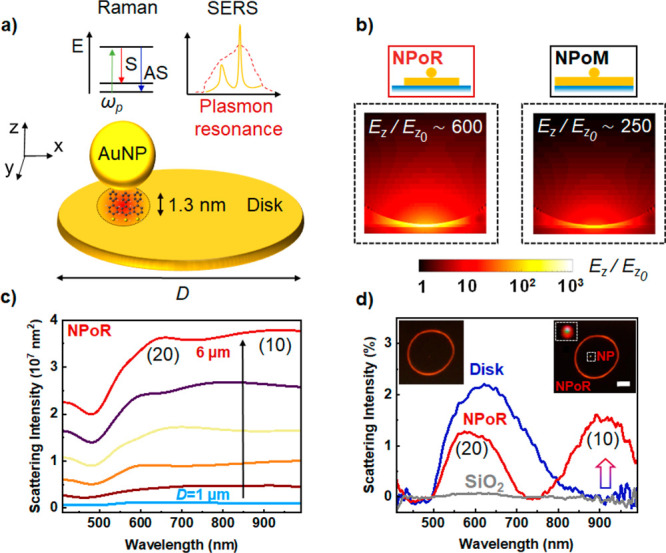
Plasmonic self-assembled nanocavities are ideal platforms for extreme light localization as they deliver mode volumes of <50 nm. Here we show that high-order plasmonic modes within additional micrometer-scale resonators surrounding each nanocavity can boost light localization to intensity enhancements >10. Plasmon interference in these hybrid microresonator nanocavities produces surface-enhanced Raman scattering (SERS) signals many-fold larger than in the bare plasmonic constructs. These now allow remote access to molecules inside the ultrathin gaps, avoiding direct irradiation and thus preventing molecular damage. Combining subnanometer gaps with micrometer-scale resonators places a high computational demand on simulations, so a generalized boundary element method (BEM) solver is developed which requires 100-fold less computational resources to characterize these systems. Our results on extreme near-field enhancement open new potential for single-molecule photonic circuits, mid-infrared detectors, and remote spectroscopy.
等离子体自组装纳米腔是实现极端光局域化的理想平台,因为它们能实现小于50纳米的模式体积。在此我们表明,围绕每个纳米腔的额外微米级谐振器内的高阶等离子体模式可将光局域化提升至强度增强超过10倍。这些混合微谐振器纳米腔内的等离子体干涉产生的表面增强拉曼散射(SERS)信号比裸等离子体结构中的信号大许多倍。这现在使得能够远程访问超薄间隙内的分子,避免直接照射从而防止分子损伤。将亚纳米间隙与微米级谐振器相结合对模拟提出了很高的计算要求,因此开发了一种广义边界元法(BEM)求解器,该求解器表征这些系统所需的计算资源减少了100倍。我们关于极端近场增强的结果为单分子光子电路、中红外探测器和远程光谱学开辟了新的潜力。