MRC/CSO Social and Public Health Sciences Unit, University of Glasgow, Glasgow, UK
MRC/CSO Social and Public Health Sciences Unit, University of Glasgow, Glasgow, UK.
BMJ Sex Reprod Health. 2021 Oct;47(4):269-276. doi: 10.1136/bmjsrh-2020-200975. Epub 2021 Mar 11.
The initial response to COVID-19 in the UK involved a rapid contraction of face-to-face sexual and reproductive health (SRH) services and widespread use of remote workarounds. This study sought to illuminate young people's experiences of accessing and using condoms and contraception in the early months of the pandemic.
We analysed data, including open-text responses, from an online survey conducted in June-July 2020 with a convenience sample of 2005 16-24-year-olds living in Scotland.
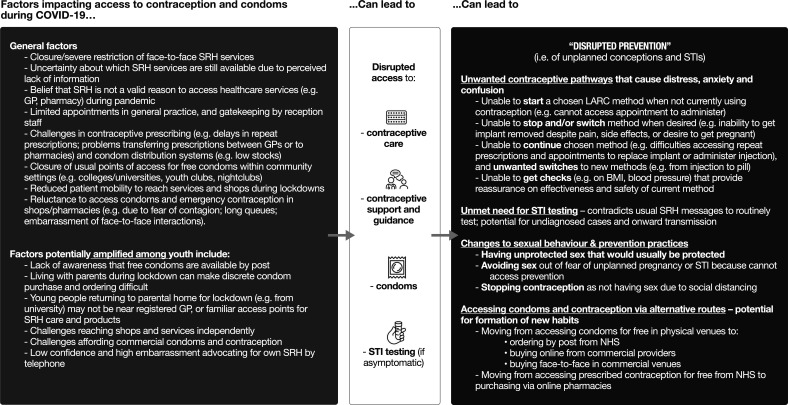
Among those who used condoms and contraception, one quarter reported that COVID-19 mitigation measures had made a difference to their access or use. Open-text responses revealed a landscape of , including changes to sexual risk-taking and preventive practices, unwanted contraceptive pathways, unmet need for sexually transmitted infection (STI) testing, and switches from freely provided to commercially sold condoms and contraception. Pandemic-related barriers to accessing free condoms and contraception included: (1) uncertainty about the legitimacy of accessing SRH care and self-censorship of need; (2) confusion about differences between SRH care and advice received from healthcare professionals during the pandemic compared with routine practice; and (3) exacerbation of existing access barriers, alongside reduced social support and resources to navigate SRH care.
Emerging barriers to STI and pregnancy prevention within the context of COVID-19 have the potential to undermine positive SRH practices, and widen inequalities, among young people. As SRH services are restored amid evolving pandemic restrictions, messaging to support navigation of condom and contraception services should be co-created with young people.
英国对 COVID-19 的初步应对措施包括迅速收缩面对面的性健康和生殖健康(SRH)服务,并广泛采用远程解决方法。本研究旨在阐明年轻人在大流行早期获取和使用避孕套和避孕药的经验。
我们分析了 2020 年 6 月至 7 月期间对居住在苏格兰的 2005 名 16-24 岁的年轻人进行的一项在线调查的数据,包括开放文本的回复。
在使用避孕套和避孕药的人群中,有四分之一的人报告称 COVID-19 缓解措施对他们的获取或使用产生了影响。开放文本的回复揭示了一幅景象,包括性行为风险和预防措施的变化、意外的避孕途径、性传播感染(STI)检测的未满足需求,以及从免费提供到商业销售的避孕套和避孕药的转变。与获取免费避孕套和避孕药相关的大流行障碍包括:(1)对获取 SRH 护理的合法性的不确定性以及对需求的自我审查;(2)对大流行期间与常规实践相比从医疗保健专业人员那里获得的 SRH 护理和建议之间的差异感到困惑;(3)在现有获取障碍加剧的情况下,社会支持和资源减少,难以应对 SRH 护理。
在 COVID-19 背景下,新出现的 STI 和妊娠预防障碍有可能破坏年轻人的积极 SRH 实践,并扩大不平等现象。随着 SRH 服务在不断演变的大流行限制中得到恢复,支持避孕套和避孕药服务导航的信息传递应与年轻人共同创建。