Nuffield Department of Population Health, University of Oxford, Oxford, Oxfordshire, UK
Botswana-Harvard AIDS Institute Partnership, Gaborone, Botswana.
Open Heart. 2021 Feb;8(1). doi: 10.1136/openhrt-2020-001461.
To identify factors associated with hypertension control among treated middle-aged UK adults.
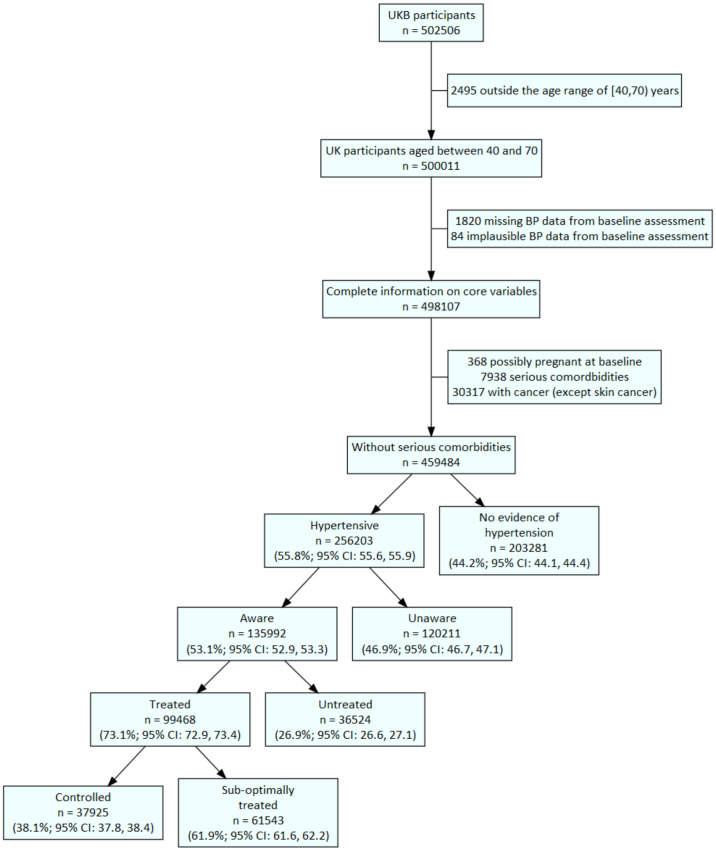
A cross-sectional population-based study including 99 468 previously diagnosed, treated hypertensives enrolled in the UK Biobank. Hypertension control was defined as systolic blood pressure <140 mm Hg and diastolic blood pressure <90 mm Hg.
Median age was 62.3 years (IQR 57.3 to 66.0), 45.9% female, 92.0% white, 40.1% obese, 9.3% current smokers and 19.4% had prior cardiovascular disease. 38.1% (95% CI 37.8% to 38.4%) were controlled. In multivariable logistic regression, associations with lack of hypertension control included: older age (OR 0.61, 95% CI 0.58 to 0.64 for 60-69 years compared with age 40-50 years), higher alcohol use (OR 0.61, 95% CI 0.58 to 0.64, for consuming >30 units per week compared with none), black ethnicity (OR 0.73, 95% CI 0.65 to 0.82 compared with white), obesity (OR 0.73, 95% CI 0.71 to 0.76 compared with normal body mass index). The strongest positive association with control was having ≥3 comorbidities (OR 2.09, 95% CI 1.95 to 2.23). Comorbidities associated with control included cardiovascular disease (OR 2.11, 95% CI 2.04 to 2.19), migraines (OR 1.68, 95% CI 1.56 to 1.81), diabetes (OR 1.32, 95% CI 1.27 to 1.36) and depression (OR 1.27, 95% CI 1.20 to 1.34).
In one of the largest population-based analyses of middle-aged adults with measured blood pressure, the majority of treated hypertensives were uncontrolled. Risk factors for hypertension were associated with a lower probability of control. Having a comorbidity was associated with higher probability of control, possibly due to more frequent interaction with the healthcare system and/or appropriate management of those at greater cardiovascular risk.
确定与英国中年接受治疗的成年人高血压控制相关的因素。
这是一项基于人群的横断面研究,纳入了英国生物库中 99468 名此前确诊且接受治疗的高血压患者。高血压控制定义为收缩压<140mmHg 和舒张压<90mmHg。
中位年龄为 62.3 岁(IQR 57.3 至 66.0),45.9%为女性,92.0%为白人,40.1%为肥胖,9.3%为当前吸烟者,19.4%有既往心血管疾病。38.1%(95%CI 37.8%至 38.4%)患者血压得到控制。在多变量逻辑回归中,与高血压控制不佳相关的因素包括:年龄较大(60-69 岁与 40-50 岁相比,OR 0.61,95%CI 0.58 至 0.64)、饮酒量较高(每周>30 单位与不饮酒相比,OR 0.61,95%CI 0.58 至 0.64)、黑种人(与白人相比,OR 0.73,95%CI 0.65 至 0.82)、肥胖(与正常体重指数相比,OR 0.73,95%CI 0.71 至 0.76)。与控制相关的最强正相关因素是存在≥3 种合并症(OR 2.09,95%CI 1.95 至 2.23)。与控制相关的合并症包括心血管疾病(OR 2.11,95%CI 2.04 至 2.19)、偏头痛(OR 1.68,95%CI 1.56 至 1.81)、糖尿病(OR 1.32,95%CI 1.27 至 1.36)和抑郁症(OR 1.27,95%CI 1.20 至 1.34)。
在对中年人群进行的最大规模基于人群的血压测量分析之一中,大多数接受治疗的高血压患者血压未得到控制。高血压的危险因素与控制的可能性降低有关。存在合并症与更高的控制可能性相关,这可能是由于与医疗保健系统的互动更频繁,或者对心血管风险较高的患者进行了更适当的管理。