Duke Lemur Center, Durham, NC, 27705, USA.
Department of Biology, Duke University, Durham, NC, 27708, USA.
Sci Rep. 2021 Mar 11;11(1):5740. doi: 10.1038/s41598-021-84727-3.
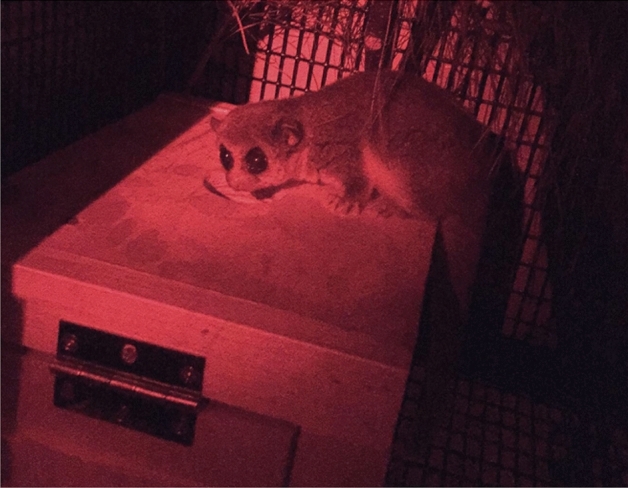
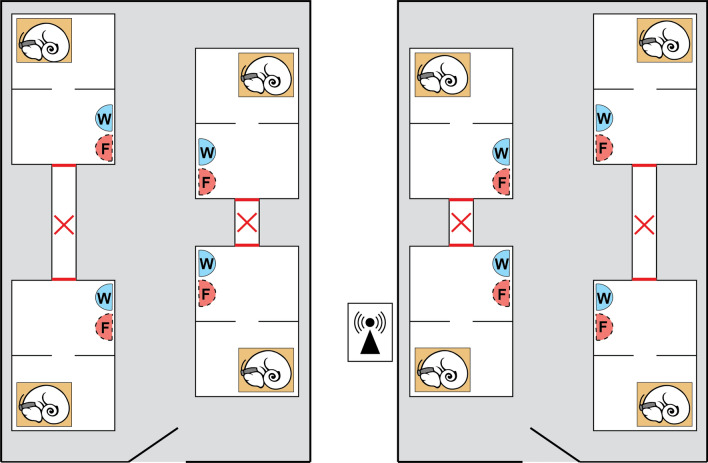
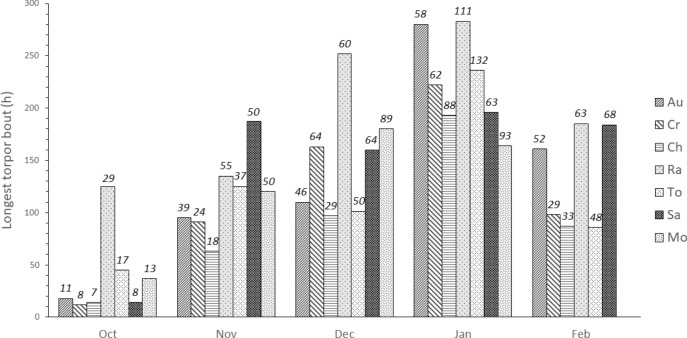
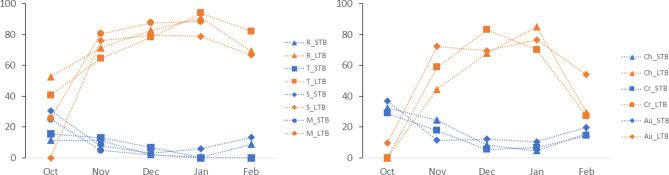
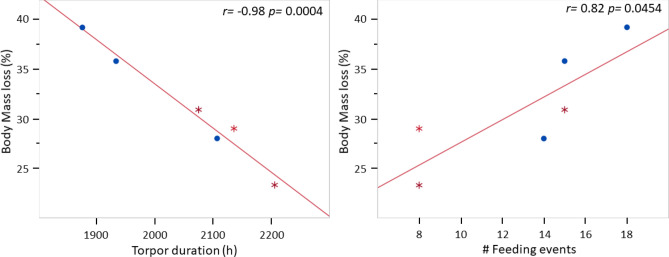
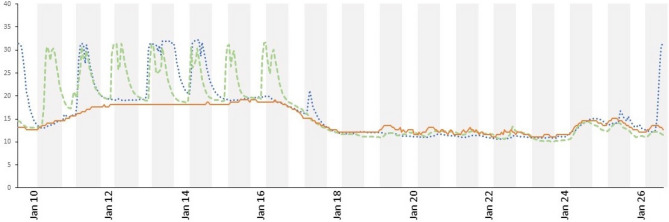
In nature, photoperiod signals environmental seasonality and is a strong selective "zeitgeber" that synchronizes biological rhythms. For animals facing seasonal environmental challenges and energetic bottlenecks, daily torpor and hibernation are two metabolic strategies that can save energy. In the wild, the dwarf lemurs of Madagascar are obligate hibernators, hibernating between 3 and 7 months a year. In captivity, however, dwarf lemurs generally express torpor for periods far shorter than the hibernation season in Madagascar. We investigated whether fat-tailed dwarf lemurs (Cheirogaleus medius) housed at the Duke Lemur Center (DLC) could hibernate, by subjecting 8 individuals to husbandry conditions more in accord with those in Madagascar, including alternating photoperiods, low ambient temperatures, and food restriction. All dwarf lemurs displayed daily and multiday torpor bouts, including bouts lasting ~ 11 days. Ambient temperature was the greatest predictor of torpor bout duration, and food ingestion and night length also played a role. Unlike their wild counterparts, who rarely leave their hibernacula and do not feed during hibernation, DLC dwarf lemurs sporadically moved and ate. While demonstrating that captive dwarf lemurs are physiologically capable of hibernation, we argue that facilitating their hibernation serves both husbandry and research goals: first, it enables lemurs to express the biphasic phenotypes (fattening and fat depletion) that are characteristic of their wild conspecifics; second, by "renaturalizing" dwarf lemurs in captivity, they will emerge a better model for understanding both metabolic extremes in primates generally and metabolic disorders in humans specifically.
在自然界中,光周期信号反映了环境的季节性,是同步生物节律的强大选择“时间信号”。对于面临季节性环境挑战和能量瓶颈的动物来说,每日蛰伏和冬眠是两种可以节省能量的代谢策略。在野外,马达加斯加的侏儒狐猴是强制性冬眠动物,每年冬眠 3 到 7 个月。然而,在圈养环境中,侏儒狐猴通常表现出的蛰伏期远远短于马达加斯加的冬眠期。我们通过让 8 只胖尾侏儒狐猴(Cheirogaleus medius)在杜克狐猴中心(DLC)接受更符合马达加斯加环境的饲养条件,包括交替的光周期、较低的环境温度和食物限制,来研究它们是否可以冬眠。所有的胖尾侏儒狐猴都表现出每日和多日的蛰伏期,包括持续约 11 天的蛰伏期。环境温度是蛰伏期持续时间的最大预测因素,而食物摄入和夜间长度也起作用。与很少离开冬眠地且在冬眠期间不进食的野生同类不同,DLC 的胖尾侏儒狐猴偶尔会移动和进食。虽然这表明圈养的胖尾侏儒狐猴在生理上能够冬眠,但我们认为促进它们的冬眠符合饲养和研究目标:首先,它使狐猴能够表现出其野生同类特有的双相表型(增肥和脂肪消耗);其次,通过在圈养环境中“使狐猴自然化”,它们将成为理解灵长类动物代谢极端情况以及人类代谢紊乱的更好模型。