Blanco Marina B, Greene Lydia K, Ellsaesser Laura N, Williams Cathy V, Ostrowski Catherine A, Davison Megan M, Welser Kay, Klopfer Peter H
Duke Lemur Center, Durham, NC, United States.
Department of Biology, Duke University, Durham, NC, United States.
Front Physiol. 2023 Sep 7;14:1251042. doi: 10.3389/fphys.2023.1251042. eCollection 2023.
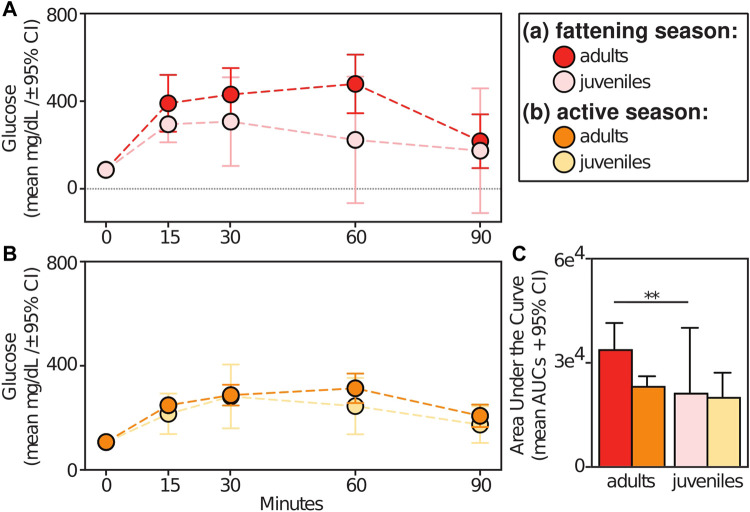
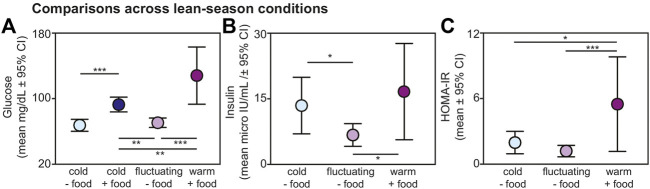
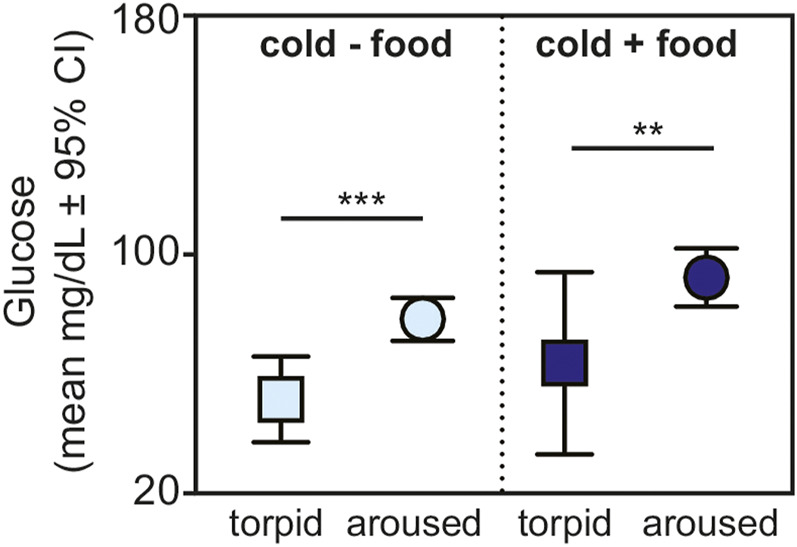
Feast-fast cycles allow animals to live in seasonal environments by promoting fat storage when food is plentiful and lipolysis when food is scarce. Fat-storing hibernators have mastered this cycle over a circannual schedule, by undergoing extreme fattening to stockpile fuel for the ensuing hibernation season. Insulin is intrinsic to carbohydrate and lipid metabolism and is central to regulating feast-fast cycles in mammalian hibernators. Here, we examine glucose and insulin dynamics across the feast-fast cycle in fat-tailed dwarf lemurs, the only obligate hibernator among primates. Unlike cold-adapted hibernators, dwarf lemurs inhabit tropical forests in Madagascar and hibernate under various temperature conditions. Using the captive colony at the Duke Lemur Center, we determined fasting glucose and insulin, and glucose tolerance, in dwarf lemurs across seasons. During the lean season, we maintained dwarf lemurs under stable warm, stable cold, or fluctuating ambient temperatures that variably included food provisioning or deprivation. Overall, we find that dwarf lemurs can show signatures of reversible, lean-season insulin resistance. During the fattening season prior to hibernation, dwarf lemurs had low glucose, insulin, and HOMA-IR despite consuming high-sugar diets. In the active season after hibernation, glucose, insulin, HOMA-IR, and glucose tolerance all increased, highlighting the metabolic processes at play during periods of weight gain weight loss. During the lean season, glucose remained low, but insulin and HOMA-IR increased, particularly in animals kept under warm conditions with daily food. Moreover, these lemurs had the greatest glucose intolerance in our study and had average HOMA-IR values consistent with insulin resistance (5.49), while those without food under cold (1.95) or fluctuating (1.17) temperatures did not. Remarkably low insulin in dwarf lemurs under fluctuating temperatures raises new questions about lipid metabolism when animals can passively warm and cool rather than undergo sporadic arousals. Our results underscore that seasonal changes in insulin and glucose tolerance are likely hallmarks of hibernating mammals. Because dwarf lemurs can hibernate under a range of conditions in captivity, they are an emerging model for primate metabolic flexibility with implications for human health.
进食-禁食周期使动物能够在季节性环境中生存,在食物丰富时促进脂肪储存,在食物稀缺时促进脂肪分解。储存脂肪的冬眠动物通过在一个年度周期内经历极端育肥来储存燃料,为随后的冬眠季节做准备,从而掌握了这个周期。胰岛素对于碳水化合物和脂质代谢至关重要,并且在调节哺乳动物冬眠动物的进食-禁食周期中起着核心作用。在这里,我们研究了肥尾侏儒狐猴在进食-禁食周期中的葡萄糖和胰岛素动态,肥尾侏儒狐猴是灵长类动物中唯一的专性冬眠动物。与适应寒冷的冬眠动物不同,侏儒狐猴栖息在马达加斯加的热带森林中,并在各种温度条件下冬眠。利用杜克狐猴中心的圈养群体,我们测定了侏儒狐猴在不同季节的空腹血糖和胰岛素水平以及葡萄糖耐量。在食物匮乏的季节,我们将侏儒狐猴置于稳定温暖、稳定寒冷或波动的环境温度下,这些温度条件下会不同程度地提供食物或剥夺食物。总体而言,我们发现侏儒狐猴可能表现出可逆的、食物匮乏季节胰岛素抵抗的特征。在冬眠前的育肥季节,尽管侏儒狐猴食用高糖饮食,但它们的血糖、胰岛素和胰岛素抵抗指数(HOMA-IR)都很低。在冬眠后的活跃季节,血糖、胰岛素、HOMA-IR和葡萄糖耐量均增加,突出了体重增加和体重减轻期间所起的代谢过程。在食物匮乏的季节,血糖保持较低水平,但胰岛素和HOMA-IR增加,特别是在每天有食物供应的温暖条件下饲养的动物中。此外,在我们的研究中,这些狐猴具有最大的葡萄糖不耐受性,其平均HOMA-IR值与胰岛素抵抗一致(5.49),而在寒冷(1.95)或波动(1.17)温度下没有食物的狐猴则没有。在波动温度下侏儒狐猴的胰岛素水平极低,这引发了关于动物在能够被动升温降温而非偶尔觉醒时脂质代谢的新问题。我们的结果强调,胰岛素和葡萄糖耐量的季节性变化可能是冬眠哺乳动物的标志。由于侏儒狐猴可以在圈养的一系列条件下冬眠,它们正在成为灵长类动物代谢灵活性的新兴模型,这对人类健康具有启示意义。