Financial Strategy Team, NHS North East London Commissioning Alliance, London, UK.
School of Informatics, University of Edinburgh, Edinburgh, UK.
Sci Rep. 2021 Mar 11;11(1):5806. doi: 10.1038/s41598-021-84907-1.
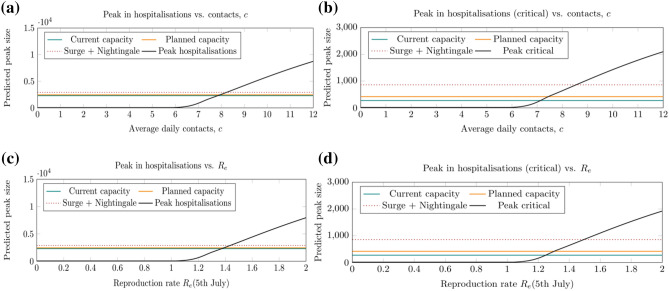
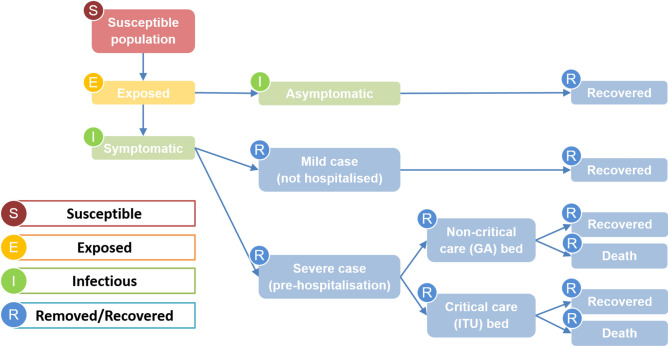
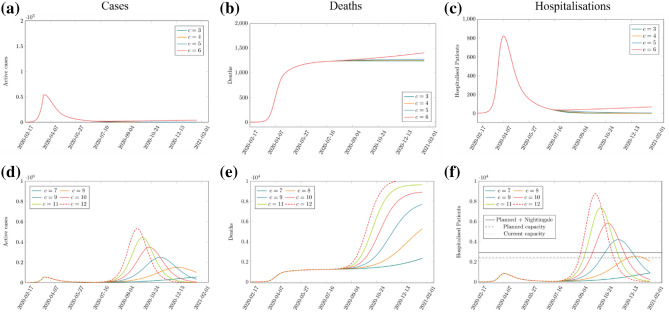
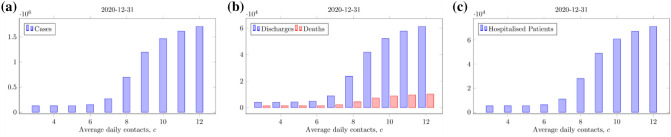
Determining the level of social distancing, quantified here as the reduction in daily number of social contacts per person, i.e. the daily contact rate, needed to maintain control of the COVID-19 epidemic and not exceed acute bed capacity in case of future epidemic waves, is important for future planning of relaxing of strict social distancing measures. This work uses mathematical modelling to simulate the levels of COVID-19 in North East London (NEL) and inform the level of social distancing necessary to protect the public and the healthcare demand from future COVID-19 waves. We used a Susceptible-Exposed-Infected-Removed (SEIR) model describing the transmission of SARS-CoV-2 in NEL, calibrated to data on hospitalised patients with confirmed COVID-19, hospital discharges and in-hospital deaths in NEL during the first epidemic wave. To account for the uncertainty in both the infectiousness period and the proportion of symptomatic infection, we simulated nine scenarios for different combinations of infectiousness period (1, 3 and 5 days) and proportion of symptomatic infection (70%, 50% and 25% of all infections). Across all scenarios, the calibrated model was used to assess the risk of occurrence and predict the strength and timing of a second COVID-19 wave under varying levels of daily contact rate from July 04, 2020. Specifically, the daily contact rate required to suppress the epidemic and prevent a resurgence of COVID-19 cases, and the daily contact rate required to stay within the acute bed capacity of the NEL system without any additional intervention measures after July 2020, were determined across the nine different scenarios. Our results caution against a full relaxing of the lockdown later in 2020, predicting that a return to pre-COVID-19 levels of social contact from July 04, 2020, would induce a second wave up to eight times the original wave. With different levels of ongoing social distancing, future resurgence can be avoided, or the strength of the resurgence can be mitigated. Keeping the daily contact rate lower than 5 or 6, depending on scenarios, can prevent an increase in the number of COVID-19 cases, could keep the effective reproduction number R below 1 and a secondary COVID-19 wave may be avoided in NEL. A daily contact rate between 6 and 7, across scenarios, is likely to increase R above 1 and result in a secondary COVID-19 wave with significantly increased COVID-19 cases and associated deaths, but with demand for hospital-based care remaining within the bed capacity of the NEL health and care system. In contrast, an increase in daily contact rate above 8 to 9, depending on scenarios, will likely exceed the acute bed capacity in NEL and may potentially require additional lockdowns. This scenario is associated with significantly increased COVID-19 cases and deaths, and acute COVID-19 care demand is likely to require significant scaling down of the usual operation of the health and care system and should be avoided. Our findings suggest that to avoid future COVID-19 waves and to stay within the acute bed capacity of the NEL health and care system, maintaining social distancing in NEL is advised with a view to limiting the average number of social interactions in the population. Increasing the level of social interaction beyond the limits described in this work could result in future COVID-19 waves that will likely exceed the acute bed capacity in the system, and depending on the strength of the resurgence may require additional lockdown measures.
确定社交距离的水平,这里量化为每个人每天减少的社交接触次数,即每天的接触率,对于未来放松严格社交距离措施的规划很重要。这项工作使用数学模型模拟了伦敦东北部(NEL)的 COVID-19 水平,并为保护公众和未来 COVID-19 浪潮中的医疗需求提供了必要的社交距离水平。我们使用描述 SARS-CoV-2 在 NEL 中传播的易感-暴露-感染-清除(SEIR)模型,该模型根据 NEL 中确诊 COVID-19 的住院患者、出院和住院死亡的数据进行了校准。为了考虑传染性期和有症状感染比例的不确定性,我们模拟了不同传染性期(1、3 和 5 天)和有症状感染比例(所有感染的 70%、50%和 25%)组合的九个场景。在所有场景中,使用校准模型评估了在不同日常接触率下(从 2020 年 7 月 4 日开始)发生第二波 COVID-19 的风险,并预测其强度和时间。具体来说,确定了在九个不同场景下抑制疫情和防止 COVID-19 病例再次出现所需的日常接触率,以及在 2020 年 7 月之后无需任何额外干预措施即可维持 NEL 系统急性病床容量所需的日常接触率。我们的研究结果警告不要在 2020 年底全面放松封锁,预测从 2020 年 7 月 4 日开始恢复到 COVID-19 之前的社交接触水平,将引发比原始波高 8 倍的第二波。通过不同水平的持续社交距离,可以避免未来的复苏,或者可以减轻复苏的强度。保持每日接触率低于 5 或 6(取决于场景)可以防止 COVID-19 病例的增加,可以使有效繁殖数 R 保持在 1 以下,并且可以避免 NEL 中的二次 COVID-19 浪潮。每日接触率在 6 到 7 之间(取决于场景)可能会导致 R 上升到 1 以上,并导致 COVID-19 病例和相关死亡人数显著增加,但 NEL 基于医院的护理需求仍在该卫生和保健系统的病床容量之内。相比之下,如果每日接触率增加到 8 到 9(取决于场景)以上,则可能超过 NEL 的急性病床容量,并且可能需要额外的封锁。这种情况与 COVID-19 病例和死亡人数的大幅增加有关,并且急性 COVID-19 护理需求可能需要对卫生和保健系统的正常运作进行重大调整,应予以避免。我们的研究结果表明,为了避免未来的 COVID-19 浪潮并保持 NEL 卫生和保健系统的急性病床容量,建议在 NEL 中保持社交距离,以期限制人群中社交互动的平均次数。超出这项工作中描述的限制增加社交互动水平可能会导致未来的 COVID-19 浪潮,这些浪潮很可能超过系统的急性病床容量,并且根据复苏的强度,可能需要采取额外的封锁措施。