Graduate School of Medical Science and Engineering, Korea Advanced Institute of Science and Technology (KAIST), Daejeon, 34141, Republic of Korea.
Exp Mol Med. 2021 Mar;53(3):318-327. doi: 10.1038/s12276-021-00576-0. Epub 2021 Mar 12.
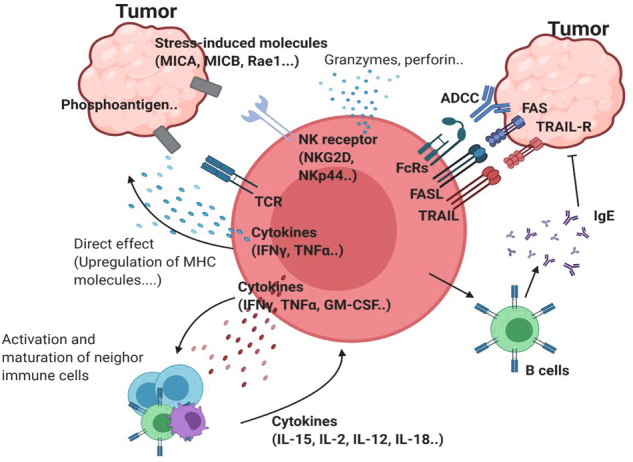
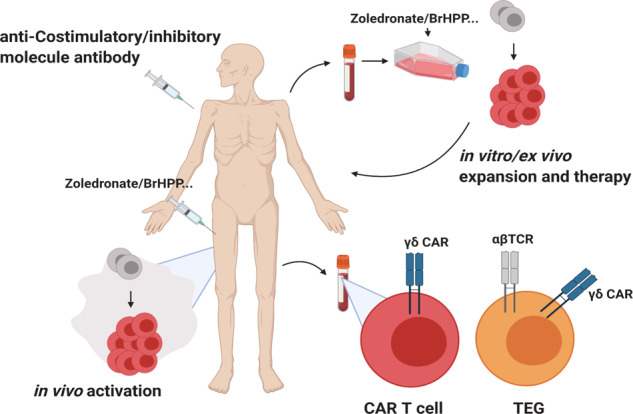
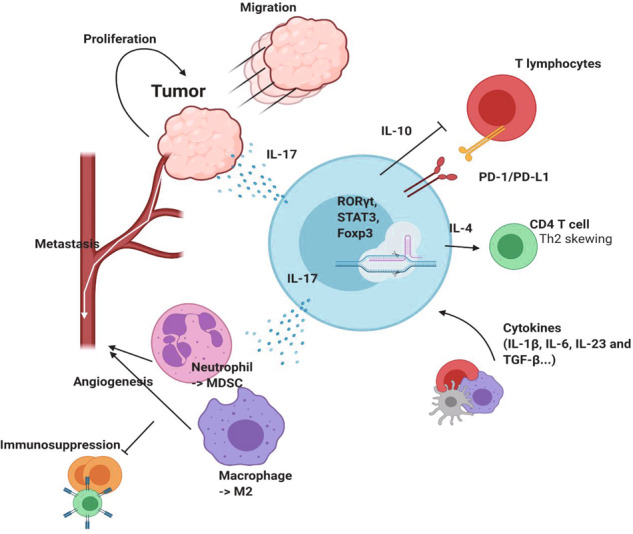
T cells of the γδ lineage are unconventional T cells with functions not restricted to MHC-mediated antigen presentation. Because of their broad antigen specificity and NK-like cytotoxicity, γδ T-cell importance in tumor immunology has been emphasized. However, some γδ T-cell subsets, especially those expressing IL-17, are immunosuppressive or tumor-promoting cells. Their cytokine profile and cytotoxicity are seemingly determined by cross-talk with microenvironment components, not by the γδTCR chain. Furthermore, much about the TCR antigen of γδ T cells remains unknown compared with the extreme diversity of their TCR chain pairs. Thus, the investigation and application of γδ T cells have been relatively difficult. Nevertheless, γδ T cells remain attractive targets for antitumor therapy because of their independence from MHC molecules. Because tumor cells have the ability to evade the immune system through MHC shedding, heterogeneous antigens, and low antigen spreading, MHC-independent γδ T cells represent good alternative targets for immunotherapy. Therefore, many approaches to using γδ T cells for antitumor therapy have been attempted, including induction of endogenous γδ T cell activation, adoptive transfer of expanded cells ex vivo, and utilization of chimeric antigen receptor (CAR)-T cells. Here, we discuss the function of γδ T cells in tumor immunology and their application to cancer therapy.
γδ 谱系 T 细胞是一种非常规 T 细胞,其功能不仅限于 MHC 介导的抗原呈递。由于其广泛的抗原特异性和 NK 样细胞毒性,γδ T 细胞在肿瘤免疫学中的重要性已得到强调。然而,一些 γδ T 细胞亚群,特别是表达 IL-17 的亚群,是具有免疫抑制或促进肿瘤生长作用的细胞。它们的细胞因子谱和细胞毒性似乎是由与微环境成分的相互作用决定的,而不是由 γδTCR 链决定的。此外,与 TCR 链的极端多样性相比,γδ T 细胞的 TCR 抗原的许多方面仍然未知。因此,γδ T 细胞的研究和应用相对困难。然而,由于 γδ T 细胞不依赖 MHC 分子,它们仍然是抗肿瘤治疗的有吸引力的靶标。由于肿瘤细胞具有通过 MHC 脱落、异质性抗原和低抗原扩散来逃避免疫系统的能力,因此 MHC 不依赖的 γδ T 细胞是免疫治疗的良好替代靶标。因此,已经尝试了许多利用 γδ T 细胞进行抗肿瘤治疗的方法,包括诱导内源性 γδ T 细胞激活、体外扩增细胞的过继转移以及嵌合抗原受体(CAR)-T 细胞的利用。在这里,我们讨论了 γδ T 细胞在肿瘤免疫学中的功能及其在癌症治疗中的应用。