Saeed Amna, Saeed Faria, Saeed Hamid, Saleem Zikria, Yang Caijun, Chang Jie, Jiang Minghuan, Zhao Mingyue, Saqlain Muhammad, Ji Wenjing, Aziz Muhammad Majid, Lambojon Krizzia, Gillani Ali Hassan, Hayat Khezar, Gul Sabiha, Fang Yu, Babar Zaheer-Ud-Din
Department of Pharmacy Administration and Clinical Pharmacy, School of Pharmacy, Xi'an Jiaotong University, Shaanxi, China.
Center for Drug Safety and Policy Research, Xi'an Jiaotong University, Shaanxi, China.
Front Pharmacol. 2021 Jan 25;11:595008. doi: 10.3389/fphar.2020.595008. eCollection 2020.
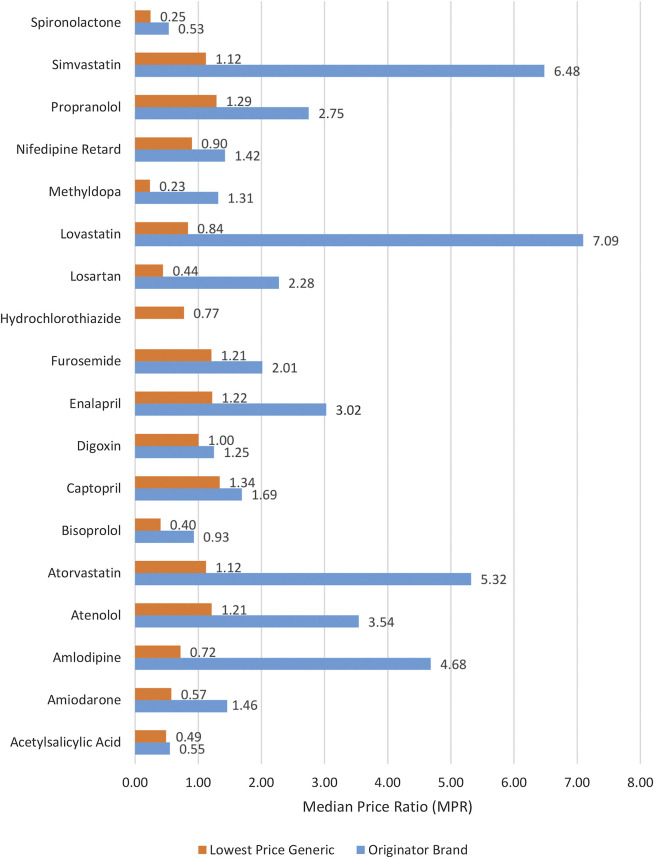
This national survey was aimed at measuring the access to cardiovascular disease (CVD) medicines in terms of their availability, price, and affordability in Pakistan. This was done by using the standard WHO/Health Action International (HAI) methodology. The price and availability data for 18 CVD medicines were collected from public sector hospitals (n = 40) and private sector retail pharmacies (n = 40) in eight cities of Pakistan. The outcome measures were availability (calculated as percentage of health facilities stocked with listed medicines), medicine price to the international reference price ratio (i.e., median price ratio (MPR)), and affordability (calculated as number of days' wages (NDWs) of the lowest paid unskilled government worker required to afford one-month treatment of a chronic disease). The affordability of standard treatment in Pakistan with four CVD drugs was compared with data from six other low and middle income countries (LMICs) using HAI database. The mean percent availability of CVD medicines was significantly low ( < 0.001) in the public sector as compared to the private sector, that is, 25.5% vs. 54.6% for originator brands (OBs) and 30.4% vs. 34.9% for lowest price generics (LPGs), respectively. For all OBs and LPGs, the inflation-adjusted mean MPR was 2.72 and 1, respectively. CVD medicines were found to be unaffordable with average NDWs of 6.4 and 2.2 for OBs and LPGs, respectively, that is, NDWs of more than 1. In international comparison with countries such as Sudan, Lebanon, Egypt, India, Afghanistan, and China, the affordability of standard treatment with selected CVD medicines (atenolol, amlodipine, captopril, and simvastatin) in Pakistan was found to be low. Overall, all four OBs and three out of four LPGs of selected CVD drugs were found unaffordable in Pakistan. This data indicated that the availability of selected CVD medicines was low in both public and private sector medicine outlets. Both OBs and LPGs were found unaffordable in the private sector, necessitating the redressal of pricing policies, structuring, and their implementation.
这项全国性调查旨在衡量巴基斯坦心血管疾病(CVD)药物在可及性、价格和可负担性方面的情况。这是通过采用世界卫生组织/国际卫生行动组织(HAI)的标准方法来完成的。从巴基斯坦八个城市的公立部门医院(n = 40)和私立部门零售药店(n = 40)收集了18种心血管疾病药物的价格和可及性数据。结果指标包括可及性(以储备有列出药物的医疗机构的百分比计算)、药品价格与国际参考价格之比(即中位数价格比(MPR))以及可负担性(以支付慢性病一个月治疗费用所需的最低薪非技术政府工作人员的日工资数(NDWs)计算)。利用HAI数据库,将巴基斯坦使用四种心血管疾病药物的标准治疗的可负担性与其他六个低收入和中等收入国家(LMICs)的数据进行了比较。与私立部门相比,公立部门心血管疾病药物的平均可及性百分比显著较低(<0.001),即原研品牌药(OBs)分别为25.5%和54.6%,最低价仿制药(LPGs)分别为30.4%和34.9%。对于所有原研品牌药和最低价仿制药,经通胀调整后的平均中位数价格比分别为2.72和1。结果发现,心血管疾病药物难以负担,原研品牌药和最低价仿制药的平均日工资数分别为6.4和2.2,即日工资数超过1。在与苏丹、黎巴嫩、埃及、印度、阿富汗和中国等国家的国际比较中,发现巴基斯坦使用选定心血管疾病药物(阿替洛尔、氨氯地平、卡托普利和辛伐他汀)的标准治疗的可负担性较低。总体而言,在巴基斯坦,选定心血管疾病药物的所有四种原研品牌药和四种最低价仿制药中的三种都难以负担。这些数据表明,选定心血管疾病药物在公立和私立部门药品销售点的可及性都很低。在私立部门,原研品牌药和最低价仿制药都难以负担,因此有必要纠正定价政策、结构及其实施情况。