Nacher Mathieu, Mergeay-Fabre Mayka, Blanchet Denis, Benoit Orelie, Pozl Tristan, Mesphoule Pauline, Sainte-Rose Vincent, Vialette Véronique, Toulet Bruno, Moua Aurélie, Saout Mona, Simon Stéphane, Guidarelli Manon, Galindo Muriel, Biche Barbara, Faurous William, Chaizemartin Laurie, Fahrasmane Aniza, Rochemont Devi, Vignier Nicolas, Vabret Astrid, Demar Magalie
Centre d'Investigation Clinique (CIC) Institut National de la Santé et de la Recherche Médicale (INSERM) 1424, Centre Hospitalier de Cayenne Andrée Rosemon, Cayenne, French Guiana.
Département Formation Recherche (DFR) Santé, Université de Guyane, Cayenne, French Guiana.
Front Med (Lausanne). 2021 Feb 23;8:621160. doi: 10.3389/fmed.2021.621160. eCollection 2021.
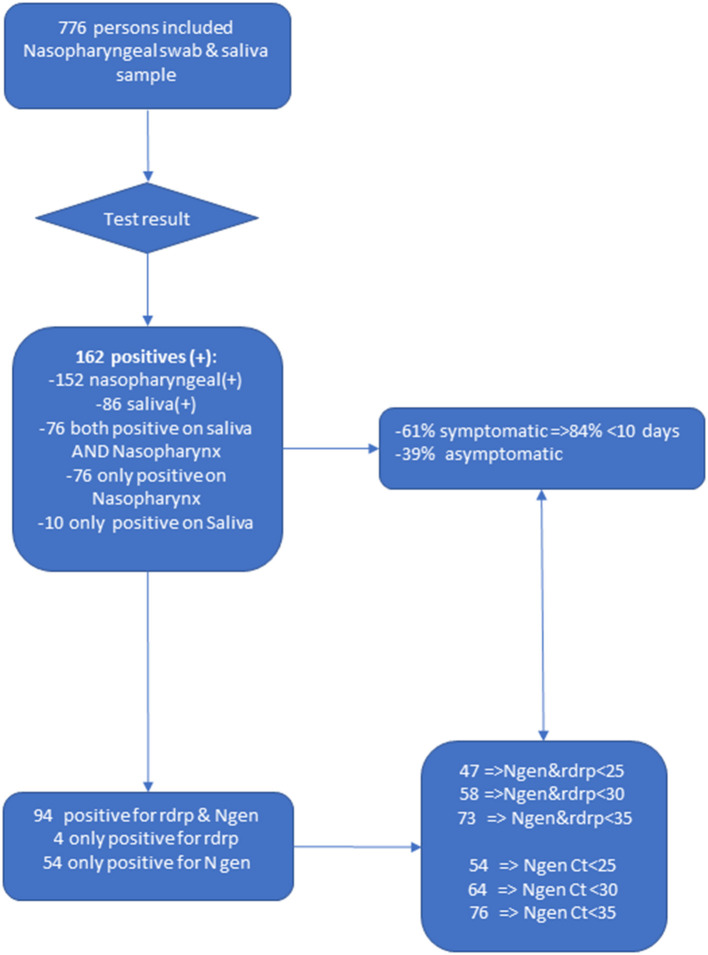
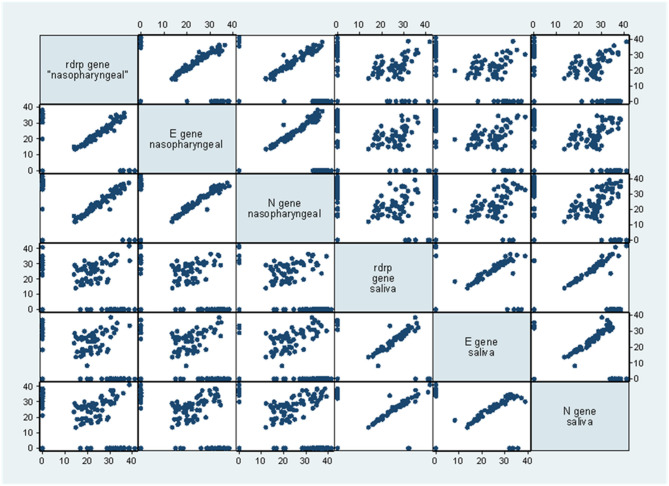
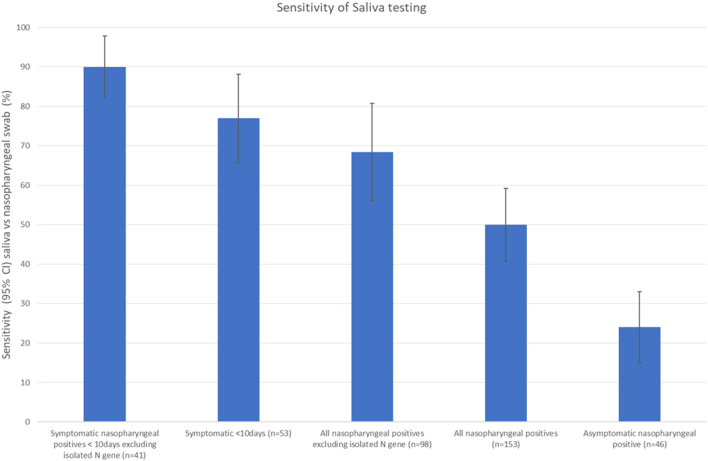
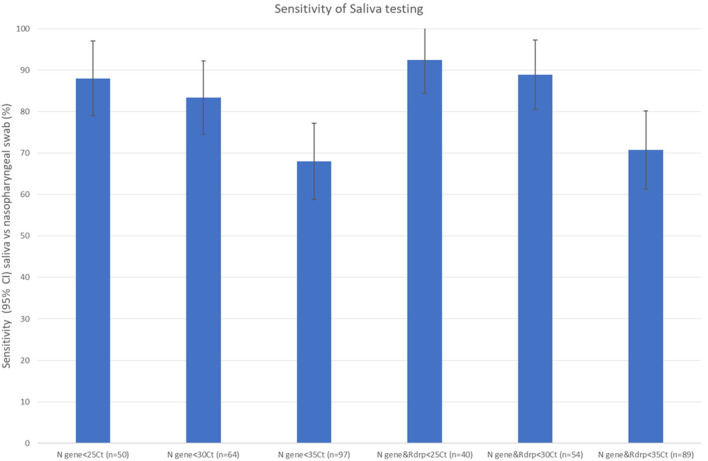
Current testing for COVID-19 relies on reverse-transcriptase polymerase chain reaction from a nasopharyngeal swab specimen. Saliva samples have advantages regarding ease and painlessness of collection, which does not require trained staff and may allow self-sampling. We enrolled 776 persons at various field-testing sites and collected nasopharyngeal and pooled saliva samples. One hundred sixty two had a positive COVID-19 RT-PCR, 61% were mildly symptomatic and 39% asymptomatic. The sensitivity of RT-PCR on saliva samples vs. nasopharygeal swabs varied depending on the patient groups considered or on Ct thresholds. There were 10 (6.2%) patients with a positive saliva sample and a negative nasopharyngeal swab, all of whom had Ct values <25 for three genes. For symptomatic patients for whom the interval between symptoms onset and sampling was <10 days sensitivity was 77% but when excluding persons with isolated N gene positivity (54/162), sensitivity was 90%. In asymptomatic patients, the sensitivity was only 24%. When we looked at patients with Cts <30, sensitivity was 83 or 88.9% when considering two genes. The relatively good performance for patients with low Cts suggests that Saliva testing could be a useful and acceptable tool to identify infectious persons in mass screening contexts, a strategically important task for contact tracing and isolation in the community.
目前针对新型冠状病毒肺炎(COVID-19)的检测依赖于对鼻咽拭子样本进行逆转录聚合酶链反应。唾液样本在采集的便捷性和无痛性方面具有优势,采集过程无需专业人员,还可进行自我采样。我们在多个现场检测点招募了776人,采集了鼻咽样本和混合唾液样本。其中162人新型冠状病毒肺炎逆转录聚合酶链反应(RT-PCR)呈阳性,61%有轻微症状,39%无症状。RT-PCR检测唾液样本与鼻咽拭子的敏感性因所考虑的患者群体或Ct阈值而异。有10名(6.2%)患者唾液样本呈阳性但鼻咽拭子呈阴性,所有这些患者三个基因的Ct值均<25。对于症状出现与采样间隔<10天的有症状患者,敏感性为77%,但排除仅N基因阳性的患者(54/162)后,敏感性为90%。在无症状患者中,敏感性仅为24%。当我们观察Ct<30的患者时,考虑两个基因时敏感性为83%或88.9%。Ct值较低患者的相对良好表现表明,唾液检测可能是在大规模筛查中识别感染者的一种有用且可接受的工具,这是社区接触者追踪和隔离的一项具有战略重要性的任务。