Wang Da-Peng, Lin Qi, Kang Kai, Wu Yi-Fang, Su Shao-Hua, Hai Jian
Department of Neurosurgery, Tong Ji Hospital, Tong Ji University School of Medicine, Shanghai, China.
Department of Neurology and Neurosurgery, Montreal Neurological Institute and Hospital, McGill University, Montreal, Quebec, Canada.
Ann Transl Med. 2021 Feb;9(3):228. doi: 10.21037/atm-20-4431.
Chronic cerebral hypoperfusion (CCH) is a major risk factor for vascular dementia (VaD). There are currently no broadly effective prevention or treatment strategies for VaD, but recent studies have reported promising results following vascular bypass surgery and pharmacomodulation of the brain endocannabinoid system (ECS). In this study, early effects of encephalomyosynangiosis (EMS) bypass surgery and augmented endocannabinoid signaling on CCH-induced cognitive dysfunction and neuronal damage were investigated.
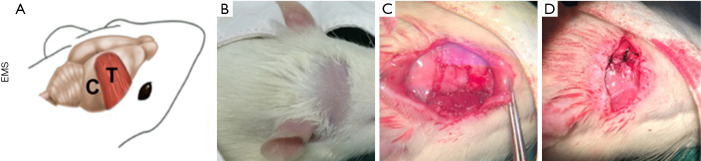
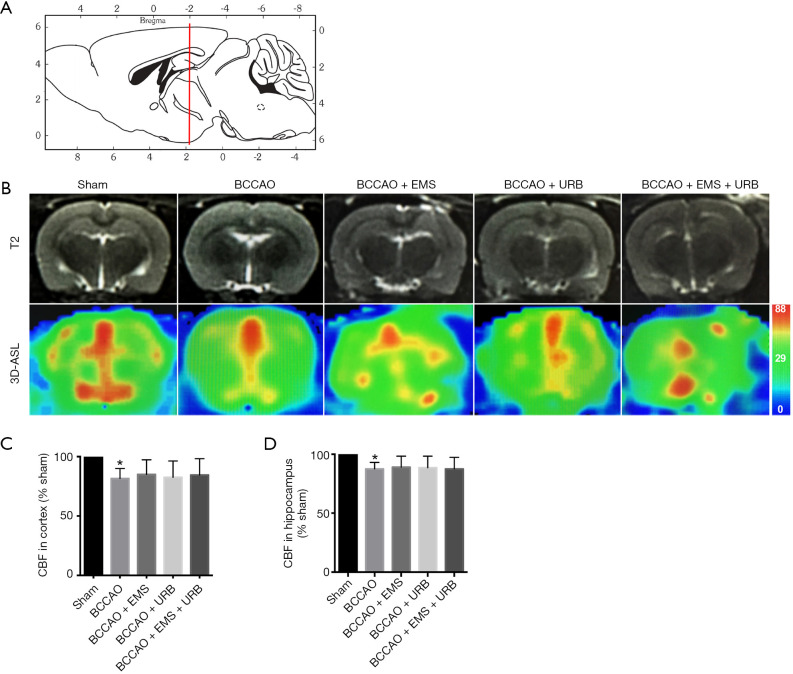
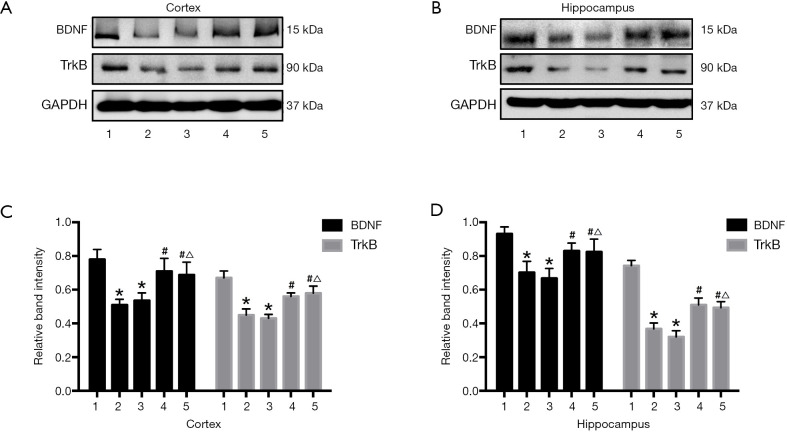
An animal model of VaD was established by bilateral common carotid artery occlusion (BCCAO). Cannabinoid signaling was upregulated by treatment with the fatty acid amide hydrolase inhibitor URB597 (URB). Spatial learning and memory, cerebral blood flow (CBF), revascularization, brain-derived neurotrophic factor (BDNF)-tropomyosin receptor kinase B (TrkB) signaling, and apoptosis were compared among Sham, BCCAO, BCCAO + EMS, BCCAO + URB, and BCCAO + URB + EMS groups. Spatial learning and memory were evaluated using the Morris water maze (MWM). The CBF in cortex and hippocampus was evaluated by 3-dimensional arterial spin labeling. The neovascularization was visualized by CD34 immunofluorescence staining, and BDNF-TrkB signaling protein expression levels were assessed by Western blotting.
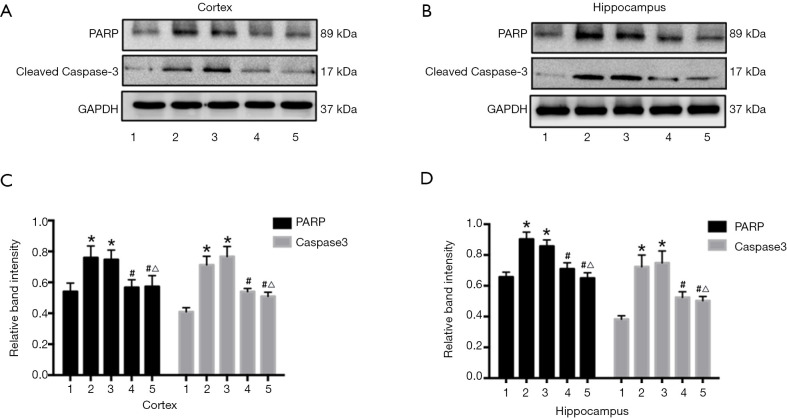
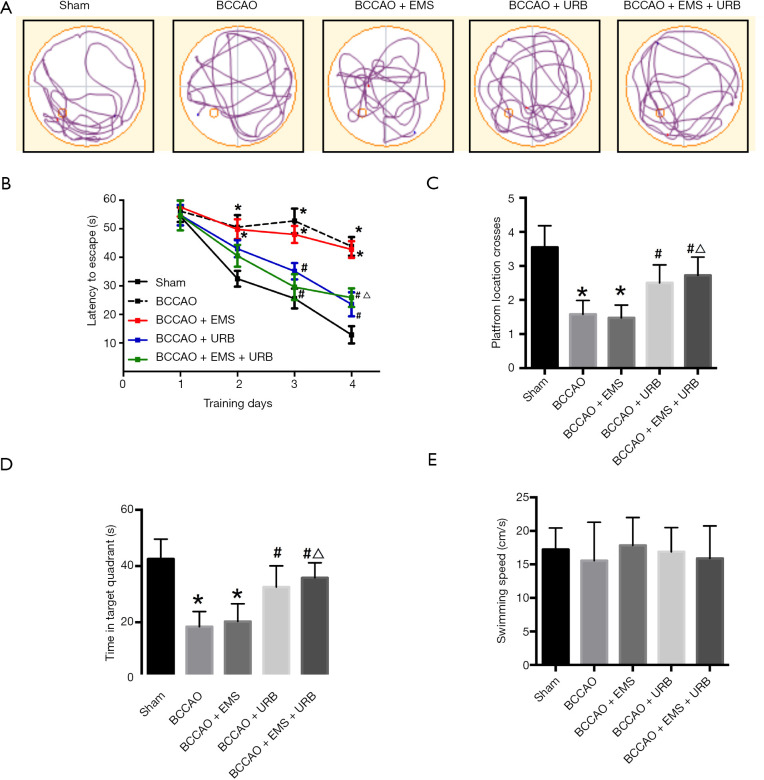
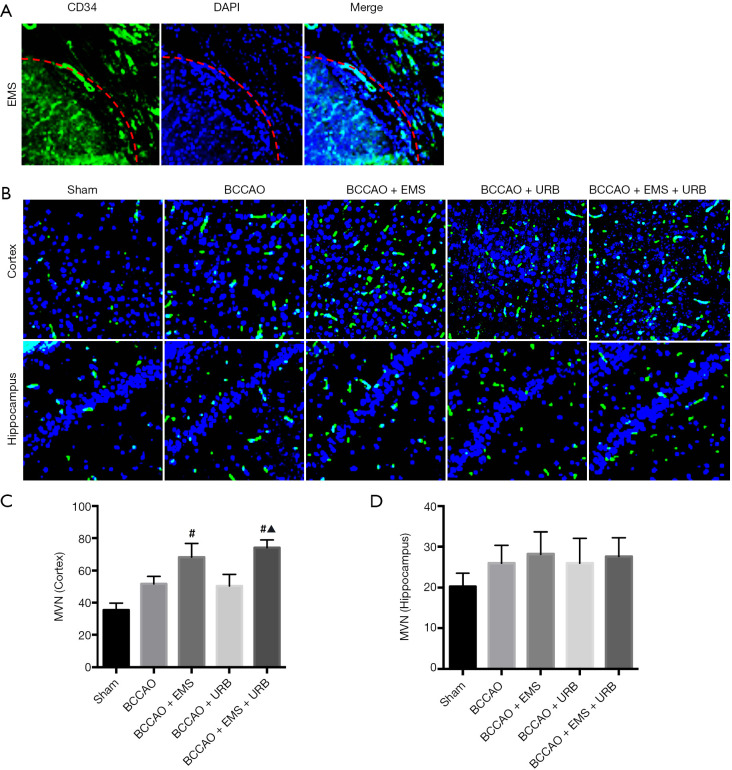
Treatment with URB597 but not EMS alone reversed the spatial learning and memory deficits induced by BCCAO. Neovascularization was enhanced after EMS surgery but not by URB597. Alternatively, there were no significant differences in CBF among treatment groups. Expression levels of BDNF and TrkB were significantly reduced by CCH compared to Sham treatment, and downregulation of both proteins was reversed by URB597 treatment but not EMS. BCCAO enhanced neuronal apoptosis, which was also reversed by URB597.
Augmentation of endogenous cannabinoid signaling but not EMS protects against CCH-induced neurodegeneration and preserves spatial learning and memory, possibly by activating BDNF-TrkB signaling.
慢性脑灌注不足(CCH)是血管性痴呆(VaD)的主要危险因素。目前尚无针对VaD的广泛有效的预防或治疗策略,但最近的研究报道了血管搭桥手术和脑内源性大麻素系统(ECS)的药物调节取得了有前景的结果。在本研究中,研究了脑肌血管吻合术(EMS)搭桥手术和增强内源性大麻素信号对CCH诱导的认知功能障碍和神经元损伤的早期影响。
通过双侧颈总动脉闭塞(BCCAO)建立VaD动物模型。用脂肪酸酰胺水解酶抑制剂URB597(URB)处理上调大麻素信号。比较假手术组、BCCAO组、BCCAO + EMS组、BCCAO + URB组和BCCAO + URB + EMS组的空间学习和记忆、脑血流量(CBF)、血管再生、脑源性神经营养因子(BDNF)-原肌球蛋白受体激酶B(TrkB)信号传导和细胞凋亡。使用莫里斯水迷宫(MWM)评估空间学习和记忆。通过三维动脉自旋标记评估皮质和海马中的CBF。通过CD34免疫荧光染色观察新生血管形成,并通过蛋白质印迹法评估BDNF-TrkB信号蛋白表达水平。
单独使用URB597而非EMS治疗可逆转BCCAO诱导的空间学习和记忆缺陷。EMS手术后新生血管形成增强,但URB597未增强。另外,各治疗组之间的CBF没有显著差异。与假手术治疗相比,CCH使BDNF和TrkB的表达水平显著降低,URB597治疗可逆转这两种蛋白的下调,但EMS不能。BCCAO增强了神经元凋亡,URB597也可逆转。
增强内源性大麻素信号而非EMS可预防CCH诱导的神经变性并保留空间学习和记忆,可能是通过激活BDNF-TrkB信号传导实现的。