British Columbia Emergency Health Services, Vancouver, BC, Canada.
Centre for Health Evaluation and Outcomes Sciences, Vancouver, BC, Canada.
CJEM. 2021 Mar;23(2):237-241. doi: 10.1007/s43678-020-00062-y. Epub 2021 Jan 20.
To date in the COVID-19 pandemic, there has been a decrease in patients accessing emergency health services, (EHS) but research has been conducted in areas with a very high incidence of COVID-19. In an area with a low COVID-19 incidence, we estimate changes in EHS use.
We compared EHS encounters in British Columbia from March 15 (the date of school and business closures) to May 15, 2020, when compared to the same period in 2019. We categorized EHS encounters into 18 presenting complaints and prespecified critical care complaints including major trauma, cardiac arrest, stroke, and ST-elevation myocardial infarction. We analyzed by descriptive methods.
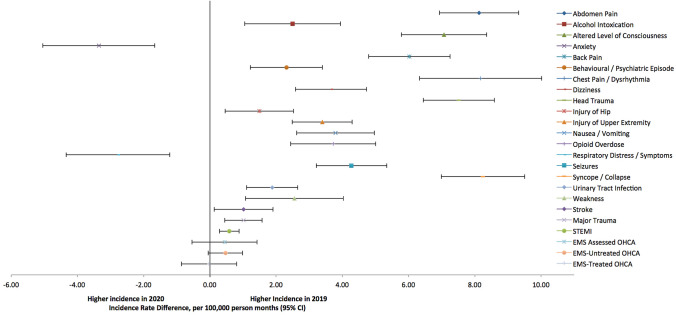
Comparing 2019 to 2020, total EHS encounters decreased from 83,925 (incidence rate 834 per 100,000 person-months) to 71,611 (incidence rate 701 per 100,000 person-months) for a decrease of 133 per 100,000 person-months (95% CI 126-141). The top 18 codes had a significant decrease in every category except respiratory and anxiety. Encounters for critically ill patients decreased significantly overall from 3019 to 2753 (incidence rate difference 3.1 per 100,000 person-months, 95% CI 1.6-4.5), including stroke, trauma, and STEMI, but the incidence of OHCA appeared stable.
In a single province with a low incidence of COVID-19, there was a 15% reduction in overall EHS use and a 9% reduction in critical illness. EHS planners will need to match patient need with available resources.
在 COVID-19 大流行期间,前往紧急医疗服务(EHS)的患者有所减少,但相关研究仅在 COVID-19 发病率非常高的地区进行。在 COVID-19 发病率较低的地区,我们评估 EHS 使用的变化情况。
我们比较了 2020 年 3 月 15 日(学校和企业关闭日)至 5 月 15 日期间不列颠哥伦比亚省的 EHS 就诊情况,并与 2019 年同期进行了比较。我们将 EHS 就诊情况分为 18 种主要就诊症状和特定危急重症症状,包括严重创伤、心搏骤停、中风和 ST 段抬高型心肌梗死。我们采用描述性方法进行分析。
与 2019 年相比,2020 年 EHS 总就诊次数从 83925 次(发病率为每 10 万人月 834 次)降至 71611 次(发病率为每 10 万人月 701 次),减少了 133 次/每 10 万人月(95%CI:126-141)。除呼吸和焦虑外,前 18 种代码在每个类别中的就诊次数均显著减少。总体而言,危重症患者就诊次数显著减少,从 3019 次降至 2753 次(发病率差异为每 10 万人月 3.1 次,95%CI:1.6-4.5),包括中风、创伤和 STEMI,但 OHCA 的发病率保持稳定。
在 COVID-19 发病率较低的单一省份,EHS 的使用总体减少了 15%,危急重症患者减少了 9%。EHS 规划者需要根据现有资源匹配患者需求。