School of Biological Sciences, Institute of Global Food Security, Queen's University Belfast, 1-33 Chlorine Gardens, Belfast, BT9 5AJ, UK.
Marine Biological Association of the UK, Citadel Hill, Plymouth, PL1 2PB, UK.
Ecology. 2021 May;102(5):e03341. doi: 10.1002/ecy.3341. Epub 2021 Apr 30.
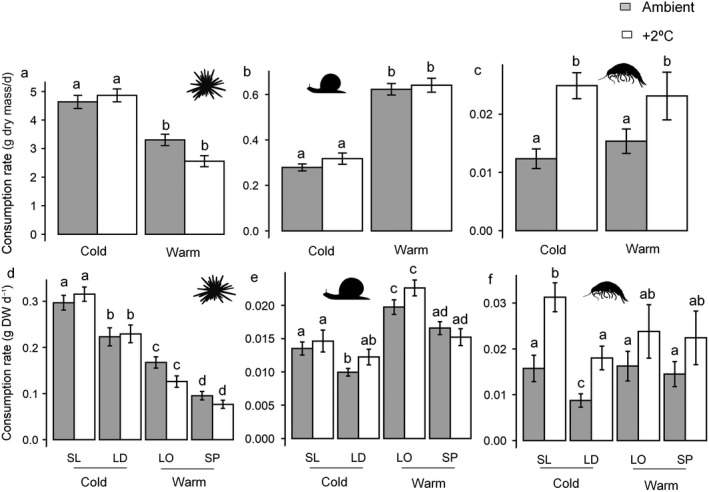
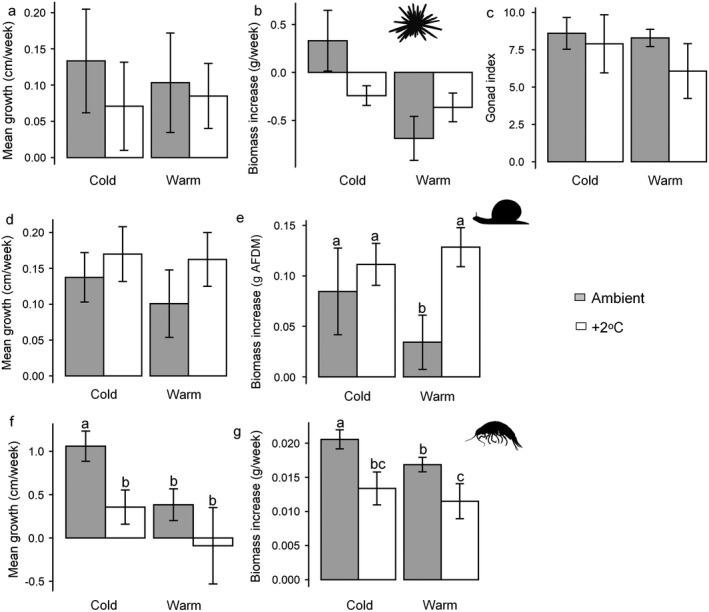
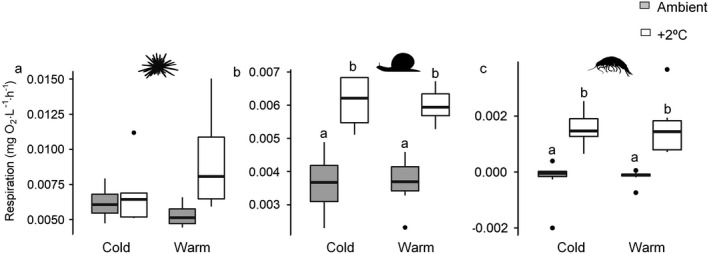
Recent warming trends have driven widespread changes in the performance and distribution of species in many regions, with consequent shifts in assemblage structure and ecosystem functioning. However, as responses to warming vary across species and regions, novel communities are emerging, particularly where warm-affinity range-expanding species have rapidly colonized communities still dominated by cold-affinity species. Such community reconfiguration may alter core ecosystem processes, such as productivity or nutrient cycling, yet it remains unclear whether novel communities function similarly to those they have replaced, and how continued warming will alter functioning in the near future. Using simplified kelp forest communities as a model system, we compared rates of respiration, consumption and secondary productivity between current cold-affinity and future warm-affinity kelp assemblages under both present-day temperatures and near-future warming in a series of mesocosm experiments. Overall, respiration rates of gastropods and amphipods increased with warming but did not differ between cold and warm affinity kelp assemblages. Consumption rates of three consumers (urchin, gastropod and amphipod) differed between kelp assemblages but only amphipod consumption rates increased with warming. A diet derived from warm-affinity kelp assemblages led to a decrease in growth and biomass of urchins, whereas the response of other consumers was variable depending on temperature treatment. These results suggest that climate-driven changes in assemblage structure of primary producers will alter per capita rates of ecosystem functioning, and that specific responses may vary in complex and unpredictable ways, with some mediated by warming more than others. Understanding how differences in life history and functional traits of dominant species will affect ecological interactions and, in turn, important ecosystem processes is crucial to understanding the wider implications of climate-driven community reconfiguration.
最近的变暖趋势导致许多地区的物种表现和分布发生了广泛变化,从而导致了生物群落结构和生态系统功能的转变。然而,由于物种和地区对变暖的反应不同,新的群落正在出现,特别是在温暖亲和性的物种迅速占据仍由寒冷亲和性物种主导的群落的地方。这种群落重构可能会改变核心生态过程,如生产力或养分循环,但目前尚不清楚新的群落是否与它们所取代的群落具有相似的功能,以及持续变暖将如何在不久的将来改变功能。我们使用简化的海带林群落作为模型系统,在一系列中观实验中,比较了在当今温度下和未来变暖条件下,当前寒冷亲和性和未来温暖亲和性海带群落的呼吸、消耗和次级生产力。总的来说,腹足类和端足类的呼吸速率随着变暖而增加,但在寒冷亲和性和温暖亲和性海带群落之间没有差异。三种消费者(海胆、腹足类和端足类)的消耗率在海带群落之间存在差异,但只有端足类的消耗率随着变暖而增加。来自温暖亲和性海带群落的食物源导致海胆的生长和生物量减少,而其他消费者的反应则根据温度处理而变化。这些结果表明,主要生产者群落结构的气候驱动变化将改变生态系统功能的个体水平速率,并且特定的反应可能以复杂和不可预测的方式变化,其中一些反应受到的影响比其他反应更大。了解占主导地位的物种的生活史和功能特征的差异将如何影响生态相互作用,以及反过来如何影响重要的生态系统过程,对于理解气候驱动的群落重构的更广泛影响至关重要。