Gilson Abby R, White Lydia J, Burrows Michael T, Smale Dan A, O'Connor Nessa E
School of Biological Sciences, Institute of Global Food Security Queen's University Belfast Belfast UK.
Present address: Trinity College Dublin, School of Natural Sciences Trinity College Dublin Dublin 2 Ireland.
Ecol Evol. 2023 Jun 20;13(6):e10146. doi: 10.1002/ece3.10146. eCollection 2023 Jun.
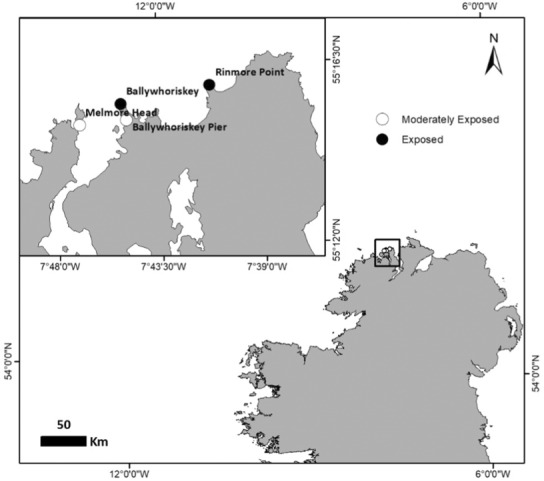
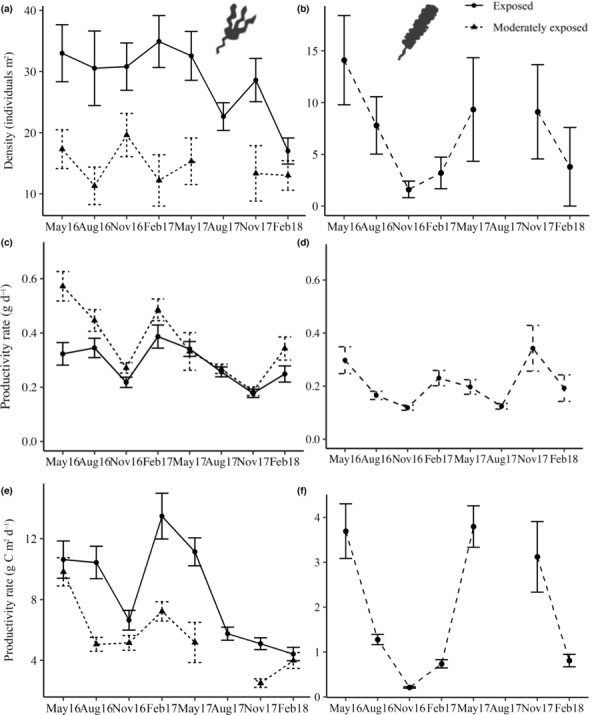
Coastal habitats are increasingly recognized as fundamentally important components of global carbon cycles, but the rates of carbon flow associated with marine macrophytes are not well resolved for many species in many regions. We quantified density, rates of primary productivity, and detritus production of intertidal stands of two common intertidal kelp species- (oarweed) and (sugar kelp)-on four NE Atlantic rocky shores over 22 months. The density of was greater at exposed compared to moderately exposed shores but remained consistently low for throughout the survey period. Individual productivity and erosion rates of did not differ between exposed and moderately exposed shores but differed across exposure levels throughout the year at moderately exposed sites only. Productivity and erosion of remained low on moderately exposed shores and showed no clear seasonal pattern. Patterns of productivity and total detrital production (erosion and dislodgement) per m of both and followed closely that of densities per m, peaking in May during both survey years. Temperature and light were key factors affecting the productivity rates of and . Erosion rates of were affected by wave exposure, temperature, light, grazing, and epiphyte cover, but only temperature-affected erosion of . Production of biomass and detritus was greater in than in and exceeded previous estimates for subtidal and warmer-water affinity kelp populations (e.g., ). These biogenic habitats are clearly important contributors to the coastal carbon cycle that have been overlooked previously and should be included in future ecosystem models. Further work is required to determine the areal extent of kelp stands in intertidal and shallow subtidal habitats, which is needed to scale up local production estimates to entire coastlines.
沿海栖息地日益被视为全球碳循环的重要基本组成部分,但许多地区许多物种与大型海洋植物相关的碳流动速率尚未得到很好的解析。我们在22个月内对东北大西洋四个岩石海岸潮间带的两种常见潮间带海带物种——(大叶藻)和(糖海带)的潮间带群落的密度、初级生产力速率和碎屑产量进行了量化。与中度暴露的海岸相比,在暴露的海岸处的密度更大,但在整个调查期间一直保持较低水平。在暴露和中度暴露的海岸之间,的个体生产力和侵蚀速率没有差异,但仅在中度暴露的地点,全年不同暴露水平之间存在差异。在中度暴露的海岸上,的生产力和侵蚀仍然很低,并且没有明显的季节性模式。每平方米的生产力和总碎屑产量(侵蚀和脱落)模式与每平方米的密度模式密切相关,在两个调查年份的5月达到峰值。温度和光照是影响和生产力速率的关键因素。的侵蚀速率受波浪暴露、温度、光照、放牧和附生植物覆盖的影响,但只有温度影响的侵蚀。的生物量和碎屑产量在中比在中更大,并且超过了先前对潮下带和暖水亲和海带种群的估计(例如,)。这些生物源栖息地显然是沿海碳循环的重要贡献者,以前被忽视了,应该纳入未来的生态系统模型中。需要进一步开展工作来确定潮间带和浅潮下带栖息地海带群落的面积范围,这是将当地产量估计扩大到整个海岸线所必需的。