Department of Experimental Cardiology, Academic Medical Center, Amsterdam University Medical Center, Amsterdam, Netherlands.
Institute of Biology, Leiden University, Leiden, The Netherlands.
Physiol Rep. 2021 Mar;9(5):e14775. doi: 10.14814/phy2.14775.
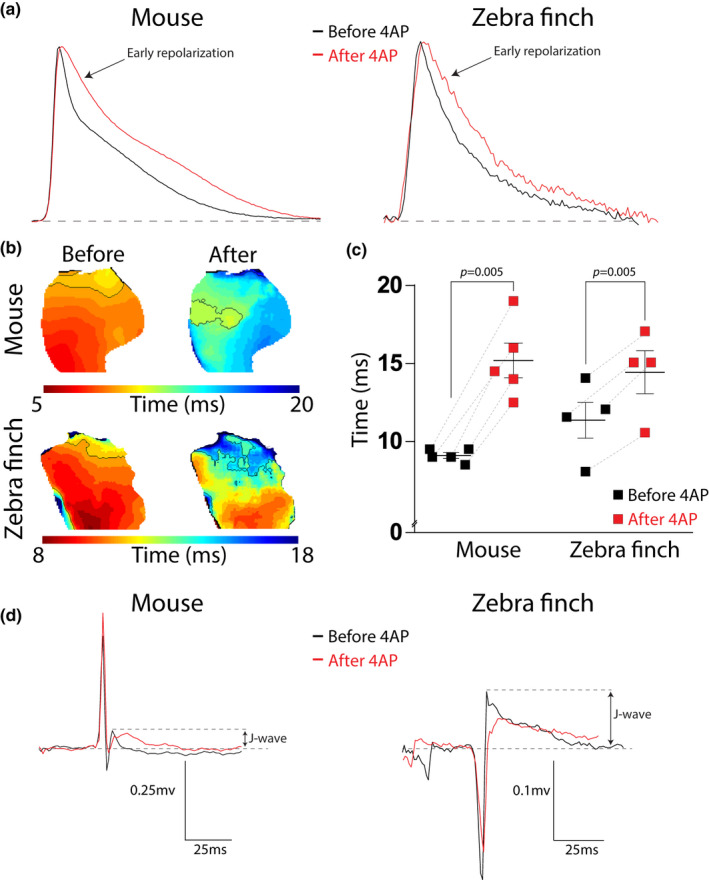
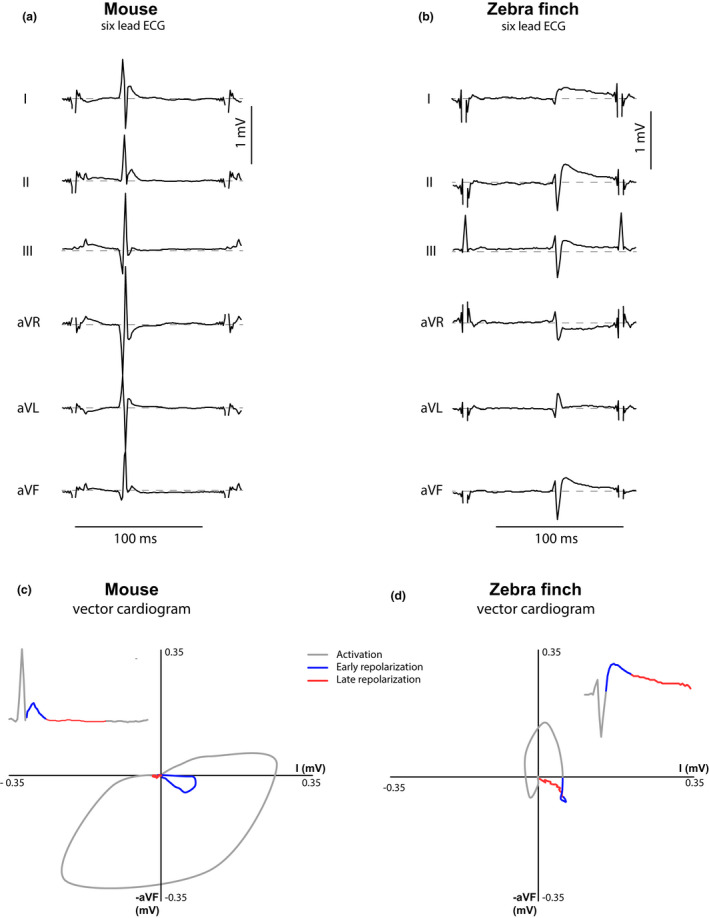
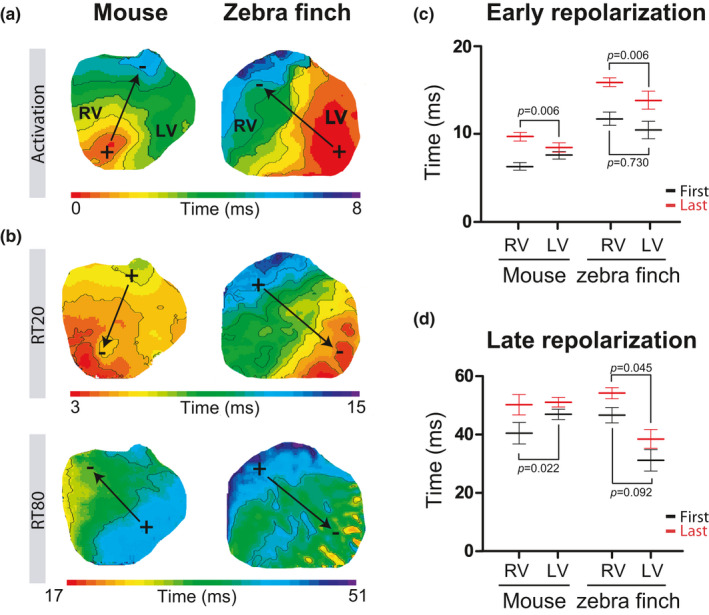
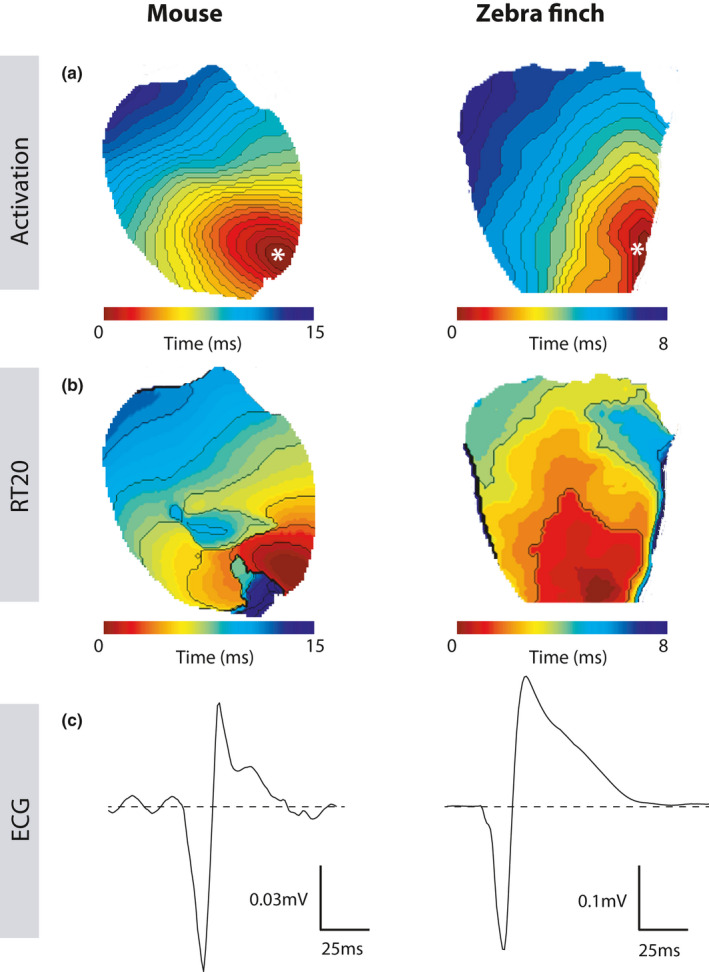
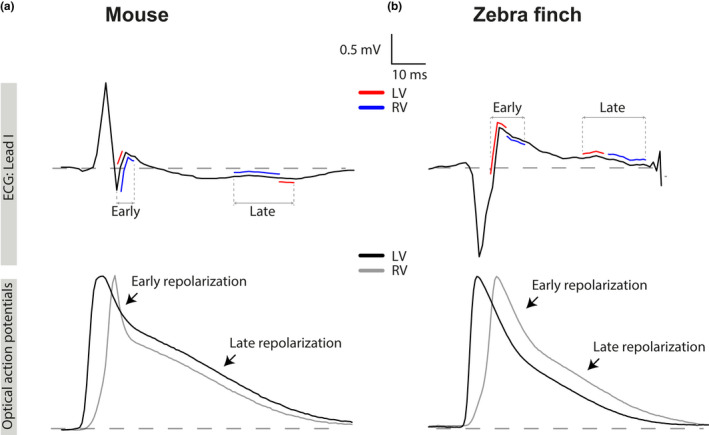
High heart rates are a feature of small endothermic-or warm-blooded-mammals and birds. In small mammals, the QT interval is short, and local ventricular recordings reveal early repolarization that coincides with the J-wave on the ECG, a positive deflection following the QRS complex. Early repolarization contributes to short QT-intervals thereby enabling brief cardiac cycles and high heart rates. We therefore hypothesized high hearts rates associate with early repolarization and J-waves on the ECG of endothermic birds. We tested this hypothesis by comparing isolated hearts of zebra finches and mice and recorded pseudo-ECGs and optical action potentials (zebra finch, n = 8; mouse, n = 8). In both species, heart rate exceeded 300 beats per min, and total ventricular activation was fast (QRS < 10 ms). Ventricular activation progressed from the left to the right ventricle in zebra finch, whereas it progressed from apex-to-base in mouse. In both species, the early repolarization front followed the activation front, causing a positive J-wave in the pseudo-ECG. Inhibition of early repolarization by 4-aminopyridine reduced J-wave amplitude in both species. Action potential duration was similar between ventricles in zebra finch, whereas in mouse the left ventricular action potential was longer. Accordingly, late repolarization had opposite directions in zebra finch (left-right) and mouse (right-left). This caused a similar direction for the zebra finch J-wave and T-wave, whereas in the mouse they were discordant. Our findings demonstrate that early repolarization and the associated J-wave may have evolved by convergence in association with high heart rates.
高心率是小型内温动物或温血哺乳动物和鸟类的特征。在小型哺乳动物中,QT 间期较短,局部心室记录显示早期复极,与心电图上的 J 波一致,即在 QRS 综合波之后出现正向偏转。早期复极导致 QT 间期缩短,从而使心脏周期短暂,心率加快。因此,我们假设内温动物鸟类的心电图上的高心率与早期复极和 J 波有关。我们通过比较斑马雀和小鼠的离体心脏并记录伪心电图和光动作电位(斑马雀,n=8;小鼠,n=8)来验证这一假设。在这两种物种中,心率均超过 300 次/分钟,心室总激活速度很快(QRS<10ms)。在斑马雀中,心室激活从左心室向右心室进行,而在小鼠中则从心尖向心底进行。在这两种物种中,早期复极前沿紧随激活前沿,导致伪心电图上出现正向 J 波。用 4-氨基吡啶抑制早期复极可降低这两种物种的 J 波幅度。斑马雀的心室之间动作电位持续时间相似,而小鼠的左心室动作电位较长。因此,斑马雀的晚期复极(左右)和小鼠的晚期复极(左右)方向相反。这导致斑马雀的 J 波和 T 波方向相似,而在小鼠中它们则不一致。我们的发现表明,早期复极和相关的 J 波可能是通过与高心率相关的趋同进化而来的。