Lloro Víctor, Giovannoni Maria Laura, Luaces Vicente Lozano-de, Manzanares Maria Cristina
Human Anatomy and Embryology Unit, Experimental Pathology and Therapeutics Department, Faculty of Medicine and Health Sciences, Health University of Barcelona campus, L'Hospitalet 08907, Barcelona, Spain.
Odontology Hospital UB, Odontostomatology Department, Faculty of Medicine and Health Sciences, Health University of Barcelona campus, L'Hospitalet 08907; Universitat de Barcelona, Barcelona, Spain.
Eur J Dent. 2021 May;15(2):340-346. doi: 10.1055/s-0041-1724152. Epub 2021 Mar 12.
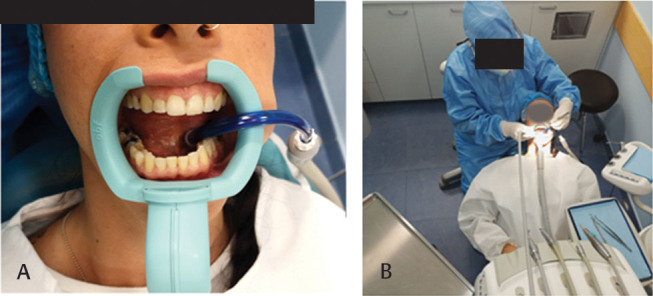
The infection risk during dental procedures is a common concern for dental professionals which has increased due to coronavirus (severe acute respiratory syndrome coronavirus 2) pandemic. The development of devices to specifically mitigate cross-contamination by droplet/splatter is crucial to stop infection transmission. The objective of this study is to assess the effectiveness of a perioral suction device (Oral BioFilter, OBF) to reduce biological contamination spread during dental procedures.
Forty patients were randomized 1:1 to a standard professional dental hygiene treatment with OBF and without. Adenosine triphosphate (ATP) bioluminescence assay was used to evaluate the spread of potential contaminants. The total number of relative light units (RLU) from key dental operatory locations: operator's face-shield, back of the surgical operator's-gloves, patient's safety-goggles, and instrumental table were measured. Percentage contamination reductions between control and OBF were compared.
Primary outcome, total RLU, was analyzed by comparing the means of logged data, using a two-sided two-sample -test. Secondary outcomes as RLU of logged data for the different locations were analyzed in the same way. Proportion of patients from whom different locations reported events (clean, acceptable, and failure) were analyzed by using Fisher's exact test.
For the whole dental environment, RLUs reduction (<150 units) achieved with OBF was 98.4% (97.4-99%). By dental operatory location the reduction in RLUs was from 99.6%, on the operator face-shield, to 83% on instrumental table. The control group reported a very high percentage of failures, (>300) being 100% on the surfaces closer to the patient's mouth and decreasing to 70% on instrumental table. In contrast, the higher failure percentage in the OBF group was found on the patient's goggles (40%), while the operator face-shield showed an absence of contamination.
OBF device has shown efficient reduction of biological aerosol cross-contamination during dental procedures as proved by ATP-bioluminescence assay. Nevertheless, for maximum safety, its use must be combined with standard protective gear such as goggles, face shield, and surgical gloves.
牙科诊疗过程中的感染风险是牙科专业人员普遍关注的问题,在冠状病毒(严重急性呼吸综合征冠状病毒2)大流行期间这一风险有所增加。开发专门用于减轻飞沫/飞溅物交叉污染的设备对于阻止感染传播至关重要。本研究的目的是评估一种口周吸引装置(口腔生物过滤器,OBF)在减少牙科诊疗过程中生物污染传播方面的有效性。
40名患者按1:1随机分为两组,一组接受使用OBF的标准专业口腔卫生治疗,另一组不使用。采用三磷酸腺苷(ATP)生物发光测定法评估潜在污染物的传播情况。测量牙科主要操作区域的相对光单位(RLU)总数:操作人员的面罩、手术操作人员手套背面、患者的安全护目镜和器械台。比较对照组和使用OBF组之间污染减少的百分比。
主要结局指标,即总RLU,通过比较对数数据的均值进行分析,采用双侧双样本t检验。不同位置对数数据的RLU作为次要结局指标,采用相同方法进行分析。使用Fisher精确检验分析不同位置报告事件(清洁、可接受和失败)的患者比例。
对于整个牙科环境,使用OBF实现的RLU减少(<150单位)为98.4%(97.4 - 99%)。按牙科操作区域划分,RLU减少率从操作人员面罩上的99.6%到器械台上的83%不等。对照组报告的失败率非常高,靠近患者口腔的表面为100%(>300),在器械台上降至70%。相比之下,OBF组中较高的失败率出现在患者护目镜上(40%),而操作人员的面罩未出现污染。
ATP生物发光测定法证明,OBF装置在牙科诊疗过程中能有效减少生物气溶胶交叉污染。然而,为了实现最大程度的安全,其使用必须与护目镜、面罩和手术手套等标准防护装备相结合。