Leow H W, Koscielniak M, Williams L, Saunders P T K, Daniels J, Doust A M, Jones M-C, Ferguson G D, Bagger Y, Horne A W, Whitaker L H R
MRC Centre for Reproductive Health, Queen's Medical Research Institute, University of Edinburgh, 47 Little France Crescent, Edinburgh, EH16 4TJ, UK.
Usher Institute, NINE Edinburgh BioQuarter, 9 Little France Road, Edinburgh, EH16 4UX, UK.
Pilot Feasibility Stud. 2021 Mar 12;7(1):67. doi: 10.1186/s40814-021-00797-0.
Endometriosis (where endometrial-like tissue is found outside the uterus) affects ~ 176 million women worldwide and can lead to debilitating pelvic pain. There is an unmet need for new medical treatment options for endometriosis. Pelvic peritoneal mesothelial cells of women with endometriosis exhibit detrimental metabolic reprogramming that creates an environment favouring the formation and survival of endometriosis lesions. We have generated powerful preclinical proof-of-concept data to show that it is possible to correct this metabolic phenotype using dichloroacetate (DCA), a non-hormonal compound previously used to treat rare metabolic disorders in children. We plan a single-arm, open-label, single site exploratory clinical trial to inform the design of a future randomised controlled trial (RCT) to determine the efficacy of DCA for the treatment of endometriosis-associated pain.
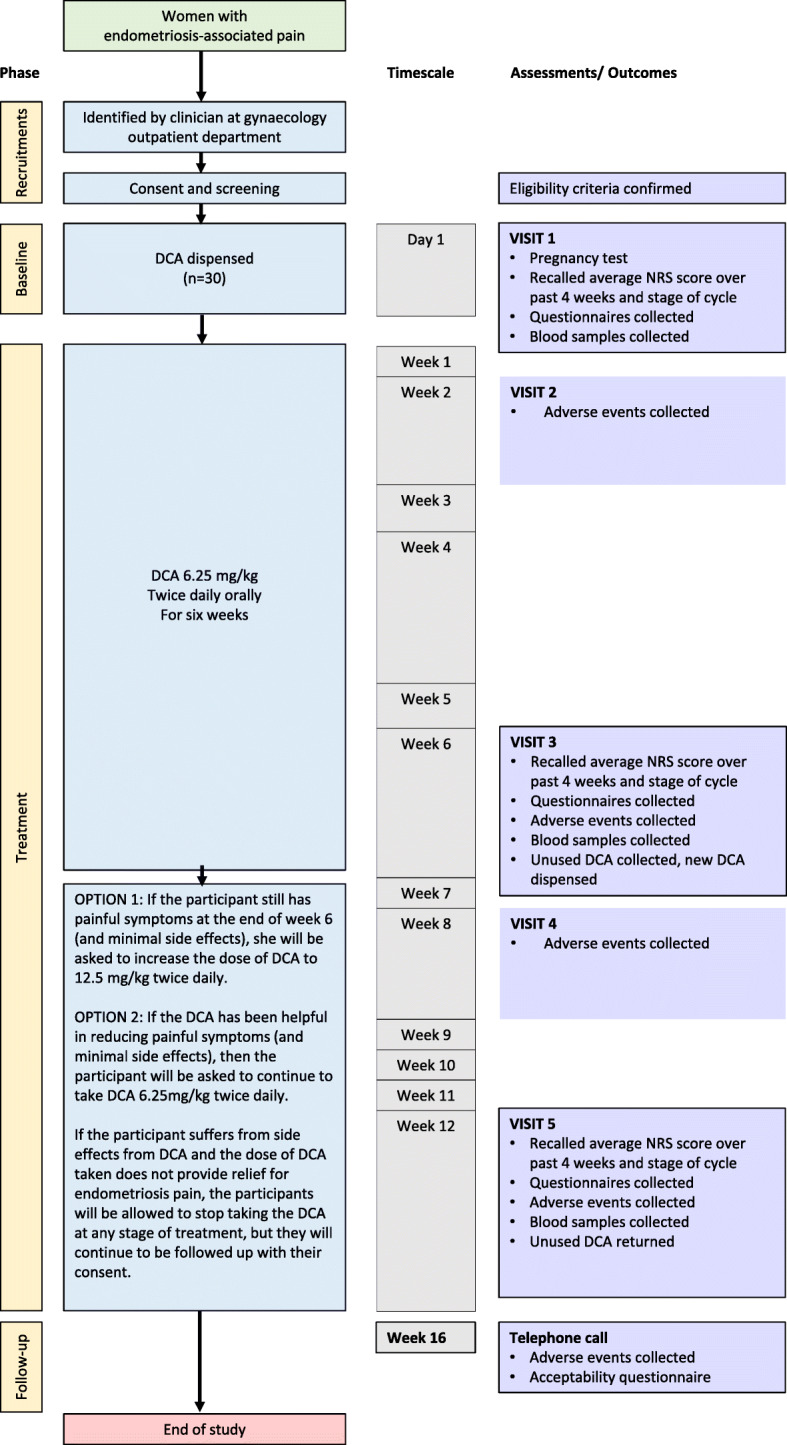
We will recruit 30 women with endometriosis-associated pain over a 6-month period. All participants will receive approximately 6.25 mg/kg oral DCA capsules twice daily for 6 weeks, with a dose increase to approximately 12.5 mg/kg twice daily for a further 6 weeks if their pain has not been adequately controlled on this dose regime and side-effects are acceptable. If pain is adequately controlled with minimal side-effects, the lower dose will be continued for a further 6 weeks. The primary objective is to determine whether it is possible to achieve acceptable recruitment and retention rates within the defined exclusion and inclusion criteria. Secondary objectives are to determine the acceptability of the trial to participants, including the proposed methods of recruitment, treatment, follow-up frequency and number of questionnaires. The recruitment rate will be determined by the proportion of patients recruited from the pool of eligible women. The retention rate will be determined by the proportion of participants who attended the final trial visit.
This is a feasibility study to explore effectiveness and acceptability of the proposed field methodology (recruitment, retention, study processes and compliance with treatment). The results will be used to inform the design of a future RCT.
ClinicalTrials.gov, NCT04046081 Registered 6 August 2019.
子宫内膜异位症(子宫外发现类似子宫内膜的组织)影响着全球约1.76亿女性,并可导致使人衰弱的盆腔疼痛。对子宫内膜异位症的新治疗选择存在未满足的需求。患有子宫内膜异位症的女性盆腔腹膜间皮细胞表现出有害的代谢重编程,这创造了一个有利于子宫内膜异位症病变形成和存活的环境。我们已经产生了有力的临床前概念验证数据,表明使用二氯乙酸(DCA)纠正这种代谢表型是可能的,DCA是一种以前用于治疗儿童罕见代谢紊乱的非激素化合物。我们计划进行一项单臂、开放标签、单中心探索性临床试验,为未来的随机对照试验(RCT)设计提供信息,以确定DCA治疗子宫内膜异位症相关疼痛的疗效。
我们将在6个月内招募30名患有子宫内膜异位症相关疼痛的女性。所有参与者将每天两次口服约6.25mg/kg的DCA胶囊,持续6周,如果在此剂量方案下疼痛未得到充分控制且副作用可接受,则剂量增加至每天两次约12.5mg/kg,再持续6周。如果疼痛通过最小的副作用得到充分控制,则较低剂量将再持续6周。主要目标是确定在规定的排除和纳入标准内是否有可能实现可接受的招募和保留率。次要目标是确定试验对参与者的可接受性,包括提议的招募、治疗、随访频率和问卷数量的方法。招募率将由从符合条件的女性群体中招募的患者比例确定。保留率将由参加最终试验访视的参与者比例确定。
这是一项可行性研究,旨在探索提议的现场方法(招募、保留、研究过程和治疗依从性)的有效性和可接受性。结果将用于为未来的RCT设计提供信息。
ClinicalTrials.gov,NCT04046081,于2019年8月6日注册。