Freeth Tony, Higgon David, Dacanalis Aris, MacDonald Lindsay, Georgakopoulou Myrto, Wojcik Adam
Department of Mechanical Engineering, University College London (UCL), London, UK.
Department of Civil, Environmental and Geomatic Engineering, University College London (UCL), London, UK.
Sci Rep. 2021 Mar 12;11(1):5821. doi: 10.1038/s41598-021-84310-w.
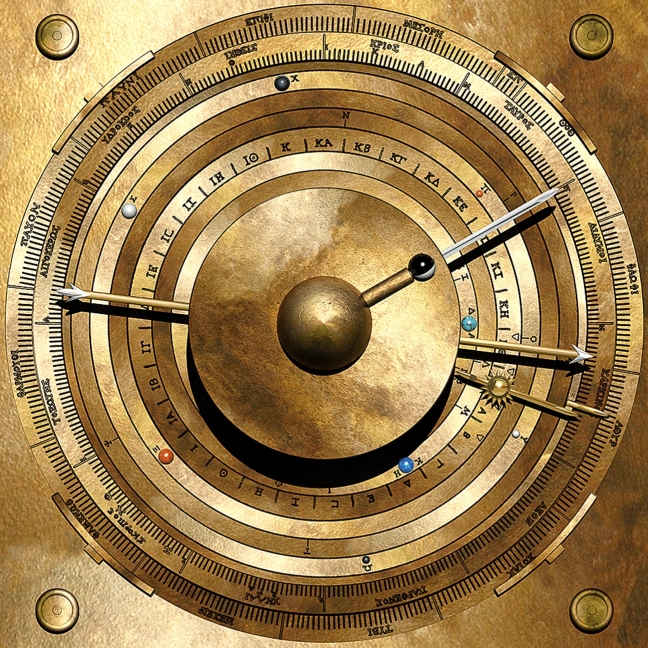
The Antikythera Mechanism, an ancient Greek astronomical calculator, has challenged researchers since its discovery in 1901. Now split into 82 fragments, only a third of the original survives, including 30 corroded bronze gearwheels. Microfocus X-ray Computed Tomography (X-ray CT) in 2005 decoded the structure of the rear of the machine but the front remained largely unresolved. X-ray CT also revealed inscriptions describing the motions of the Sun, Moon and all five planets known in antiquity and how they were displayed at the front as an ancient Greek Cosmos. Inscriptions specifying complex planetary periods forced new thinking on the mechanization of this Cosmos, but no previous reconstruction has come close to matching the data. Our discoveries lead to a new model, satisfying and explaining the evidence. Solving this complex 3D puzzle reveals a creation of genius-combining cycles from Babylonian astronomy, mathematics from Plato's Academy and ancient Greek astronomical theories.
安提基特拉机械装置是古希腊的一种天文计算器,自1901年被发现以来一直困扰着研究人员。现在它已被分成82个碎片,原始部件仅三分之一留存下来,其中包括30个腐蚀的青铜齿轮。2005年的微焦点X射线计算机断层扫描(X射线CT)解析了该机械装置后部的结构,但前部在很大程度上仍未得到解决。X射线CT还揭示了描述太阳、月亮以及古代已知的所有五颗行星运动的铭文,以及它们如何在前面展示为一个古希腊宇宙。指定复杂行星周期的铭文促使人们对这个宇宙的机械化产生新的思考,但此前的任何重建都未能接近与这些数据匹配。我们的发现带来了一个新模型,既符合又解释了这些证据。解开这个复杂的三维谜题揭示了一个天才的创造——融合了巴比伦天文学的周期、柏拉图学园的数学以及古希腊天文理论。