Division of X-Ray Imaging and CT, German Cancer Research Center (DKFZ), Im Neuenheimer Feld 280, 69120, Heidelberg, Germany.
Medical Faculty, Ruprecht-Karls-University Heidelberg, Im Neuenheimer Feld 672, 69120, Heidelberg, Germany.
Eur Radiol. 2021 Sep;31(9):6631-6639. doi: 10.1007/s00330-021-07786-0. Epub 2021 Mar 13.
To evaluate the dual-energy (DE) performance and spectral separation with respect to iodine imaging in a photon-counting CT (PCCT) and compare it to dual-source CT (DSCT) DE imaging.
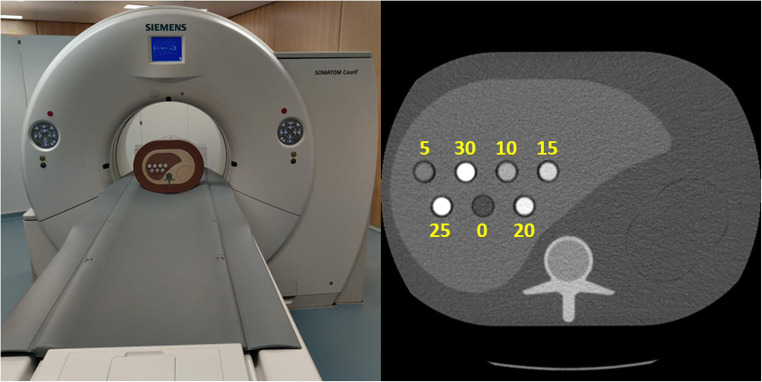
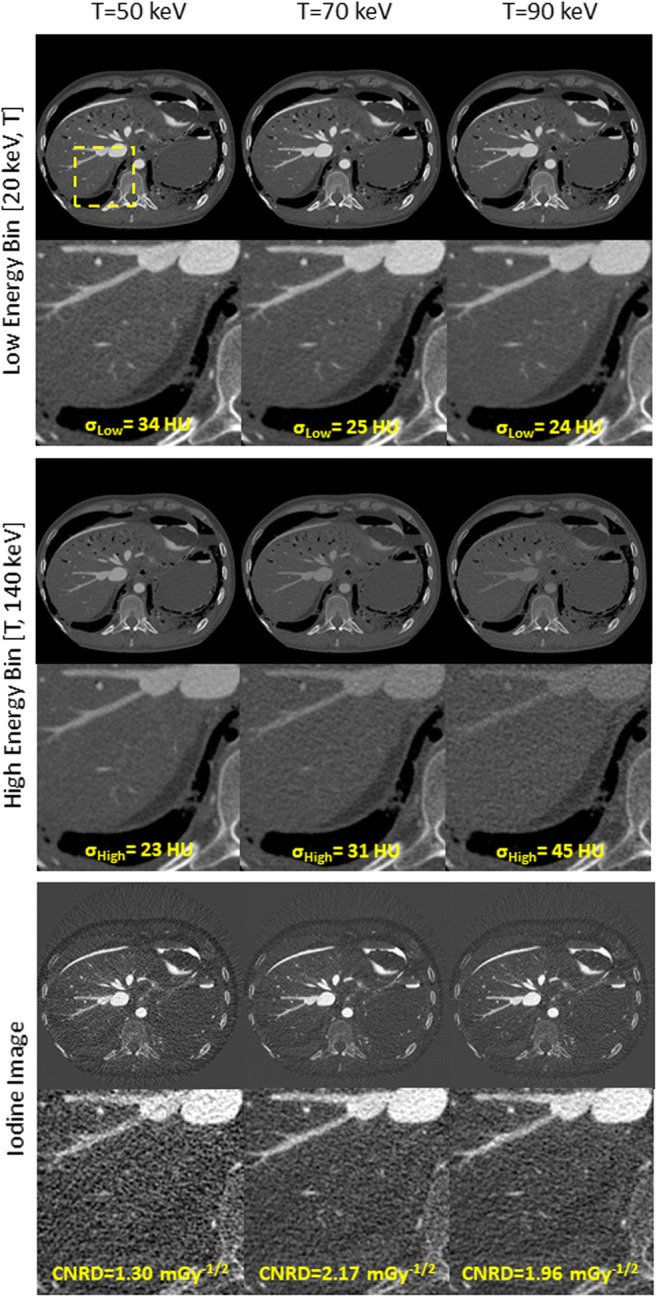
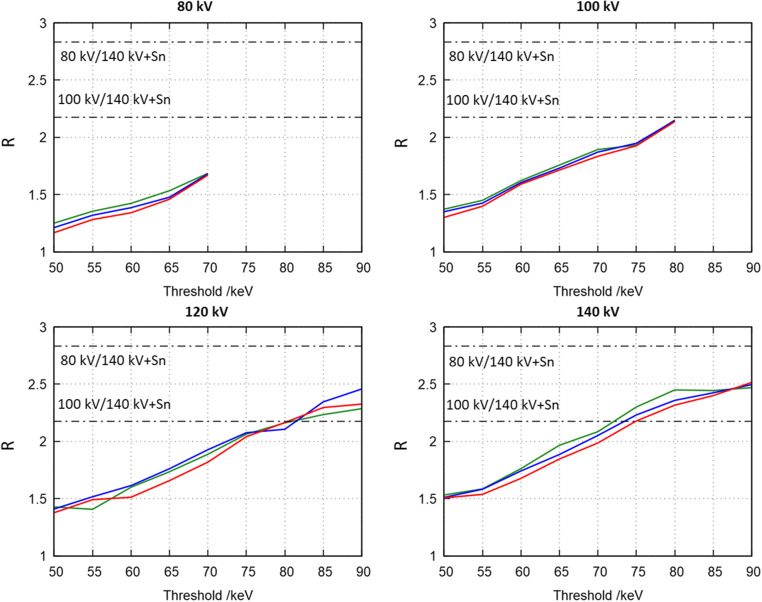
A semi-anthropomorphic phantom extendable with fat rings equipped with iodine vials is measured in an experimental PCCT. The system comprises a PC detector with two energy bins (20 keV, T) and (T, eU) with threshold T and tube voltage U. Measurements using the PCCT are performed at all available tube voltages (80 to 140 kV) and threshold settings (50-90 keV). Further measurements are performed using a conventional energy-integrating DSCT. Spectral separation is quantified as the relative contrast media ratio R between the energy bins and low/high images. Image noise and dose-normalized contrast-to-noise ratio (CNRD) are evaluated in resulting iodine images. All results are validated in a post-mortem angiography study.
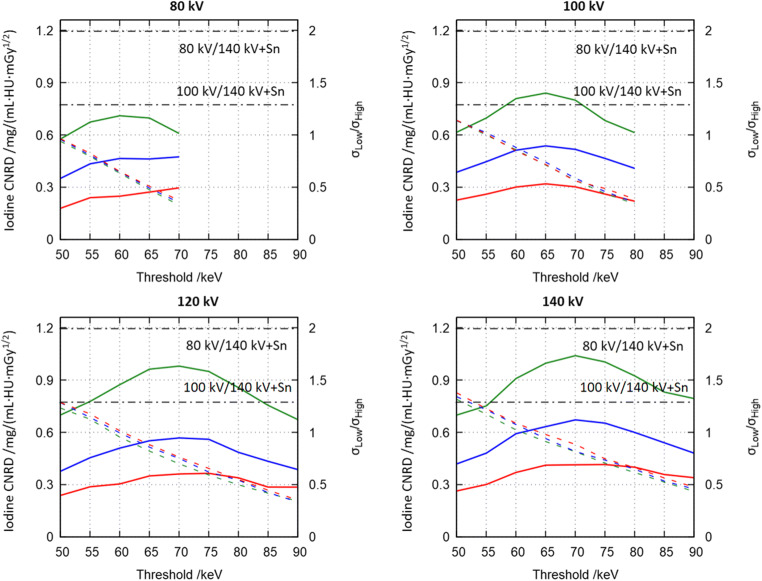
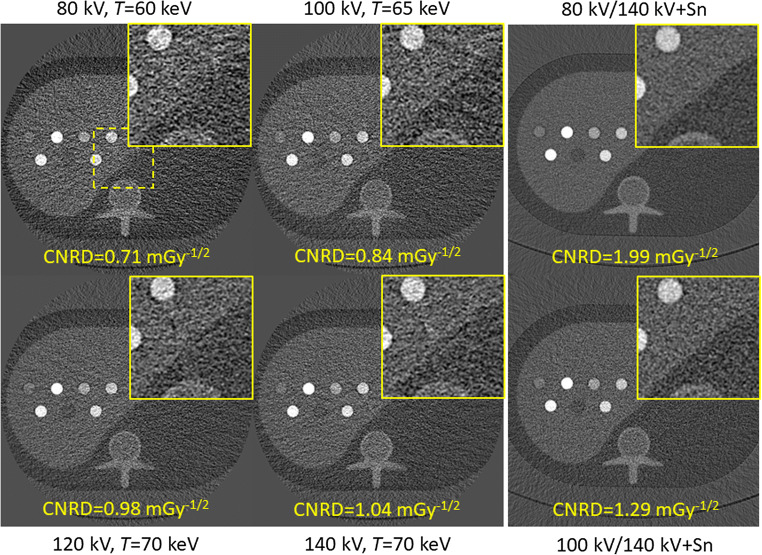
R of the PC detector varies between 1.2 and 2.6 and increases with higher thresholds and higher tube voltage. Reference R of the EI DSCT is found as 2.20 on average overall phantoms. Maximum CNRD in iodine images is found for T = 60/65/70/70 keV for 80/100/120/140 kV. The highest CNRD of the PCCT is obtained using 140 kV and is decreasing with decreasing tube voltage. All results could be confirmed in the post-mortem angiography study.
Intrinsically acquired DE data are able to provide iodine images similar to conventional DSCT. However, PCCT thresholds should be chosen with respect to tube voltage to maximize image quality in retrospectively derived image sets.
• Photon-counting CT allows for the computation of iodine images with similar quality compared to conventional dual-source dual-energy CT. • Thresholds should be chosen as a function of the tube voltage to maximize iodine contrast-to-noise ratio in derived image sets. • Image quality of retrospectively computed image sets can be maximized using optimized threshold settings.
评估在光子计数 CT(PCCT)中双能(DE)性能和光谱分离对碘成像的影响,并与双源 CT(DSCT)DE 成像进行比较。
在实验性 PCCT 中测量可扩展脂肪环的半人体模拟体模,配有碘小瓶。该系统包括一个具有两个能量-bin(20 keV,T)和(T,eU)的 PC 探测器,带有阈值 T 和管电压 U。使用 PCCT 在所有可用管电压(80-140 kV)和阈值设置(50-90 keV)下进行测量。进一步的测量使用常规能量积分 DSCT 进行。光谱分离作为能量-bin 和低/高图像之间的相对对比介质比 R 进行量化。在碘图像中评估图像噪声和剂量归一化对比噪声比(CNRD)。所有结果均在尸检血管造影研究中进行验证。
PC 探测器的 R 值在 1.2 到 2.6 之间变化,并随着更高的阈值和更高的管电压而增加。EI DSCT 的参考 R 值在整个体模上平均为 2.20。在 80/100/120/140 kV 时,碘图像的最大 CNRD 为 T = 60/65/70/70 keV。PCCT 的最高 CNRD 是在使用 140 kV 时获得的,并随着管电压的降低而降低。所有结果均在尸检血管造影研究中得到证实。
固有采集的 DE 数据能够提供与传统 DSCT 相似的碘图像。然而,为了在回顾性衍生图像集中最大化图像质量,应根据管电压选择 PCCT 阈值。
光子计数 CT 允许以与传统双源双能 CT 相似的质量计算碘图像。
为了在衍生图像集中最大化碘对比噪声比,应根据管电压选择阈值。
使用优化的阈值设置可以最大化回顾性计算的图像集的图像质量。