Inada Ken, Enomoto Minori, Yamato Kentaro, Mishima Kazuo
Department of Psychiatry, Tokyo Women's Medical University, Tokyo, Japan.
Department of Medical Technology, School of Health Sciences, Tokyo University of Technology, Tokyo, Japan.
Drugs Real World Outcomes. 2021 Sep;8(3):277-288. doi: 10.1007/s40801-021-00244-9. Epub 2021 Mar 13.
Prolonged treatment of insomnia using benzodiazepine (BZD) receptor agonists, including BZD and non-BZD hypnotic drugs, can cause drug dependence, tolerance, abuse and other adverse events. These side effects are more common and/or severe in older adults taking different hypnotic drugs concomitantly. Therefore, a single prescription is limited to 30 daily doses for most BZD receptor agonists and restrictions apply to the prescription of more than three types of hypnotic drugs in Japan. Little is known, however, about the real-world prescribing pattern of hypnotic drugs in Japan.
We analysed prescribing patterns for hypnotic drugs in Japan to evaluate whether real-world use differs from guideline recommendations.
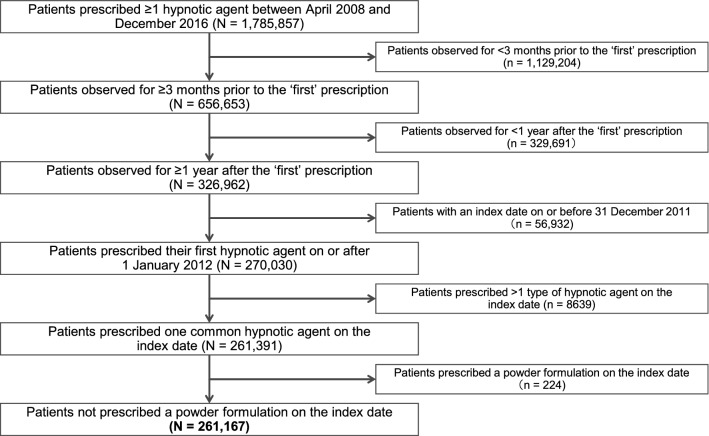
In this nationwide, retrospective, longitudinal, observational study, we analysed the types of hypnotic drugs prescribed, duration of medication and treatment setting in a subset of hospitals in Japan using a hospital-based administrative claims database (Medical Data Vision). Patients initiating treatment with hypnotic drugs between January 2012 and December 2016 were included in the analyses to assess the duration of medication and occurrence of co-prescription of a second and third hypnotic drug, within a year from prescription of the first hypnotic drugs.
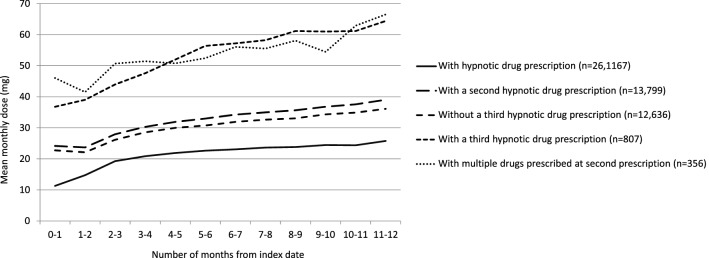
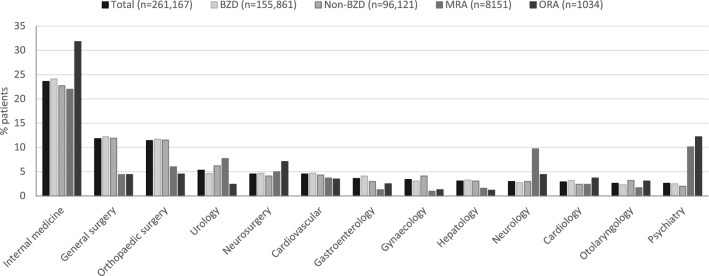
In 261,167 patients analysed, the first hypnotic drugs prescribed were BZDs (59.7%), non-BZDs (36.8%), a melatonin receptor agonist [MRA] (3.1%) and an orexin receptor antagonist [ORA] (0.4%). Benzodiazepine and non-BZD hypnotic drugs were mostly prescribed in inpatient settings (57.7% and 63.0%, respectively) and the MRA and ORA mostly in outpatient settings (62.6% and 65.4%, respectively). The departments that prescribed the most patients their first hypnotic drugs were internal medicine (23.6%), general surgery (11.8%), orthopaedic surgery (11.4%) and urology (5.3%). Of the total prescriptions of MRA and ORA as the first hypnotic drugs, 22.0% and 31.8% were in internal medicine, 4.4% each in general surgery, 6.0% and 4.5% in orthopaedic surgery, 9.7% and 4.4% in neurology, and 10.1% and 12.2% in psychiatry departments, respectively. Mean duration of medication was 1.13 months for non-BZDs, 1.15 months for BZDs, 1.29 months for the ORA and 1.83 months for the MRA. Overall, 5.3% (95% confidence interval 5.2-5.4) of patients were prescribed a second hypnotic drug; of these, 8.4% (95% confidence interval 8.0-8.9) were prescribed at least three hypnotic drugs within a year. Patients who were prescribed three or more hypnotic drugs received higher doses of the first drug than patients who received fewer hypnotic drugs.
Benzodiazepine receptor agonists were the most common hypnotic drugs prescribed as the first drug to patients in Japan. Further education and awareness may be needed on the risk of complications and adverse events associated with these therapies. The duration of BZD receptor agonist use was shorter than for the MRA and ORA, in accordance with prescribing guidelines. Long-term use and co-prescribing of hypnotic drugs were also uncommon.
使用苯二氮䓬(BZD)受体激动剂(包括BZD和非BZD催眠药物)长期治疗失眠可导致药物依赖、耐受性、滥用及其他不良事件。这些副作用在同时服用不同催眠药物的老年人中更为常见和/或严重。因此,在日本,大多数BZD受体激动剂的单次处方限量为每日30剂,且限制开具超过三种类型的催眠药物。然而,对于日本催眠药物的实际处方模式知之甚少。
我们分析了日本催眠药物的处方模式,以评估实际使用情况是否与指南建议不同。
在这项全国性、回顾性、纵向观察性研究中,我们使用基于医院的行政索赔数据库(Medical Data Vision)分析了日本部分医院开具的催眠药物类型、用药时长及治疗环境。纳入2012年1月至2016年12月开始使用催眠药物治疗的患者,以评估用药时长以及在开具第一种催眠药物后的一年内联合开具第二种和第三种催眠药物的情况。
在分析的261,167例患者中,首次开具的催眠药物为BZD类(59.7%)、非BZD类(36.8%)、褪黑素受体激动剂[MRA](3.1%)和食欲素受体拮抗剂[ORA](0.4%)。BZD和非BZD催眠药物大多在住院环境中开具(分别为57.7%和63.0%),而MRA和ORA大多在门诊环境中开具(分别为62.6%和65.4%)。为最多患者开具第一种催眠药物的科室是内科(23.6%)、普通外科(11.8%)、骨科(11.4%)和泌尿外科(5.3%)。作为第一种催眠药物的MRA和ORA的总处方中,分别有22.0%和31.8%在内科开具,普通外科各占4.4%,骨科分别为6.0%和4.5%,神经科分别为9.7%和4.4%,精神科分别为10.1%和12.2%。非BZD类药物的平均用药时长为1.13个月,BZD类为1.15个月,ORA为1.29个月,MRA为1.83个月。总体而言,5.3%(95%置信区间5.2 - 5.4)的患者开具了第二种催眠药物;其中,8.4%(95%置信区间8.0 - 8.9)的患者在一年内开具了至少三种催眠药物。开具三种或更多催眠药物的患者比开具较少催眠药物的患者接受的第一种药物剂量更高。
在日本,BZD受体激动剂是最常作为第一种药物开具给患者的催眠药物。可能需要进一步开展教育并提高对这些治疗相关并发症和不良事件风险的认识。根据处方指南,BZD受体激动剂的使用时长比MRA和ORA短。催眠药物的长期使用和联合开具也不常见。