Department of Surgical Oncology and Breast Surgery, the First Affiliated Hospital of China Medical University, Shenyang 110000, China; Department of Pathology, Institute of Basic Medical Sciences Chinese Academy of Medical Sciences, School of Basic Medicine Peking Union Medical College, Molecular Pathology Research Center, Chinese Academy of Medical Sciences, Beijing 100005, China.
State Key Laboratory of Medical Molecular Biology, Department of Biochemistry and Center for Bioinformatics, Institute of Basic Medical Sciences Chinese Academy of Medical Sciences, School of Basic Medicine Peking Union Medical College, Beijing 100005, China.
Genomics Proteomics Bioinformatics. 2021 Feb;19(1):64-79. doi: 10.1016/j.gpb.2019.05.005. Epub 2021 Mar 11.
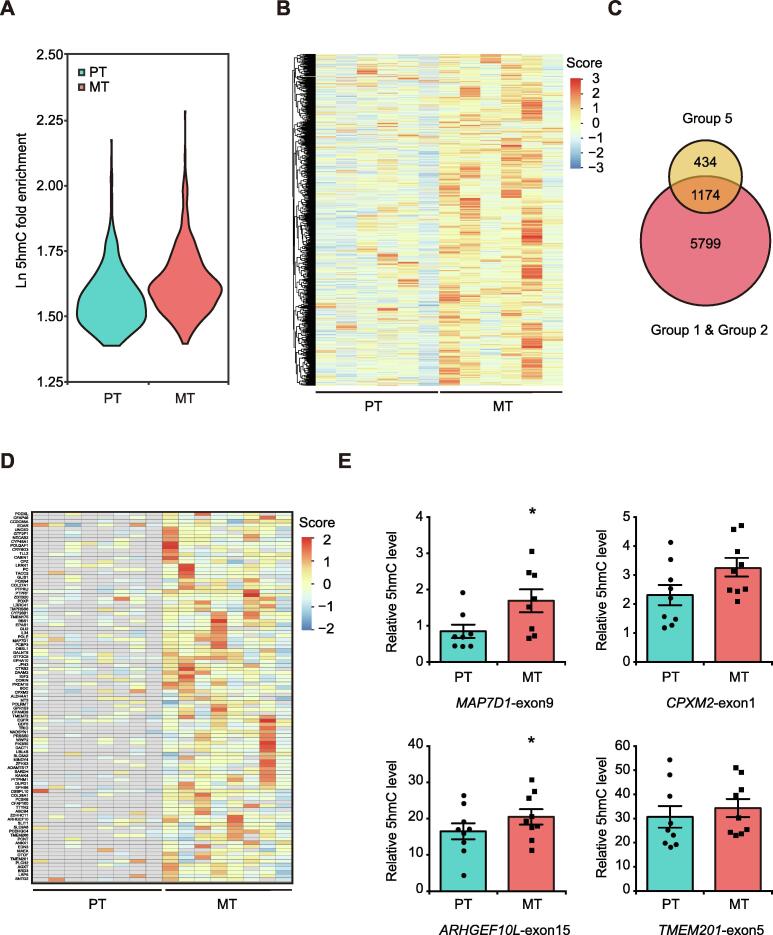
Although DNA 5-hydroxymethylcytosine (5hmC) is recognized as an important epigenetic mark in cancer, its precise role in lymph node metastasis remains elusive. In this study, we investigated how 5hmC associates with lymph node metastasis in breast cancer. Accompanying with high expression of TET1 and TET2 proteins, large numbers of genes in the metastasis-positive primary tumors exhibit higher 5hmC levels than those in the metastasis-negative primary tumors. In contrast, the TET protein expression and DNA 5hmC decrease significantly within the metastatic lesions in the lymph nodes compared to those in their matched primary tumors. Through genome-wide analysis of 8 sets of primary tumors, we identified 100 high-confidence metastasis-associated 5hmC signatures, and it is found that increased levels of DNA 5hmC and gene expression of MAP7D1 associate with high risk of lymph node metastasis. Furthermore, we demonstrate that MAP7D1, regulated by TET1, promotes tumor growth and metastasis. In conclusion, the dynamic 5hmC profiles during lymph node metastasis suggest a link between DNA 5hmC and lymph node metastasis. Meanwhile, the role of MAP7D1 in breast cancer progression suggests that the metastasis-associated 5hmC signatures are potential biomarkers to predict the risk for lymph node metastasis, which may serve as diagnostic and therapeutic targets for metastatic breast cancer.
尽管 DNA 5-羟甲基胞嘧啶(5hmC)被认为是癌症中一种重要的表观遗传标记,但它在淋巴结转移中的精确作用仍不清楚。在这项研究中,我们研究了 5hmC 如何与乳腺癌的淋巴结转移相关。伴随着 TET1 和 TET2 蛋白的高表达,转移阳性的原发肿瘤中大量基因的 5hmC 水平高于转移阴性的原发肿瘤。相比之下,在淋巴结中的转移性病变中,TET 蛋白表达和 DNA 5hmC 显著降低。通过对 8 组原发肿瘤的全基因组分析,我们鉴定出 100 个高可信度的与转移相关的 5hmC 特征,并且发现 DNA 5hmC 水平升高和 MAP7D1 基因表达与淋巴结转移的高风险相关。此外,我们证明了由 TET1 调控的 MAP7D1 促进肿瘤生长和转移。总之,淋巴结转移过程中的动态 5hmC 谱提示 DNA 5hmC 与淋巴结转移之间存在联系。同时,MAP7D1 在乳腺癌进展中的作用表明,与转移相关的 5hmC 特征可能是预测淋巴结转移风险的潜在生物标志物,可作为转移性乳腺癌的诊断和治疗靶点。