Pal Jiban K
Library, Documentation and Information Science Division, Indian Statistical Institute, 203 B. T. Road, Kolkata, 700108 India.
Scientometrics. 2021;126(5):4173-4193. doi: 10.1007/s11192-021-03912-3. Epub 2021 Mar 6.
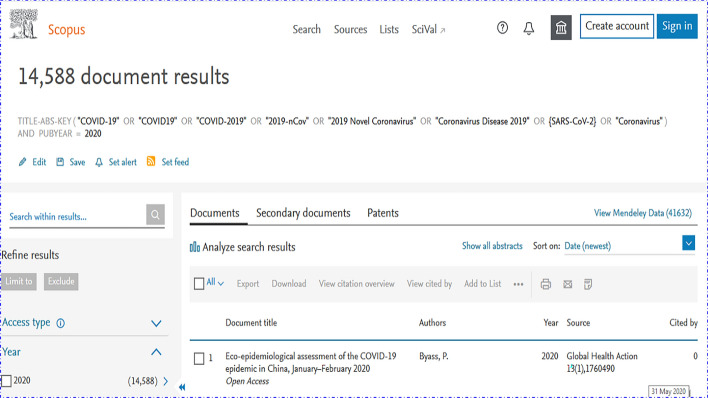
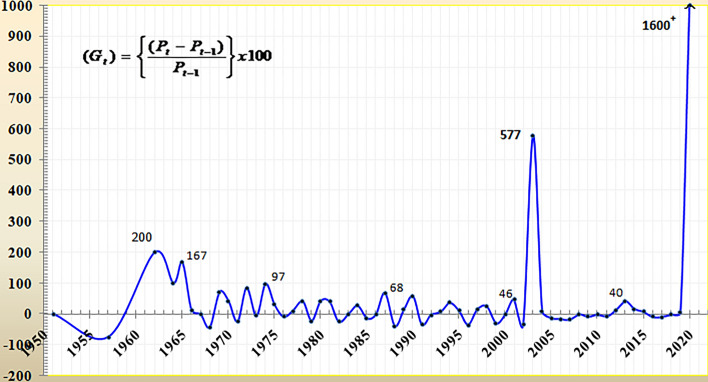
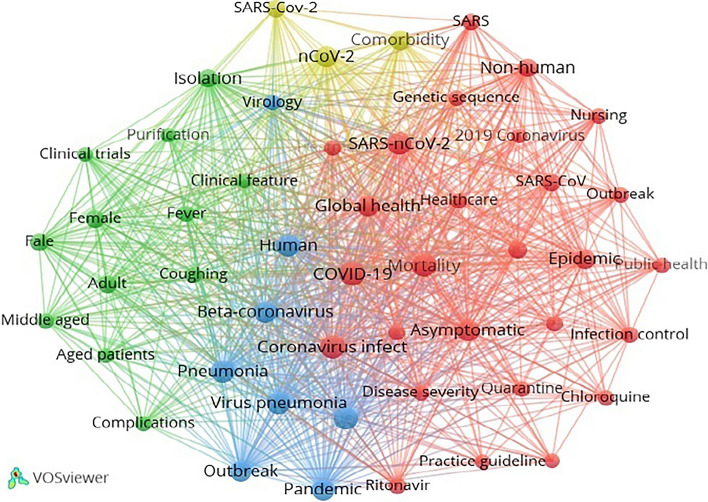
The scholarly output of the new coronavirus research has been proliferating. During five months, an amount of 14,588 scientific publications about nCoV-2 and COVID-19 has been generated intensively (as indexed in Scopus on 31 May 2020). Such a knowledge outburst has created ample interest in understanding the research landscape of this newly configured area. This paper demonstrates on scientometric dimensions of the novel coronavirus (2019-nCov) research using quantifiable characteristics of the publication dataset. Findings reveal that the rate of publication growth (1600%) is very significant to a synergic response of the researchers to combat with the most extended sequence of an RNA virus. Indeed their response has geared up to an average of 100 articles per day. Many scholarly publishers have disclosed their preprint servers to make the publications available immediately, even by enabling Open Access. The scientific contents have published in more than 500 journals from 240 academic publishers. While the top-ten publishers occupied almost 70% of the articles, then about 25% of the studies were sponsored by 300 funding agencies. Among the notable journals Lancet, Nature, BMJ, JAMA, JMV, and NEJM are prominent. Findings also reveal that majority of the contributions have occurred in Medical Science, focusing on virology, immunology, epidemiology, pharmacology, public health, critical care, and emergency medicine. However, the closely associated terms are virus transmission, infection control, asymptomatic, quarantine, pneumonia, human, disease severity, clinical trials, viral pathogenesis, pandemic, risk, and mortality. The study suggests that academic hubs are located mostly in the USA, China, Italy, and the UK. Among the productive institutions; Huazhong Univ (China), Tongji Med. College (China), Harvard Med. School (USA), Univ of Milan (Italy), INSERM (France), UCL (UK) are outstanding. The G7 countries together produced 50% of the global research output on nCov-2. It also noted an encouraging trend of collaborative research across many countries and disciplines, where the values of CI (6.46), DC (0.79), and CC (0.59) are very significant. It examines the geographical diversity of the collaborating authors, thereby visualized their linkages via co-authorship occurrences. Finally, it analyzed the publications' impact to showcase the most influential contributions of the new coronavirus research.
新型冠状病毒研究的学术成果一直在激增。在五个月的时间里,大量关于新冠病毒2型和新冠肺炎的科学出版物密集产生(截至2020年5月31日在Scopus数据库中的索引)。如此大量的知识涌现引发了人们对理解这个新形成领域的研究格局的浓厚兴趣。本文利用出版物数据集的可量化特征,从科学计量学维度展示了新型冠状病毒(2019 - nCoV)的研究情况。研究结果表明,出版物的增长速度(1600%)对于研究人员应对RNA病毒最长序列的协同反应具有重要意义。实际上,他们的反应速度已加快至平均每天100篇文章。许多学术出版商开放了他们的预印本服务器,甚至通过开放获取使出版物能够立即获取。科学内容发表在来自240家学术出版商的500多种期刊上。虽然前十的出版商几乎占据了70%的文章,但约25%的研究由300个资助机构赞助。在著名期刊中,《柳叶刀》《自然》《英国医学杂志》《美国医学会杂志》《医学病毒学杂志》和《新英格兰医学杂志》尤为突出。研究结果还显示,大部分研究集中在医学领域,重点是病毒学、免疫学、流行病学、药理学、公共卫生、重症监护和急诊医学。然而,与之紧密相关的术语有病毒传播、感染控制、无症状、隔离、肺炎、人类、疾病严重程度、临床试验、病毒发病机制、大流行、风险和死亡率。研究表明,学术中心大多位于美国、中国、意大利和英国。在高产机构中,华中科技大学(中国)、同济大学医学院(中国)、哈佛医学院(美国)、米兰大学(意大利)、法国国家健康与医学研究院(法国)、伦敦大学学院(英国)表现突出。七国集团国家共同产出了全球50%的关于新冠病毒2型的研究成果。研究还注意到一个令人鼓舞的趋势,即许多国家和学科之间的合作研究,其合作指数(CI)为6.46、离散系数(DC)为0.79、共被引系数(CC)为0.59,这些数值都非常显著。研究考察了合作作者的地理多样性,并通过共同作者关系直观展示了他们之间的联系。最后,分析了出版物的影响力,以展示新型冠状病毒研究中最具影响力的贡献。