Heleven Elien, van Dun Kim, De Witte Sara, Baeken Chris, Van Overwalle Frank
Department of Psychology and Center for Neuroscience, Vrije Universiteit Brussel, Brussels, Belgium.
Biomedical Research Institute, Hasselt University, Hasselt, Belgium.
Front Hum Neurosci. 2021 Feb 25;15:593821. doi: 10.3389/fnhum.2021.593821. eCollection 2021.
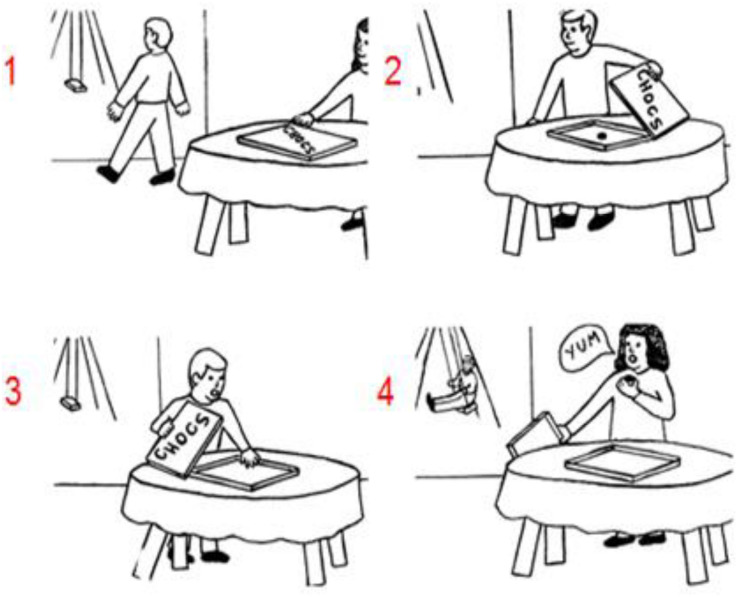
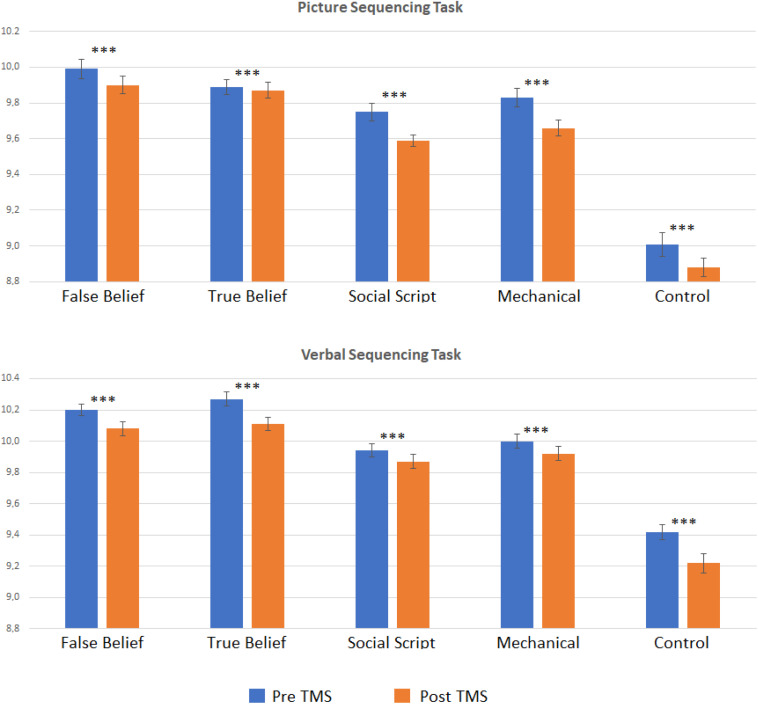
An increasing number of studies demonstrated the involvement of the cerebellum in (social) sequence processing. The current preliminary study is the first to investigate the causal involvement of the cerebellum in sequence generation, using low-frequency repetitive transcranial magnetic stimulation (LF-rTMS). By targeting the posterior cerebellum, we hypothesized that the induced neuro-excitability modulation would lead to altered performance on a Picture and Story sequencing task, which involve the generation of the correct chronological order of various social and non-social stories depicted in cartoons or sentences. Our results indicate that participants receiving LF-rTMS over the cerebellum, as compared to sham participants, showed a stronger learning effect from pre to post stimulation for both tasks and for all types of sequences (i.e. mechanical, social scripts, false belief, true belief). No differences between sequence types were observed. Our results suggest a positive effect of LF-rTMS on sequence generation. We conclude that the cerebellum is causally involved in the generation of sequences of social and nonsocial events. Our discussion focuses on recommendations for future studies.
越来越多的研究表明小脑参与(社交)序列处理。当前的初步研究首次使用低频重复经颅磁刺激(LF-rTMS)来探究小脑在序列生成中的因果关系。通过靶向小脑后部,我们假设诱导的神经兴奋性调节会导致在图片和故事排序任务中的表现改变,这些任务涉及生成卡通或句子中描绘的各种社交和非社交故事的正确时间顺序。我们的结果表明,与假刺激组参与者相比,接受小脑部位LF-rTMS刺激的参与者在两项任务以及所有类型的序列(即机械、社交脚本、错误信念、真实信念)上从刺激前到刺激后都表现出更强的学习效果。未观察到序列类型之间的差异。我们的结果表明LF-rTMS对序列生成有积极影响。我们得出结论,小脑在社交和非社交事件序列的生成中存在因果关系。我们的讨论集中在对未来研究的建议上。