Vishnolia Krishan K, Rakovic Aleksandar, Hoene Celine, Tarhbalouti Karim, Aherrahrou Zouhair, Erdmann Jeanette
Institute for Cardiogenetics, University of Lübeck, Lübeck, Germany.
DZHK (German Research Centre for Cardiovascular Research), Partner Site Hamburg/Lübeck/Kiel, Lübeck, Germany.
Front Physiol. 2021 Feb 25;12:633171. doi: 10.3389/fphys.2021.633171. eCollection 2021.
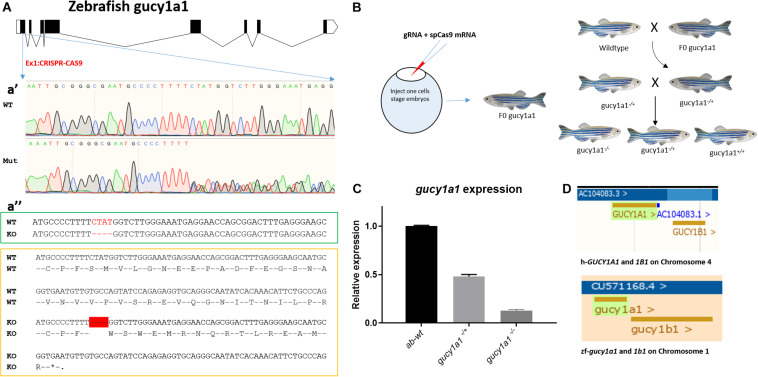
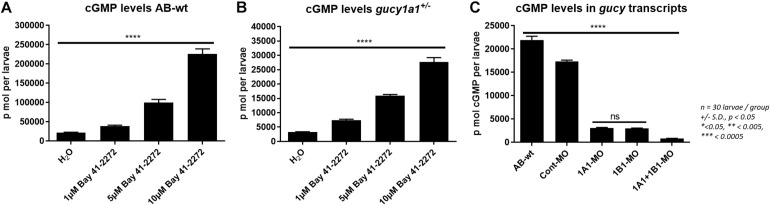
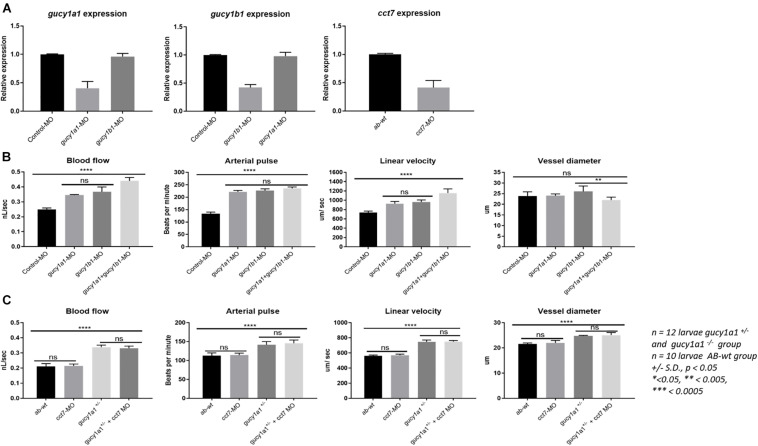
Soluble guanylyl cyclase (sGC) protein is a heterodimer formed by two subunits encoded by and genes. The chromosomal locus 4q32.1 harbors both of these genes, which has been previously significantly associated with coronary artery disease, myocardial infarction, and high blood pressure. Blood pressure is influenced by both the environment and genetics and is complemented by several biological pathways. The underlying mechanisms associated with this locus and its genes still need to be investigated. In the current study, we aimed to establish the zebrafish as a model organism to investigate the mechanisms surrounding sGC activity and blood pressure. A zebrafish mutant line was generated using the CRISPR-Cas9 system by inducing a 4-bp deletion frameshift mutation. This mutation resulted in a reduction of expression in both heterozygote and homozygote zebrafish. Blood flow parameters (blood flow, arterial pulse, linear velocity, and vessel diameter) investigated in the mutants showed a significant increase in blood flow and linear velocity, which was augmented in the homozygotes. No significant differences were observed for the blood flow parameters measured from larvae with individual morpholino downregulation of and , but an increase in blood flow and linear velocity was observed after co-morpholino downregulation of both genes. In addition, the pharmacological sGC stimulator BAY41-2272 rescued the impaired cGMP production in the zebrafish mutant larvae. Downregulation of gene did not show any significant difference on the blood flow parameters in both wild-type and background larvae. In summary, we successfully established a zebrafish platform for investigating sGC-associated pathways and underlying mechanisms in depth. This model system will have further applications, including for potential drug screening experiments.
可溶性鸟苷酸环化酶(sGC)蛋白是一种异源二聚体,由 和 基因编码的两个亚基组成。染色体位点4q32.1包含这两个基因,此前该位点与冠状动脉疾病、心肌梗死和高血压显著相关。血压受环境和遗传因素的影响,并且有多种生物学途径参与其中。与该位点及其基因相关的潜在机制仍有待研究。在本研究中,我们旨在建立斑马鱼作为模式生物,以研究围绕sGC活性和血压的机制。使用CRISPR-Cas9系统诱导4个碱基对的缺失移码突变,生成了一个斑马鱼突变系。这种突变导致杂合子和纯合子斑马鱼中 表达均降低。在 突变体中研究的血流参数(血流量、动脉脉搏、线速度和血管直径)显示血流量和线速度显著增加,在纯合子中增加更为明显。对单个吗啉代下调 和 的幼虫测量的血流参数未观察到显著差异,但在两个基因共同吗啉代下调后观察到血流量和线速度增加。此外,药理学sGC刺激剂BAY41-2272挽救了斑马鱼 突变体幼虫中受损的cGMP产生。在野生型和 背景幼虫中, 基因的下调对血流参数均未显示任何显著差异。总之,我们成功建立了一个斑马鱼平台,用于深入研究与sGC相关的途径和潜在机制。该模型系统将有进一步的应用,包括用于潜在的药物筛选实验。