Eisele Gudrun, Vachon Hugo, Myin-Germeys Inez, Viechtbauer Wolfgang
Department of Neurosciences, Center for Contextual Psychiatry, KU Leuven, Leuven, Belgium.
Department of Psychiatry and Neuropsychology, School for Mental Health and Neuroscience, Maastricht University, Maastricht, Netherlands.
Front Psychol. 2021 Feb 26;12:580684. doi: 10.3389/fpsyg.2021.580684. eCollection 2021.
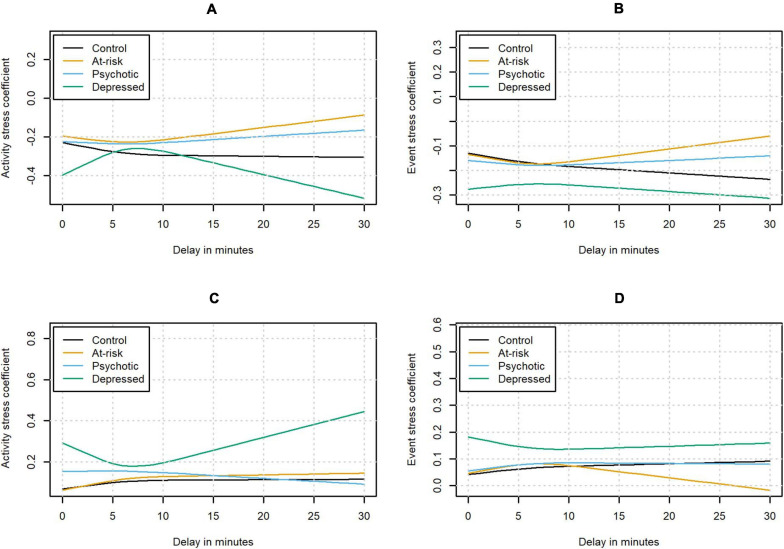
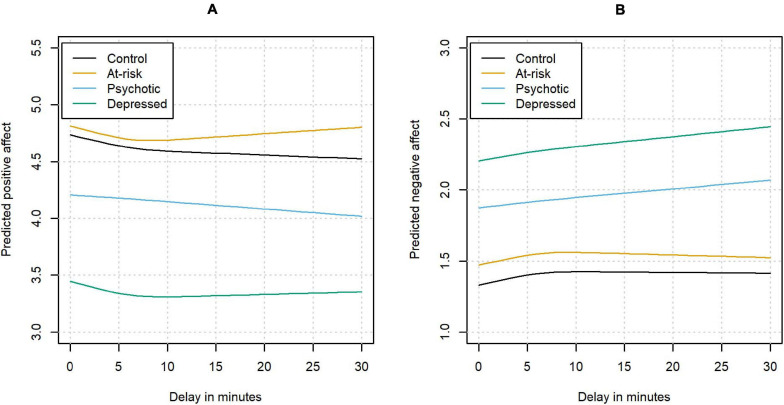
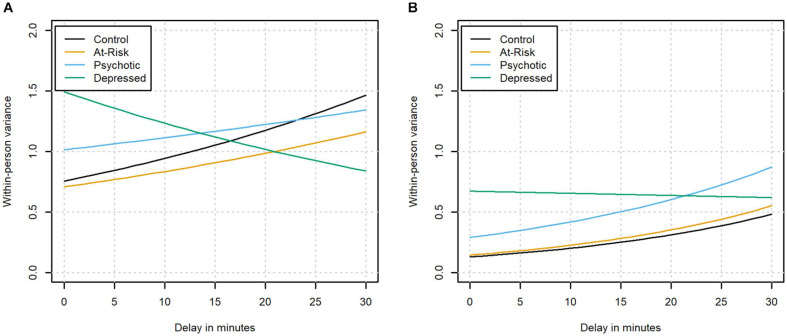
Delayed responses are a common phenomenon in experience sampling studies. Yet no consensus exists on whether they should be excluded from the analysis or what the threshold for exclusion should be. Delayed responses could introduce bias, but previous investigations of systematic differences between delayed and timely responses have offered unclear results. To investigate differences as a function of delay, we conducted secondary analyses of nine paper and pencil based experience sampling studies including 1,528 individuals with different clinical statuses. In all participants, there were significant decreases in positive and increases in negative affect as a function of delay. In addition, delayed answers of participants without depression showed higher within-person variability and an initial strengthening in the relationships between contextual stress and affect. Participants with depression mostly showed the opposite pattern. Delayed responses seem qualitatively different from timely responses. Further research is needed to understand the mechanisms underlying these differences.
延迟反应是经验抽样研究中的常见现象。然而,对于是否应将其排除在分析之外或排除阈值应为多少,目前尚无共识。延迟反应可能会引入偏差,但先前对延迟反应和及时反应之间系统差异的调查结果并不明确。为了研究延迟时间的差异,我们对9项基于纸笔的经验抽样研究进行了二次分析,这些研究涉及1528名具有不同临床状态的个体。在所有参与者中,积极情绪显著下降,消极情绪随延迟时间增加。此外,没有抑郁症的参与者的延迟回答显示出更高的个体内变异性,以及情境压力与情绪之间关系的初步增强。患有抑郁症的参与者大多表现出相反的模式。延迟反应似乎在性质上与及时反应不同。需要进一步研究以了解这些差异背后的机制。