Kohn Lisa A, Kohn Donald B
Division of Pediatric Allergy and Immunology, Department of Pediatrics, David Geffen School of Medicine, University of California, Los Angeles, Los Angeles, CA, United States.
Division of Pediatric Hematology/Oncology, Department of Pediatrics, David Geffen School of Medicine, University of California, Los Angeles, Los Angeles, CA, United States.
Front Immunol. 2021 Feb 25;12:648951. doi: 10.3389/fimmu.2021.648951. eCollection 2021.
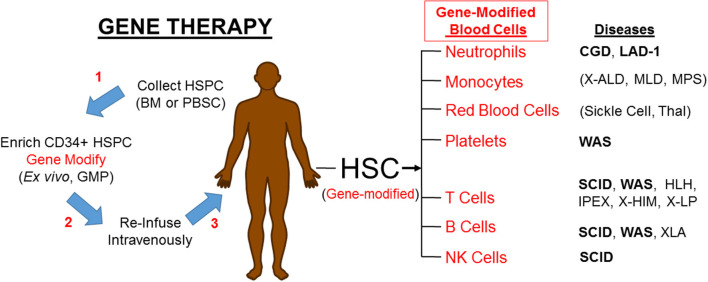
Gene therapy is an innovative treatment for Primary Immune Deficiencies (PIDs) that uses autologous hematopoietic stem cell transplantation to deliver stem cells with added or edited versions of the missing or malfunctioning gene that causes the PID. Initial studies of gene therapy for PIDs in the 1990-2000's used integrating murine gamma-retroviral vectors. While these studies showed clinical efficacy in many cases, especially with the administration of marrow cytoreductive conditioning before cell re-infusion, these vectors caused genotoxicity and development of leukoproliferative disorders in several patients. More recent studies used lentiviral vectors in which the enhancer elements of the long terminal repeats self-inactivate during reverse transcription ("SIN" vectors). These SIN vectors have excellent safety profiles and have not been reported to cause any clinically significant genotoxicity. Gene therapy has successfully treated several PIDs including Adenosine Deaminase Severe Combined Immunodeficiency (SCID), X-linked SCID, Artemis SCID, Wiskott-Aldrich Syndrome, X-linked Chronic Granulomatous Disease and Leukocyte Adhesion Deficiency-I. In all, gene therapy for PIDs has progressed over the recent decades to be equal or better than allogeneic HSCT in terms of efficacy and safety. Further improvements in methods should lead to more consistent and reliable efficacy from gene therapy for a growing list of PIDs.
基因疗法是一种针对原发性免疫缺陷病(PID)的创新治疗方法,它利用自体造血干细胞移植来递送带有导致PID的缺失或功能异常基因的添加或编辑版本的干细胞。20世纪90年代至21世纪初对PID基因疗法的初步研究使用了整合型鼠γ-逆转录病毒载体。虽然这些研究在许多情况下显示出临床疗效,尤其是在细胞重新输注前给予骨髓细胞减灭预处理时,但这些载体在一些患者中导致了基因毒性和白血病增殖性疾病的发生。最近的研究使用了慢病毒载体,其中长末端重复序列的增强子元件在逆转录过程中自我失活(“SIN”载体)。这些SIN载体具有出色的安全性,尚未有导致任何具有临床意义的基因毒性的报道。基因疗法已成功治疗了多种PID,包括腺苷脱氨酶严重联合免疫缺陷病(SCID)、X连锁SCID、阿蒂米斯SCID、威斯科特-奥尔德里奇综合征、X连锁慢性肉芽肿病和白细胞黏附缺陷-I型。总体而言,近几十年来,PID的基因疗法在疗效和安全性方面已发展到与异基因造血干细胞移植相当或更好的水平。方法的进一步改进应能使基因疗法对越来越多的PID产生更一致、可靠的疗效。