Zanghì Aurora, D'Amico Emanuele, Lo Fermo Salvatore, Patti Francesco
Department "G.F. Ingrassia"; University of Catania, Catania, Italy.
Department "G.F. Ingrassia", Policlinico G. Rodolico, V. Santa Sofia 78, Catania, 95123, Italy.
Ther Adv Chronic Dis. 2021 Feb 27;12:2040622320983121. doi: 10.1177/2040622320983121. eCollection 2021.
We aimed to examine the frequency of polypharmacy in a large cohort of patients at the time of diagnosis of relapsing-remitting multiple sclerosis (RRMS) and to explore its effects on discontinuation of first disease-modifying treatment (DMT) using survival analysis.
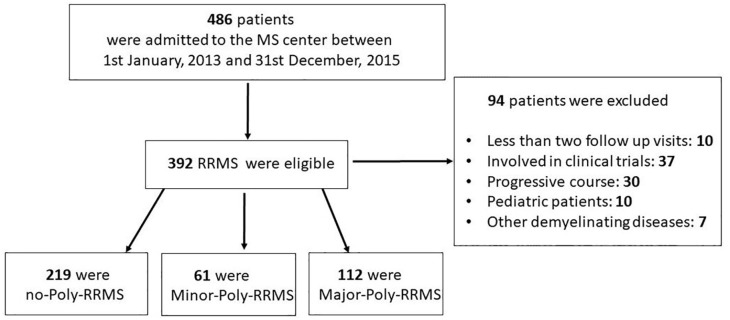
This was a cohort ambispective single-centre study. We enrolled RRMS patients starting their first DMT between 1st January 2013 and 31st December 2015. According to the number of medicines prescribed (except DMTs), we divided the patients into three groups: no-poly RRMS, minor-poly RRMS (from one to three medications), and major-poly RRMS (more than three medications).
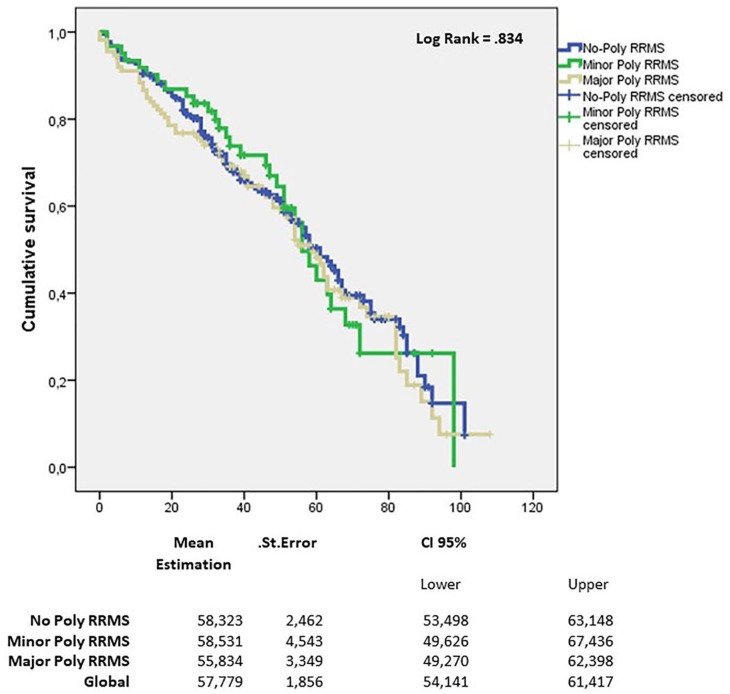
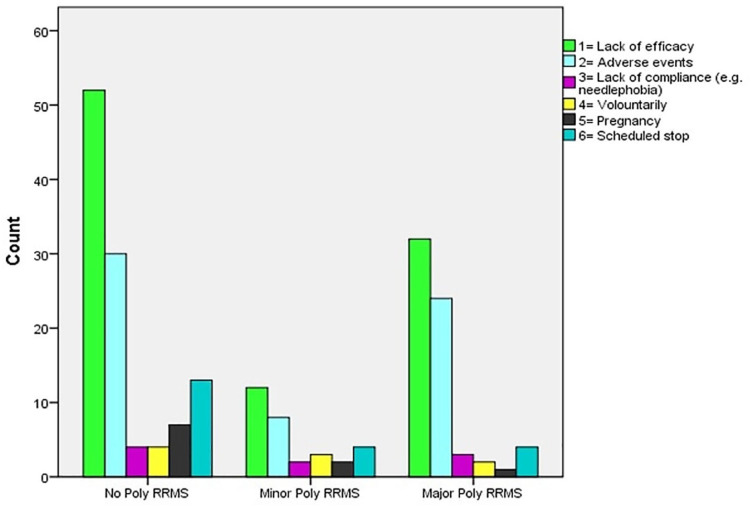
A total of 392 RRMS patients were enrolled (mean age 41.1). The minor-poly RRMS group included 61 patients (15.6%) and the major-poly RRMS group included 112 (28.6%). Individuals in these groups were older and had higher median body mass index (BMI) than patients in the no-poly RRMS group ( < 0.05). Upon multinomial regression analysis, older age at onset was associated with minor and major polypharmacy (OR 1.050, CI 1.010-1.093, = 0.015 and OR 1.063, CI 1.026-1.101, = 0.001, respectively) and higher BMI was associated with major polypharmacy (OR 1.186, CI 1.18-1.29, = 0.001). The rates of discontinuation of first DMT were similar among the three groups (50.7% for no-Poly RRMS, 50.8% for minor-Poly RRMS, and 53.3% for major-Poly RRMS, = 0.264). At log-Rank test, there were no differences among the three groups ( = 0.834).
Polypharmacy was more common in older RRMS patients with high BMI.
我们旨在研究复发缓解型多发性硬化症(RRMS)患者确诊时多重用药的频率,并使用生存分析探讨其对首次疾病修正治疗(DMT)停药的影响。
这是一项队列回顾性单中心研究。我们纳入了2013年1月1日至2015年12月31日开始首次DMT治疗的RRMS患者。根据所开药物(不包括DMT)的数量,我们将患者分为三组:无多重用药的RRMS患者、轻度多重用药的RRMS患者(服用一至三种药物)和重度多重用药的RRMS患者(服用三种以上药物)。
共纳入392例RRMS患者(平均年龄41.1岁)。轻度多重用药的RRMS组包括61例患者(15.6%),重度多重用药的RRMS组包括112例患者(28.6%)。与无多重用药的RRMS组患者相比,这些组中的个体年龄更大,中位体重指数(BMI)更高(P<0.05)。在多项回归分析中,发病时年龄较大与轻度和重度多重用药相关(分别为OR 1.050,CI 1.010 - 1.093,P = 0.015和OR 1.063,CI 1.026 - 1.101,P = 0.001),较高的BMI与重度多重用药相关(OR 1.186,CI 1.18 - 1.29,P = 0.001)。三组中首次DMT停药率相似(无多重用药的RRMS组为50.7%,轻度多重用药的RRMS组为50.8%,重度多重用药的RRMS组为53.3%,P = 0.264)。在对数秩检验中,三组之间无差异(P = 0.834)。
多重用药在年龄较大、BMI较高的RRMS患者中更为常见。