Ippolito Mariachiara, Ramanan Mahesh, Bellina Davide, Catalisano Giulia, Iozzo Pasquale, Di Guardo Andrea, Moscarelli Alessandra, Grasselli Giacomo, Giarratano Antonino, Bassetti Matteo, Tabah Alexis, Cortegiani Andrea
Department of Surgical, Oncological and Oral Science (Di.Chir.On.S.), University of Palermo, Palermo, Sicilia, Italy.
Intensive Care Units, Caboolture and Prince Charles Hospitals, School of Medicine, University of Queensland, The George Institute for Global Health, University of New South Wales, Sydney, Queensland, Australia.
Ther Adv Infect Dis. 2021 Feb 25;8:2049936121998562. doi: 10.1177/2049936121998562. eCollection 2021 Jan-Dec.
Italy was the first Western country to be heavily affected by COVID-19. Healthcare workers (HCWs) were exposed to a high risk of occupational infection, partially due to insufficient personal protective equipment (PPE) supplies. This study aimed to describe the practices, availability, training, confidence in PPE use and the adverse effects due to extended PPE use, as reported by HCWs in Italy. We also aimed to provide a comparison between Italian data and those from other countries.
This study was a secondary analysis of a previously published international study, the PPE-SAFE Survey, conducted in April 2020. Data were analysed from the original study database.
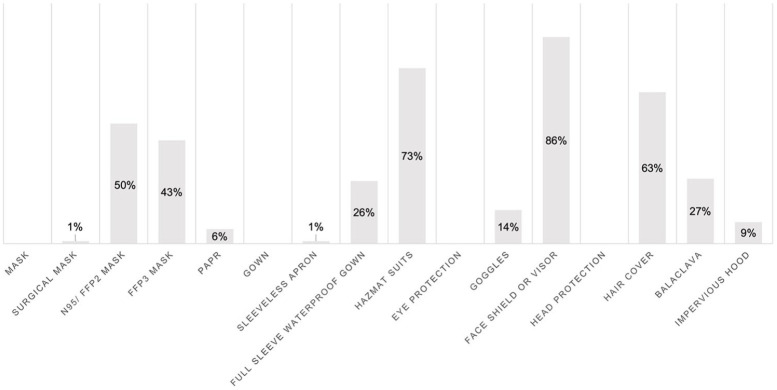
We analysed the responses from 380 healthcare workers based in Italy, out of the 2711 respondents to the international survey. Among the Italian respondents, FFP2 and FFP3 respirators or equivalent were the most used masks for routine tasks (respectively 188/380, 50%; and 163/380, 43%). The median time of wearing PPE without taking a break was 5 h [interquartile range (IQR) 4-6], with statistically significant difference from other countries [median 4 h (IQR 2-5) < 0.0001]. In Italy, 249 out of 380 (65%) HCWs had never performed a formal fit test for a N95 mask or equivalent and 91/380 (24%) never had a partner for donning and doffing procedures. Most of the respondents (299/380, 79%) had received formal training in PPE use at any time.
Most of the surveyed Italian HCWs reported working at above usual capacity, long shifts with PPE without breaks and routine use in intensive care unit of aerosol protection (e.g. FFP2/FFP3), hazmat suits and face shields/visors. The correct adherence to safety procedures (e.g. donning/doffing in pairs, performing fit test) has substantial scope for improvement in the future.
意大利是首个受新冠疫情严重影响的西方国家。医护人员面临着较高的职业感染风险,部分原因是个人防护装备(PPE)供应不足。本研究旨在描述意大利医护人员报告的PPE使用习惯、供应情况、培训情况、对PPE使用的信心以及长时间使用PPE所产生的不良影响。我们还旨在对意大利的数据与其他国家的数据进行比较。
本研究是对先前发表的一项国际研究——2020年4月进行的PPE-SAFE调查的二次分析。数据来自原始研究数据库。
在国际调查的2711名受访者中,我们分析了来自意大利的380名医护人员的回复。在意大利受访者中,FFP2和FFP3呼吸器或同等产品是日常工作中使用最多的口罩(分别为188/380,50%;和163/380,43%)。不休息佩戴PPE的中位时间为5小时[四分位间距(IQR)4 - 6],与其他国家存在统计学显著差异[中位时间4小时(IQR 2 - 5),P < 0.0001]。在意大利,380名医护人员中有249名(65%)从未对N95口罩或同等产品进行过正式的适配测试,91/380(24%)从未有搭档协助进行穿脱程序。大多数受访者(299/380,79%)曾在任何时间接受过PPE使用的正式培训。
大多数接受调查的意大利医护人员报告称工作强度高于正常水平,长时间连续佩戴PPE且无休息,在重症监护病房日常使用气溶胶防护装备(如FFP2/FFP3)、防护服和面罩/面屏。未来,在正确遵守安全程序(如成对穿脱、进行适配测试)方面仍有很大的改进空间。