VHA Home HealthCare, Toronto, ON, Canada; Dalla Lana School of Public Health, University of Toronto, Toronto, ON, Canada.
VHA Home HealthCare, Toronto, ON, Canada; Dalla Lana School of Public Health, University of Toronto, Toronto, ON, Canada.
Am J Infect Control. 2023 May;51(5):490-497. doi: 10.1016/j.ajic.2022.07.021. Epub 2022 Jul 30.
Appropriate and consistent facial protective equipment (FPE) use is critical for preventing respiratory illness transmission. Little is known about FPE adherence by home care providers. The purpose of this study is to adapt an existing facial protection questionnaire and use it to develop an initial understanding of factors influencing home care providers' adherence to FPE during the COVID-19 pandemic.
A survey was shared with home care providers during Wave 2 of the COVID-19 pandemic in Ontario. Descriptive statistics and logistic regression by FPE adherence were conducted across individual, organizational, and environmental factors.
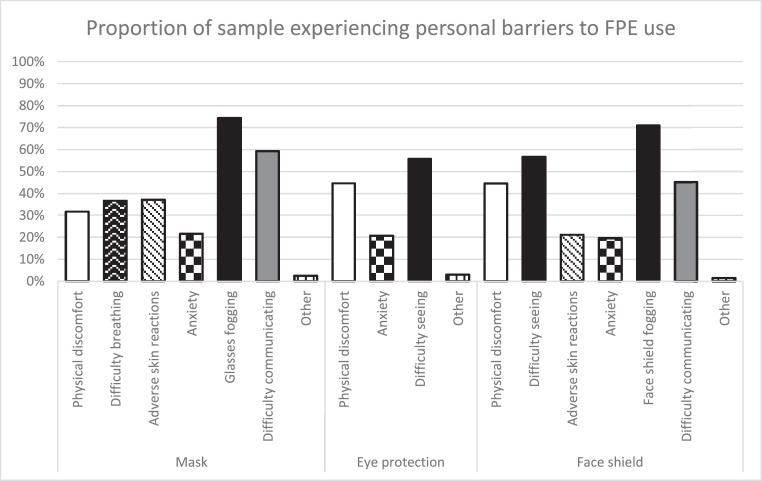
Of the 199 respondents (140 personal support workers; 59 nurses), 71% reported that they always used FPE as required, with greater adherence to masks (89%) than eye protection (73%). The always-adherent reported greater perceived FPE efficacy, knowledge of recommended use and perceived occupational risk, lower education, and not experiencing personal barriers (including difficulty seeing, discomfort, communication challenges).
Adherence rates were relatively high. In this context, with participants reporting high levels of organizational support, individual-level factors were the significant predictors of adherence.
Initiatives addressing perceived FPE efficacy, knowledge of recommended use, perception of at-work risk, and personal barriers to use may improve FPE adherence.
适当且一致地使用面部防护设备(FPE)对于防止呼吸道疾病传播至关重要。但对于家庭护理提供者对 FPE 的依从性知之甚少。本研究旨在改编现有的面部保护问卷,并利用它初步了解在 COVID-19 大流行期间影响家庭护理提供者遵守 FPE 的因素。
在安大略省 COVID-19 大流行的第二波期间,向家庭护理提供者分享了一份调查。针对个人、组织和环境因素,进行了 FPE 依从性的描述性统计和逻辑回归分析。
在 199 名受访者(140 名个人支持工作者;59 名护士)中,71%的人报告说他们始终按照要求使用 FPE,对口罩的依从性(89%)高于对眼部防护的依从性(73%)。始终遵守的人报告说他们认为 FPE 更有效、更了解推荐的使用方法和感知到的职业风险,且教育程度较低,没有遇到个人障碍(包括视力障碍、不适、沟通障碍)。
遵守率相对较高。在这种情况下,由于参与者报告了高水平的组织支持,因此个人层面的因素是遵守的重要预测因素。
解决 FPE 效能、推荐使用知识、工作中风险感知和使用障碍等方面的措施可能会提高 FPE 依从性。