Lin Gang, Qi Kang, Liu Bing, Liu Haibo, Li Jian
Department of Thoracic Surgery, Peking University First Affiliated Hospital, Peking University, Beijing, China.
Transl Lung Cancer Res. 2021 Feb;10(2):622-635. doi: 10.21037/tlcr-19-517b.
Currently, there is no reliable method for predicting the prognosis of patients with large cell lung cancer (LCLC). The aim of this study was to develop and validate a nomogram model for accurately predicting the prognosis of patients with LCLC.
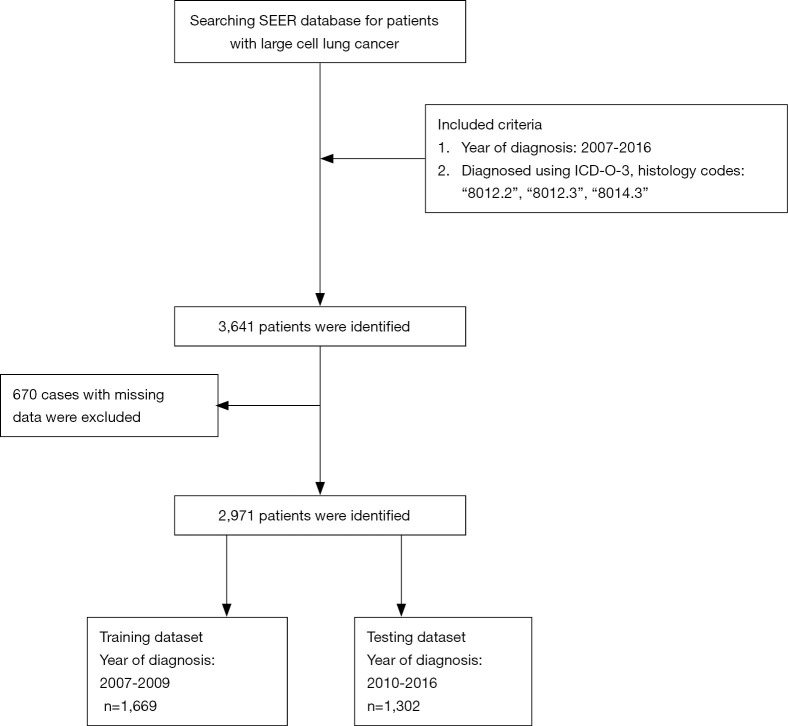
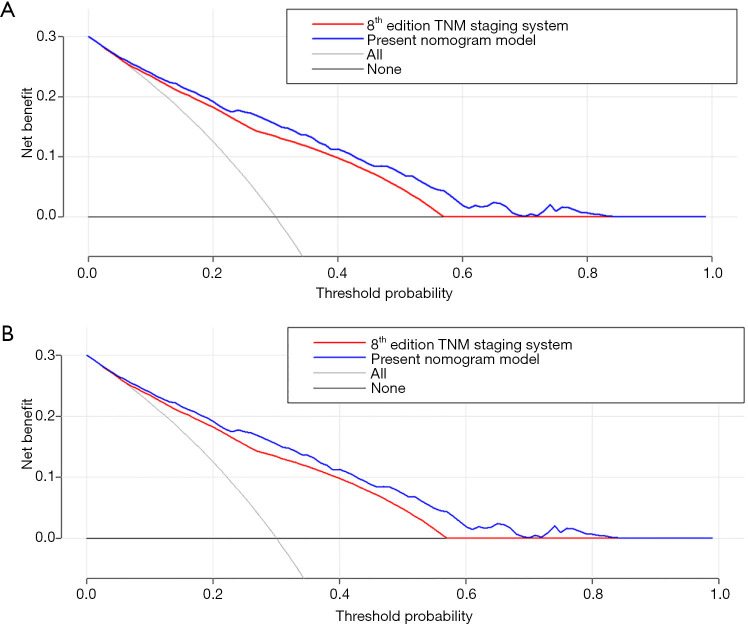
LCLC patients, diagnosed from 2007 to 2009, were identified from the Surveillance, Epidemiology and End Results (SEER) database and used as the training dataset. Significant clinicopathologic variables (P<0.05) in a multivariate Cox regression were selected to build the nomogram. The performance of the nomogram model was evaluated by the concordance index (C-index), the area under the curve (AUC), and internal calibration. LCLC patients diagnosed from 2010 to 2016 in the SEER database were selected as a testing dataset for external validation. The nomogram model was also compared with the currently used American Joint Committee on Cancer (AJCC) tumor-node-metastasis (TNM) staging system (8 edition) by using C-index and a decision curve analysis.
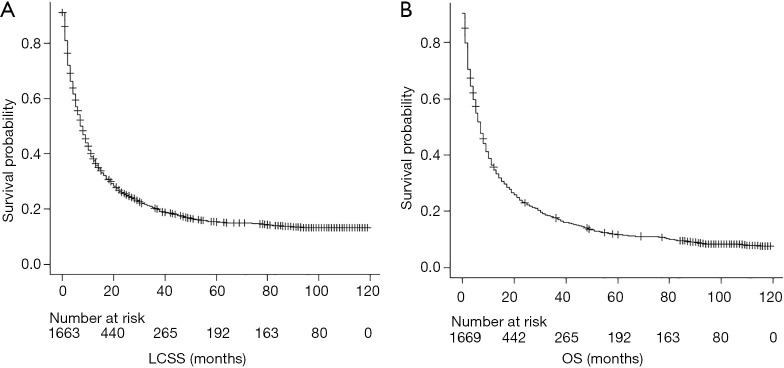
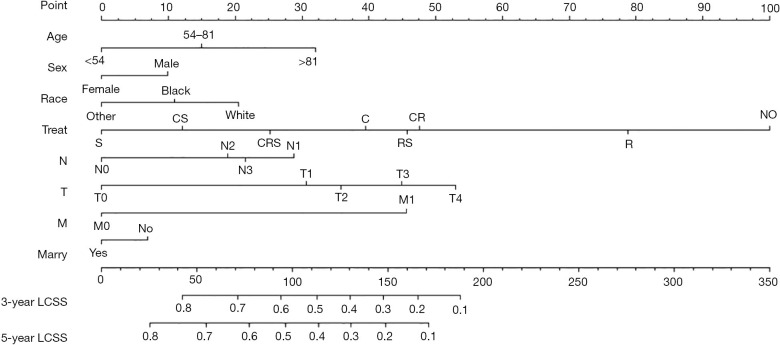
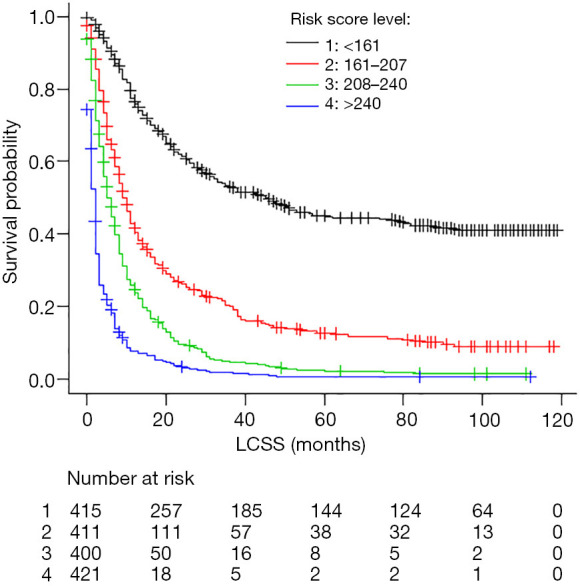
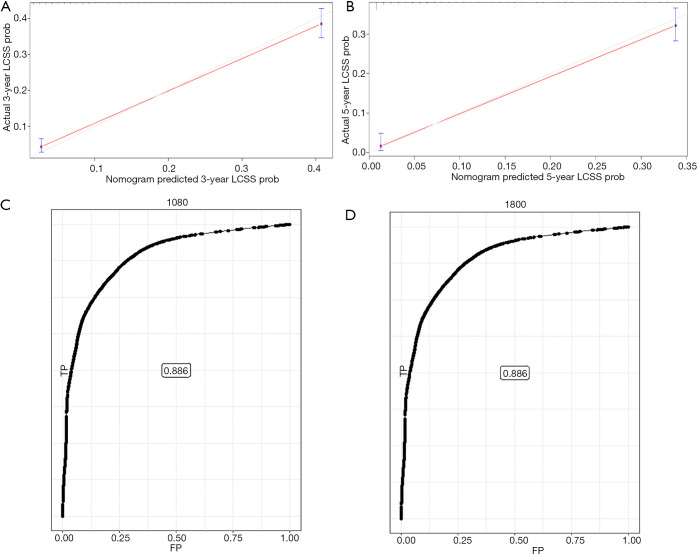
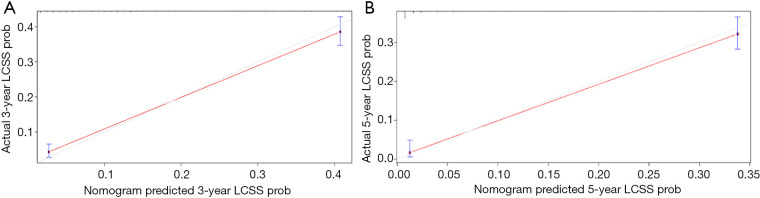
Eight variables-age, sex, race, marital status, T stage, N stage, M stage, and treatment strategy-were statistically significant in the multivariate Cox model and were selected to develop the nomogram model. This model exhibited excellent predictive performance. The C-index and AUC value were 0.761 [95% confidence interval (CI), 0.754 to 0.768] and 0.886 for the training dataset and 0.773 (95% CI, 0.765 to 0.781) and 0.876 for the testing dataset, respectively. This model also predicted three-year and five-year lung cancer-specific survival (LCSS) in both datasets with good fidelity. This nomogram model performs significantly better than the 8th edition AJCC TNM staging system, with a higher C-index (P<0.001) and better net benefits in predicting LCSS in LCLC patients.
We developed and validated a prognostic nomogram model for predicting 3- and 5-year LCSS in LCLC patients with good discrimination and calibration abilities. The nomogram may be useful in assisting clinicians to make individualized decisions for appropriate treatment in LCLC.
目前,尚无可靠方法预测大细胞肺癌(LCLC)患者的预后。本研究旨在开发并验证一种列线图模型,以准确预测LCLC患者的预后。
从监测、流行病学和最终结果(SEER)数据库中识别出2007年至2009年诊断的LCLC患者,并将其用作训练数据集。在多变量Cox回归中选择具有统计学意义的临床病理变量(P<0.05)来构建列线图。通过一致性指数(C-index)、曲线下面积(AUC)和内部校准来评估列线图模型的性能。将SEER数据库中2010年至2016年诊断的LCLC患者作为外部验证的测试数据集。还使用C-index和决策曲线分析将列线图模型与当前使用的美国癌症联合委员会(AJCC)肿瘤-淋巴结-转移(TNM)分期系统(第8版)进行比较。
八个变量——年龄、性别、种族、婚姻状况、T分期、N分期、M分期和治疗策略——在多变量Cox模型中具有统计学意义,并被选择用于开发列线图模型。该模型表现出优异的预测性能。训练数据集的C-index和AUC值分别为0.761[95%置信区间(CI),0.754至0.768]和0.886,测试数据集的分别为0.773(95%CI,0.765至0.781)和0.876。该模型还在两个数据集中以良好的保真度预测了三年和五年肺癌特异性生存率(LCSS)。该列线图模型的表现明显优于第8版AJCC TNM分期系统,在预测LCLC患者的LCSS方面具有更高的C-index(P<0.001)和更好的净效益。
我们开发并验证了一种预后列线图模型,用于预测LCLC患者3年和5年的LCSS,具有良好的区分能力和校准能力。该列线图可能有助于临床医生为LCLC患者做出适当治疗的个体化决策。